

The Athlete Does Not Live Inside Your Spreadsheet
Why I built the Agile Strength Planner - and why better programming needs less rigidity, not more software

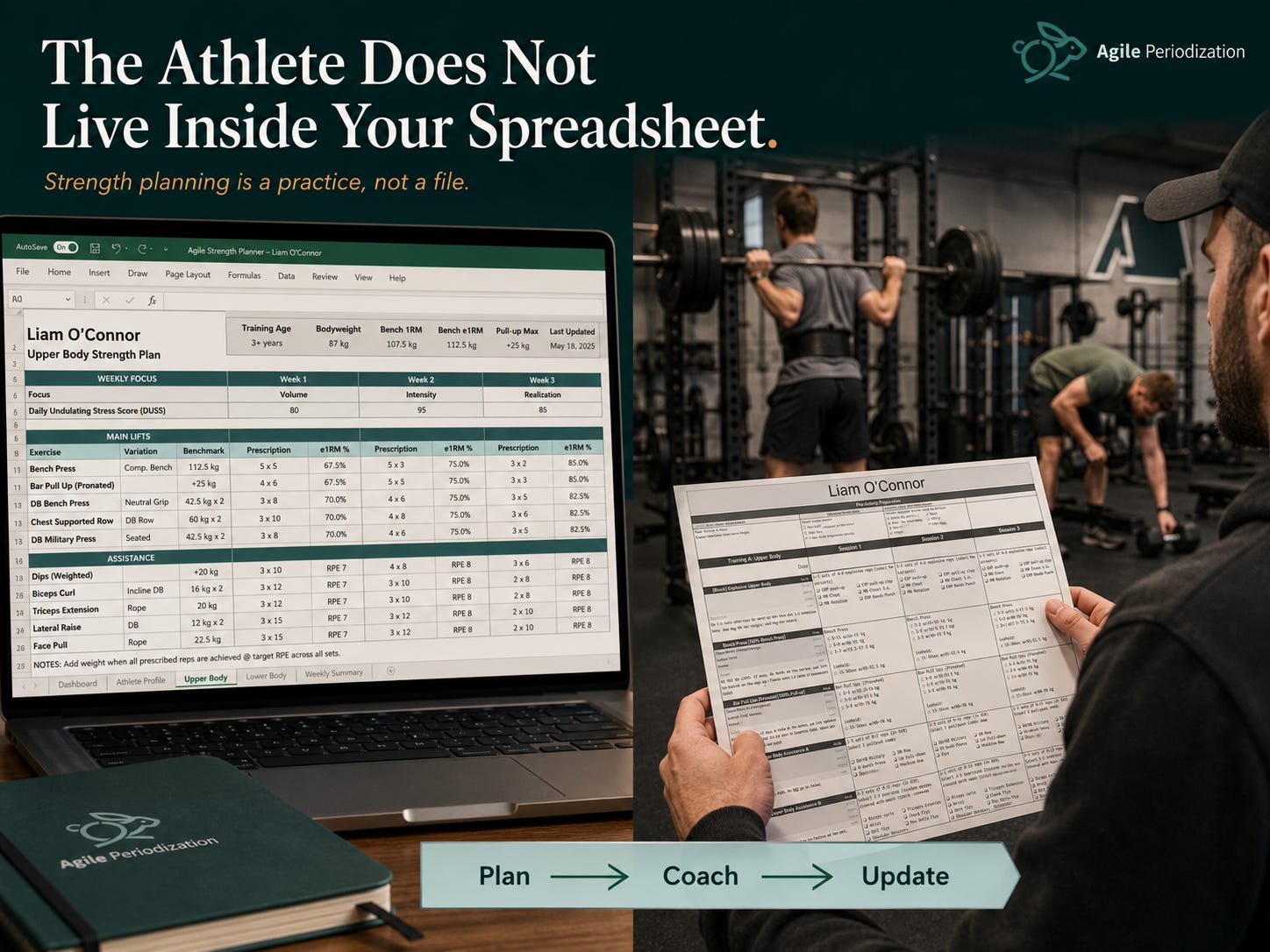
Every coach has had this experience. You spend an evening building a clean program. The progression makes sense, the percentages are calculated, every exercise has its place, and the final spreadsheet looks like a small engineering project. Then the athlete walks into the gym with sore adductors, poor sleep, a painful thumb from sparring, and the news that the squat rack is occupied for the next twenty minutes.
Your beautiful plan is not necessarily wrong. It is simply a map meeting the territory.
That distinction matters because most strength-programming software is built as if the map should control the territory. It asks us to define the exact exercise, exact set, exact repetition target, exact load, and exact session before the athlete arrives. In return, it gives us the warm comfort of precision. The problem is that this precision often becomes administrative work for the coach and a prison for the athlete.
The Agile Strength Planner was built from a different assumption: a prescription should help the athlete find the right training zone quickly, but it should not pretend that the coach can predict every interaction in advance. The plan provides a ballpark, an intention, and quality controls. The athlete and coach still need to make decisions.
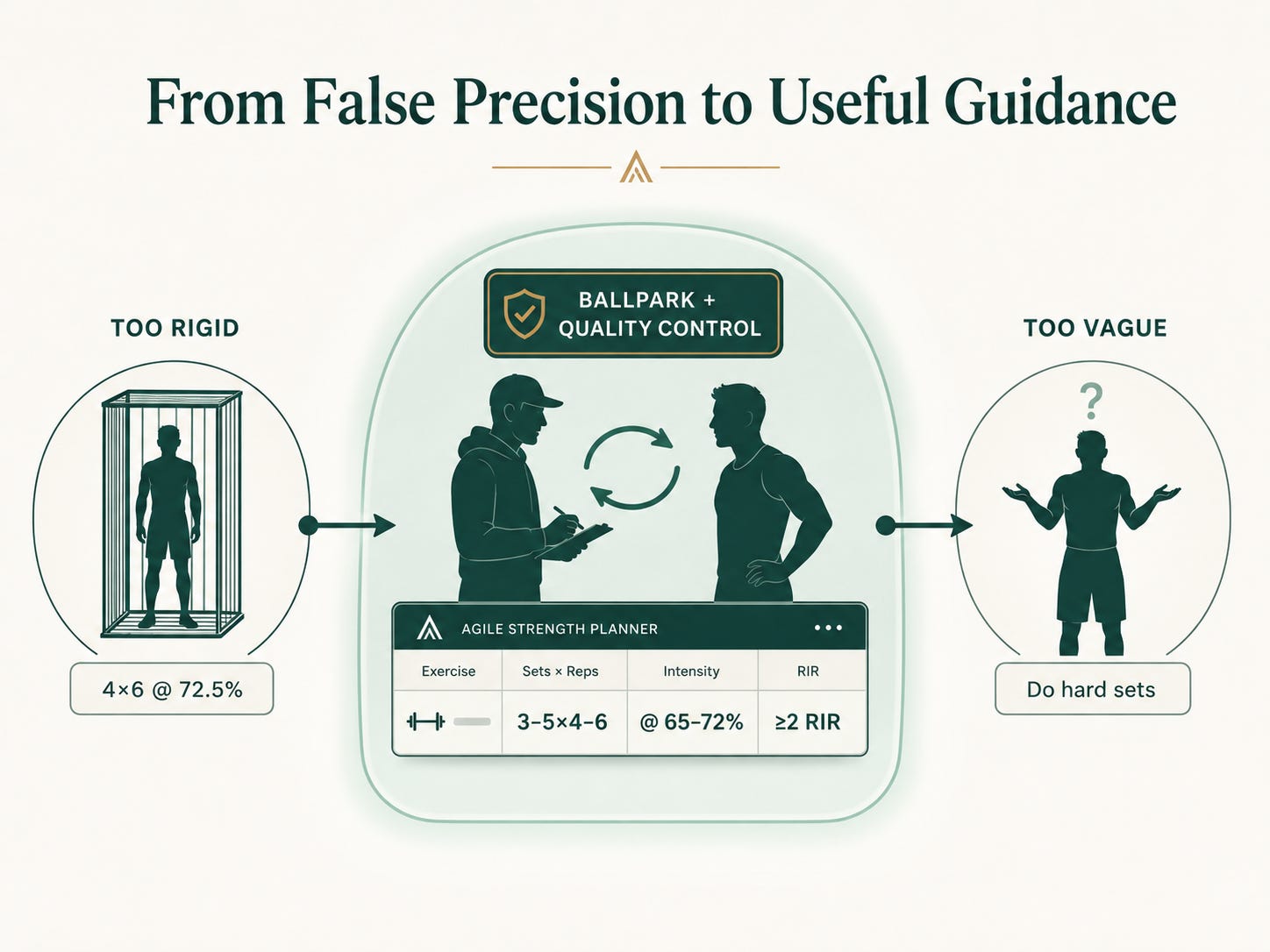
That is not a weakness in the system. That is coaching. The central tension is summarized in Figure 1.
The promise of software - and the hidden bill
I am not against apps. Apps can be excellent for collecting training logs, analyzing trends, distributing programs, and keeping information synchronized. The problem begins when the interface quietly starts dictating the coaching process. The tool no longer serves the coach; the coach begins serving the tool.
This usually happens in small, annoying ways. You need to enter a separate maximum for every assistance exercise. You can only see one session at a time, so the three- or four-week progression disappears behind menus. The athlete needs to carry a phone around the gym, unlock it, find the next exercise, enter a set, and repeat the ritual. The coach spends more time formatting the program than thinking about the program.
None of these actions is catastrophic. That is why the cost is easy to ignore. But the friction compounds across athletes, sessions, weeks, and seasons. A tool that saves two minutes in theory can steal hours once you include setup, data entry, correction, athlete education, and troubleshooting.
There is also a philosophical cost. When software asks for an exact number, we feel pressure to provide one. A load of 107.5 kg looks more professional than a range of 100-110 kg. Yet the extra decimal does not mean we understand the athlete better. It may only mean that our spreadsheet is more confident than we should be.
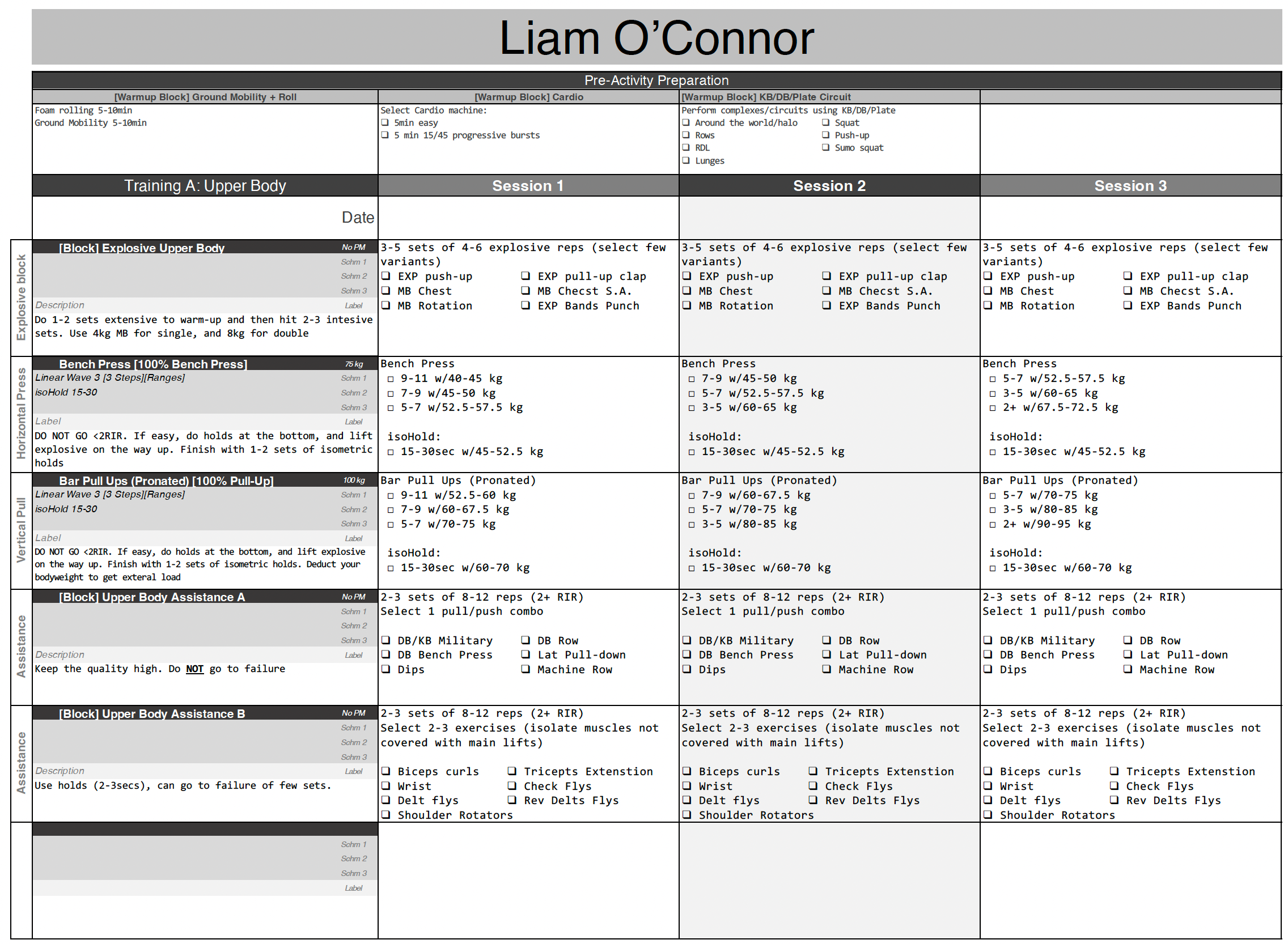
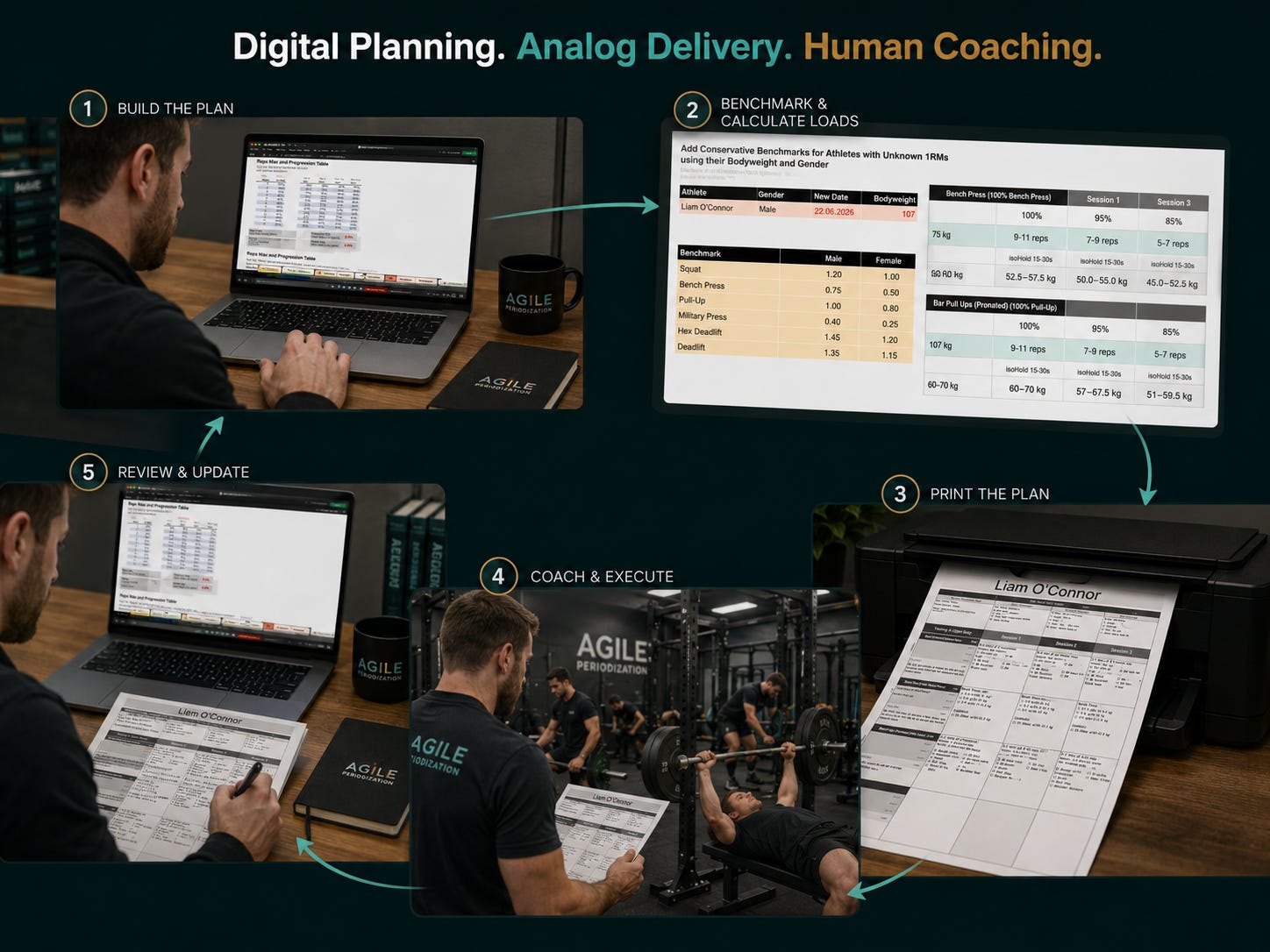
The Agile Strength Planner tries to reduce that friction. It uses Excel where Excel is useful: storing information, connecting tables, performing calculations, updating benchmarks, parsing prescriptions, and building reusable templates. Then it deliberately returns the program to a simple output: a printable card that can sit on a clipboard, hang near a station, or travel with the athlete.
Digital planning. Analog delivery. Human coaching.
The middle ground between rigid and vague
Strength prescription often gets pushed toward two unhelpful extremes.
At one extreme, the coach prescribes everything with false precision: four sets of six repetitions at 72.5 percent, followed by three sets of eight at 64 percent, with no room for the athlete who slept badly, performed hard technical training earlier, or simply responds differently to the generic rep-max table.
At the other extreme, the coach writes something like “three hard sets” or “work up to a heavy five.” This preserves freedom, but it can create an unnecessary search problem. The athlete spends several sets figuring out where to begin, overshoots the target, or stays too conservative because the instruction provides no useful anchor.
The practical middle ground, illustrated in Figure 2, is a ballpark estimate plus quality control. You might prescribe three to five sets of four to six repetitions at 65-72 percent, then add “keep at least two repetitions in reserve” or “all repetitions should remain fast and technically clean.” The percentage helps the athlete enter the right neighborhood. The quality control helps the athlete choose the right house.
This is the distinction between precision and significance. A precise statement can still be useless. A less precise statement can be more meaningful because it helps the athlete act under real conditions.
The planner does not remove uncertainty. It organizes it.
The prescription puzzle
The first practical problem is simple: how do you provide useful load recommendations without testing a one-repetition maximum for every exercise in the program?
You cannot realistically test the back squat, front squat, split squat, step-up, Romanian deadlift, dumbbell bench press, landmine press, single-arm press, pulldown, chin-up, row, and every other variation you might use. Even if you could, the process would consume training time, increase fatigue, and produce numbers with a shorter shelf life than we like to admit.
The usual alternatives are equally unsatisfying. You can leave the athlete to guess the load. You can enter values manually for every exercise. Or you can prescribe percentages only for a tiny set of main lifts and abandon useful guidance everywhere else.
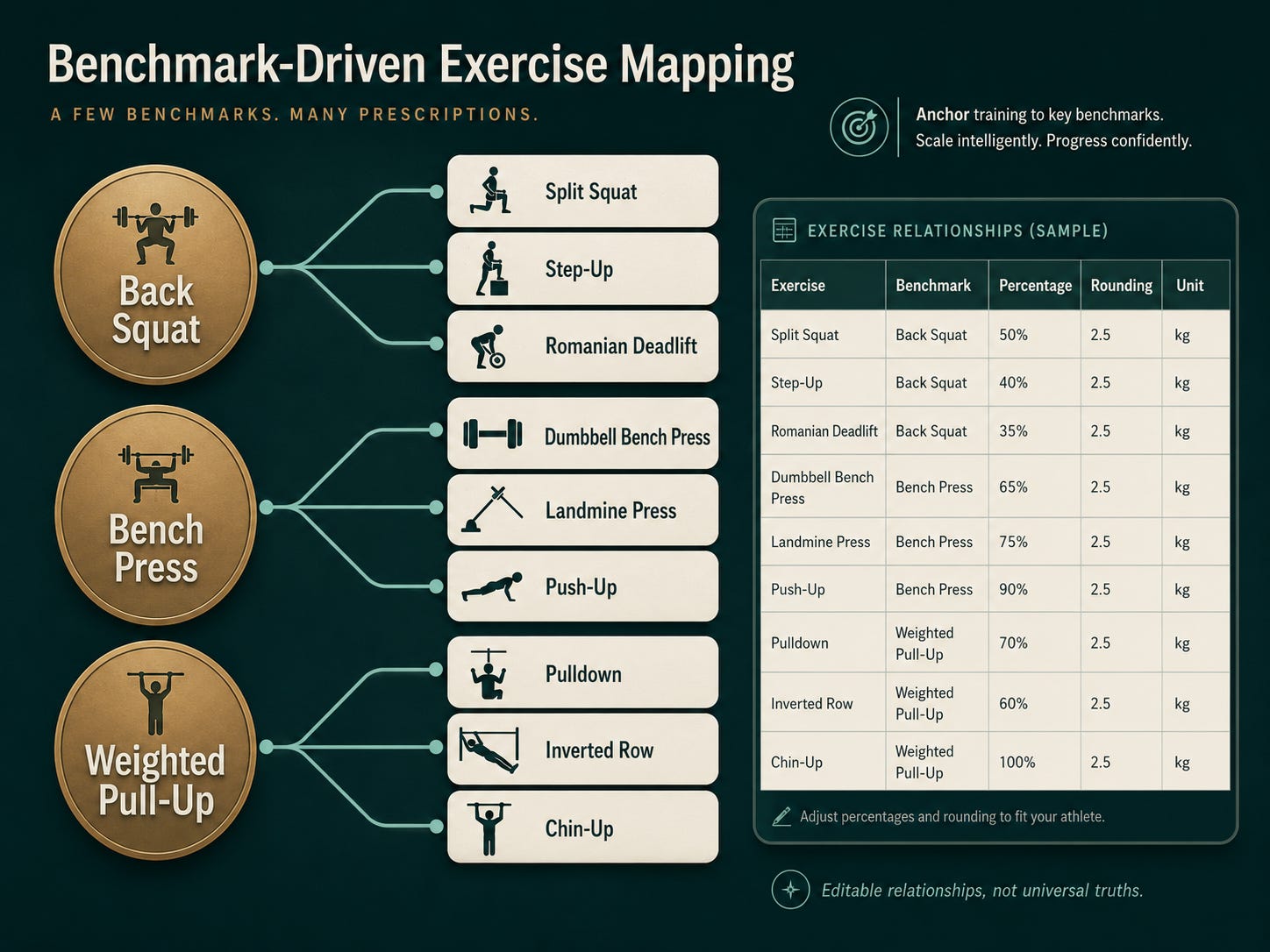
The Agile Strength Planner uses a different solution: benchmark movements as reference points. The basic network logic is shown in Figure 3.
Instead of pretending that every exercise needs an independent maximum, the planner allows exercises to be related to a smaller number of benchmark lifts. A dumbbell bench press can be related to the barbell bench press. A Romanian deadlift can be related to a squat, deadlift, or hex-bar benchmark, depending on how you organize your system. The exact relationship is editable because it is a coaching prior, not a universal law.
This is important. The relationship is not “true” in the scientific or metaphysical sense. It is useful enough to provide a conservative starting point. You begin with the best available estimate, observe what the athlete does, and update the benchmark or relationship when reality disagrees.
That is Bayesian updating without the statistics lecture: start with what usually works, test it against what actually happens, and revise the plan.
New athletes do not need to wait for perfect testing
This benchmark logic also helps when a new athlete enters the system. Rather than postponing percentage-based work until a formal testing battery is complete, you can begin with conservative prescription maximums based on the information you have. The initial estimate may use body mass, training experience, known performance, and coach judgment.
The goal is not to guess the athlete’s true one-repetition maximum with laboratory accuracy. The goal is to provide a safe and useful first draft so the athlete can train now. Over the next sessions, plus sets, RIR feedback, velocity data, technical quality, and normal coaching observation give you better information. The benchmark can then be updated.
This is the Minimum Viable Program logic applied to strength prescription: good enough to start, conservative enough to protect the downside, and flexible enough to improve.
The perfect initial number does not exist. A responsible starting number and a tight feedback loop do.
The prescription atom
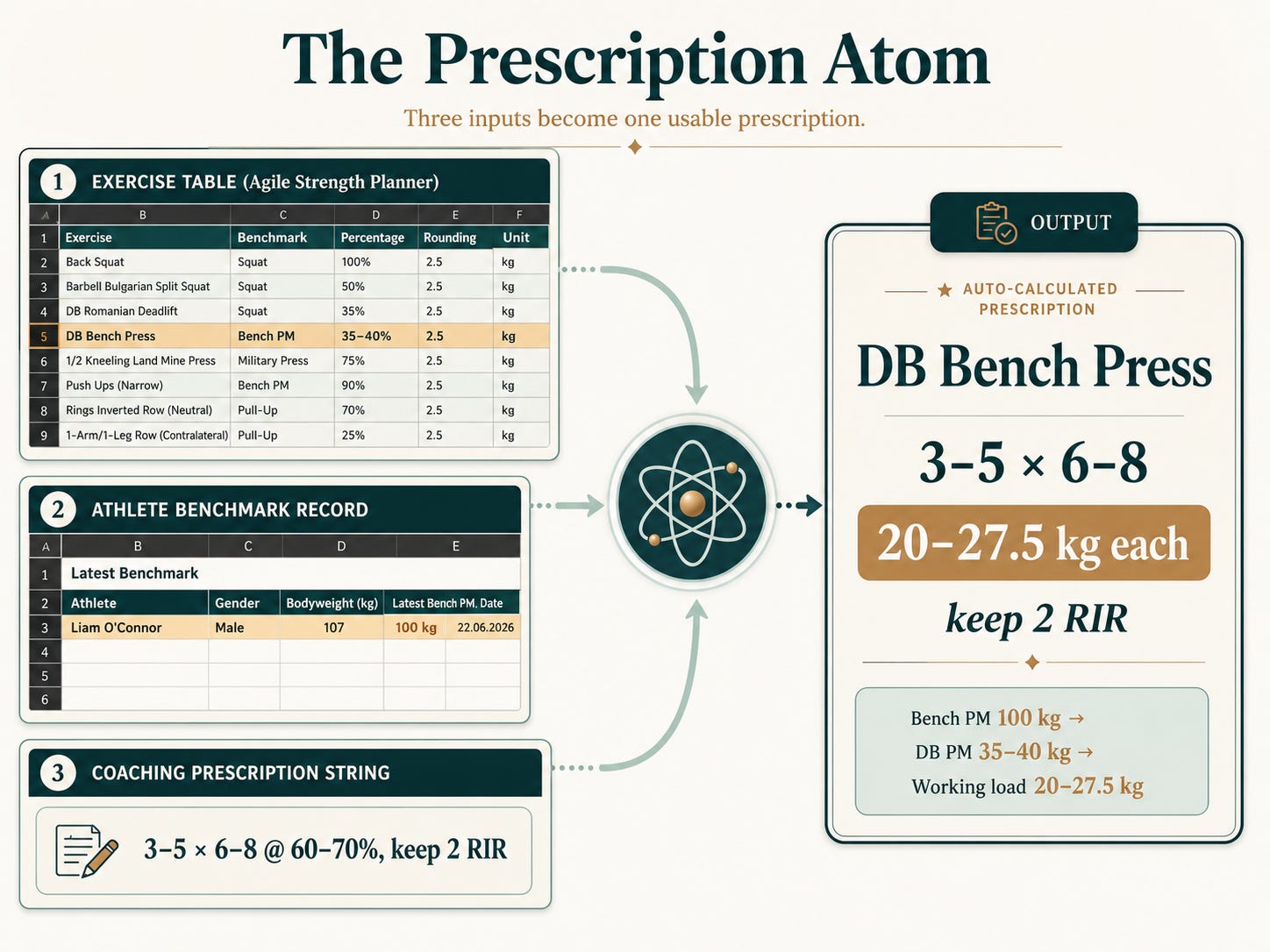
The core building block inside the planner is what I call the prescription atom. Its three-part structure is shown in Figure 4. It combines three things:
The exercise and its relationship to a benchmark.
The athlete’s latest available benchmark or prescription maximum.
The training scheme written in normal coaching language.
When these elements are combined, the planner calculates the relevant load while preserving the original instruction. This matters because coaches do not think only in isolated numbers. We think in combinations: sets, repetitions, ranges, intent, RIR, tempo, technical cues, back-off work, isometrics, rehabilitation options, and what the athlete should do when the first plan does not fit.
A prescription might read:
3-5 sets of 6-8 repetitions at 60-70%. Keep at least two repetitions in reserve. Stop the set if position deteriorates.
The planner identifies the percentage range, applies it to the selected athlete and exercise, rounds the result according to your equipment, and returns a clean text prescription. The coaching language remains visible. The calculation is automated, but the intention is not lost.
Why a text prescription is more powerful than ten input boxes
Most software separates the prescription into fields: sets, reps, percentage, tempo, RIR, rest, and notes. That structure is useful for databases, but it often fragments the coaching idea. It becomes difficult to write a progression that includes a top set, two different back-off options, an isometric hold, and a qualitative instruction without fighting the interface.
The Agile Strength Planner treats the prescription as a string that can contain both calculable percentages and normal language. That gives you room to build prescriptions such as:
Work to a top set of five while keeping two repetitions in reserve.
Repeat the first set for three additional sets.
Choose one hypertrophy, isometric, or rehabilitation option.
Complete three to five explosive repetitions while speed remains high.
Perform a 15-30 second hold using a percentage of the relevant prescription maximum.
The point is not to make every prescription complicated. The point is to avoid forcing every coaching idea into the same rigid form.
Form should follow the problem.
Modularity: give options without producing chaos
The word individualization often creates an image of a coach writing a completely unique program for every athlete. In theory, that sounds impressive. In practice, it can become an administrative nightmare, especially with teams, group settings, or athletes who train remotely.
The alternative is not one-size-fits-all programming. The alternative is modularity.
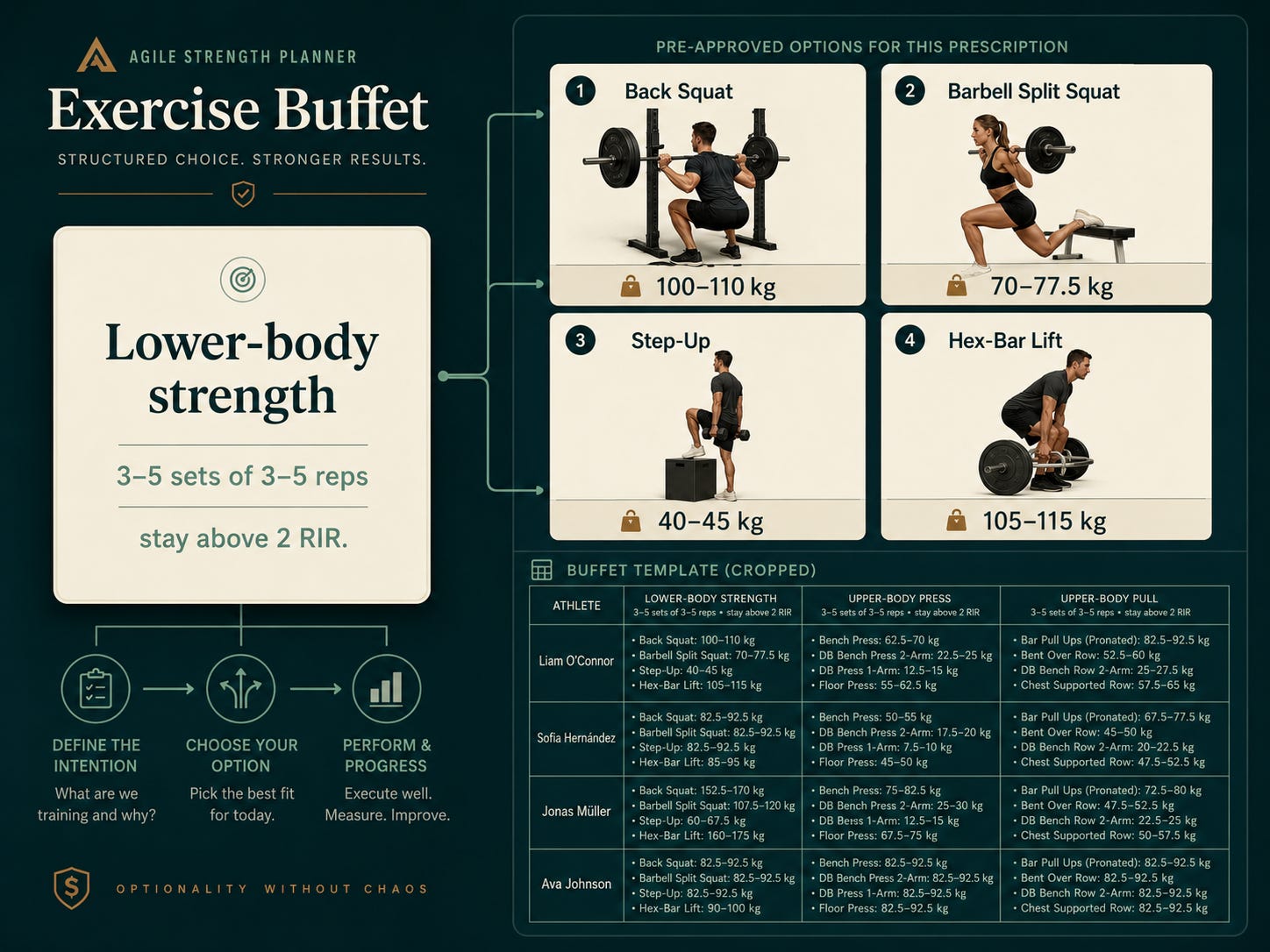
A modular program has stable training intentions and flexible components. You may prescribe an explosive block, a lower-body strength slot, a horizontal press, a vertical pull, and an assistance block. Inside each slot, the athlete can have one primary option and several acceptable alternatives. The options are not random; they belong to the same functional role in the program.
This is where the planner’s “buffet” logic becomes useful. Figure 5 shows how one stable training intention can support several pre-approved paths. Suppose the goal is lower-body strength for three to five sets of three to five repetitions. One athlete may back squat. Another may use a hex bar because of shoulder irritation. A combat athlete with a painful thumb may choose a machine or belt squat. A remote athlete may use the best option available in a hotel gym.
The coach can provide estimated loads for every option. The athlete gets freedom, but not confusion.
A plan should provide guardrails, not handcuffs
Optionality is sometimes criticized because the athlete might choose the easiest movement. That can happen. But rigid prescriptions do not eliminate poor decisions; they merely hide them until the athlete skips the session, performs the exercise badly, or changes it without telling you.
The answer is not less autonomy. The answer is better constraints and better communication. Define the purpose of the slot. Limit the acceptable options. Explain the decision rule. Review what the athlete selected and why.
For example:
Choose the option that allows hard, technically clean lower-body work without increasing current pain. Stay above two repetitions in reserve. Record the option and top load used.
That is not a free-for-all. It is a decision system.
The best coach is not the one who makes every decision forever. The best coach gradually improves the quality of the athlete’s decisions.
The Scheme Builder: heuristics made editable
Percentage-based programming depends on rep-max relationships, but these relationships vary between athletes, exercises, techniques, tempos, and training histories. A generic table can still be useful, as long as we remember what it is: a prior.
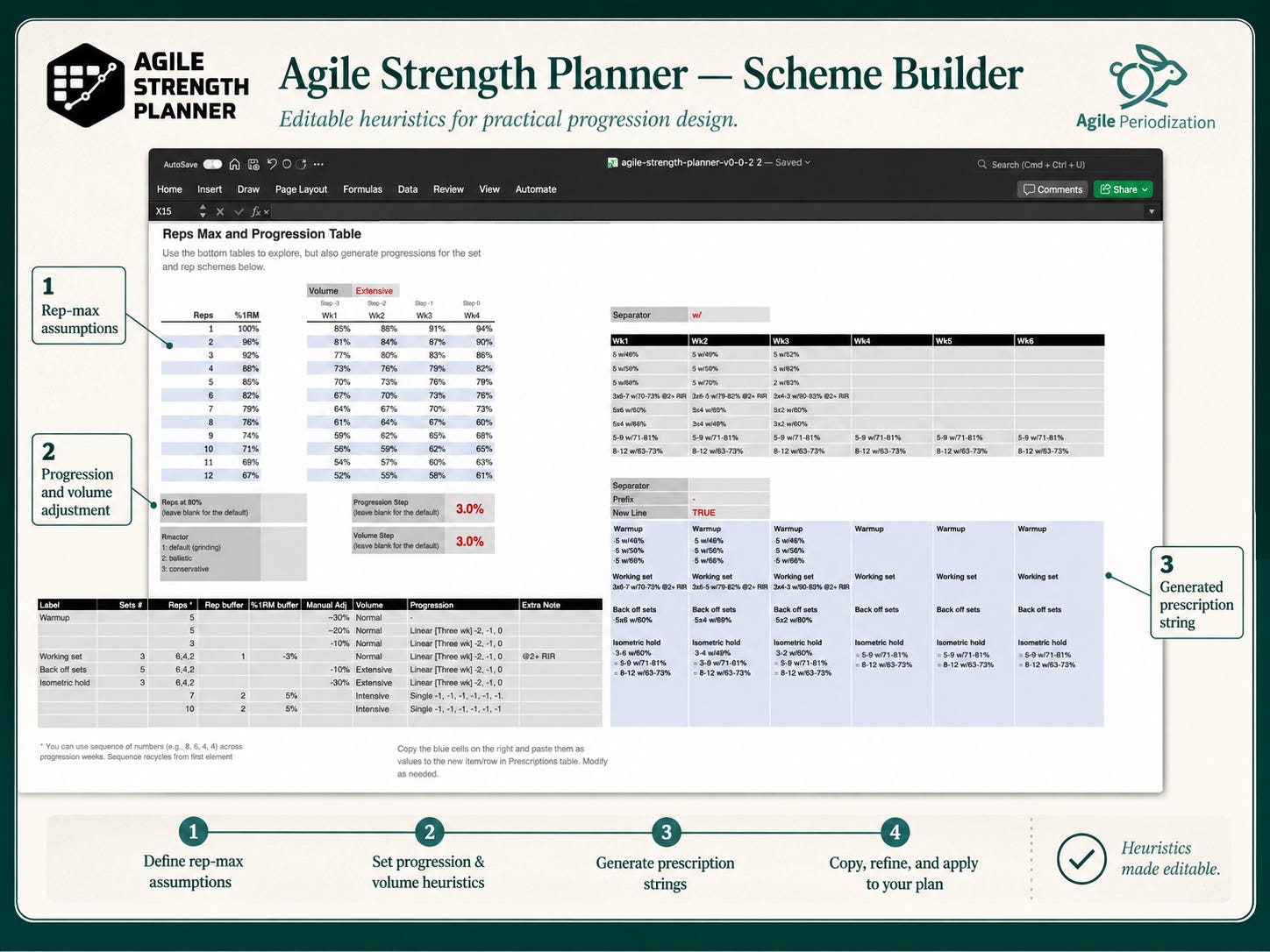
The built-in Scheme Builder, also called the Prescription Generator, allows the coach to create reusable progressions while keeping the assumptions visible and editable. You can adjust the expected number of repetitions at 80 percent, use different multiplication factors for grinding or ballistic work, account for the number of sets, add percentage or repetition buffers, and organize linear or undulating progressions.
This is particularly useful for athletes who are not strength-sport specialists. A football player or MMA fighter may need to preserve speed, technical quality, and energy for sport practice. The load appropriate for one hard set is not automatically appropriate for five sets. The load that allows a grinding repetition is not automatically appropriate when the intention is explosive execution.
As summarized in Figure 6, the Scheme Builder helps convert those coaching decisions into a reusable prescription. It does not prove that the percentages are correct. It saves you from rebuilding the same logic every time.
You can watch the dedicated Scheme Builder walkthrough here:
Why I still want paper in the gym
The phrase “back to paper” can sound nostalgic, as if I want to return to a time before useful technology. That is not the point. I want to use technology at the part of the process where it creates leverage, and remove it where it creates friction.
Excel is excellent for building the program. It can store athlete records, identify the latest benchmark, relate exercises to reference movements, parse percentages, round loads, recycle templates, and generate multiple athlete-specific outputs. A printed card is excellent for delivering the program on the gym floor. It is visible at a glance, does not need a battery, does not send notifications, and can display three or four weeks of progression on one page.
This matters even more in team training. A coach can print athlete-specific loads and place the sheets at relevant stations. Athletes can move through the session without opening an app between sets. The coach can see the entire workout and spend attention on movement, effort, communication, and flow.
The card also becomes a simple training log. The athlete can circle an option, write the actual load, record repetitions, or leave a note. That information can later be used to update the benchmark or next cycle.
The process is not “paper instead of technology.” It is the feedback loop depicted in Figure 7:
Build → calculate → print → coach → observe → update.
Three practical use cases
1. The new athlete
A new athlete arrives without reliable testing data. The coach creates conservative starting benchmarks, generates the first training card, and lets the athlete begin. The early sessions are treated as information-gathering rather than as a final verdict. Loads are adjusted from RIR, performance, and observation. After a few iterations, the prescription maximum becomes more representative.
The athlete trains immediately. The coach learns without wasting a week on ceremonial testing.
2. The remote combat-sport athlete
A fighter is training in another city. The coach does not know exactly how the athlete feels after the morning skill session, what equipment will be free, or whether a small injury will change the exercise choice. A rigid plan creates either compliance theater or constant messaging.
A modular card solves a large part of the problem. The training intention remains stable, but the athlete can choose from pre-approved options and still receive useful load ranges. The quality controls define how hard the work should feel. The athlete records what was done and the coach updates the next iteration.
The program provides direction without pretending the coach is standing beside the athlete.
3. The team workout
A team has one training block and several athletes sharing stations. The coach needs athlete-specific loads, but does not want twenty athletes staring at phones. The planner creates a team sheet or several station sheets with calculated loads for the selected progression step.
The sheets are printed and placed around the gym. The athletes know where to start. The coach retains the ability to adjust. The session moves.
This is not glamorous. It is useful. Useful usually wins.
What the planner does - and what it does not do
The Agile Strength Planner performs the repetitive work that software should perform. It stores athletes, benchmarks, exercises, relationships, schemes, and templates. It pulls the latest benchmark, calculates prescription maximums, parses percentage ranges, rounds loads, and produces individual or team outputs.
It does not know whether the athlete slept well, whether the last sparring session was excessive, whether a painful movement is dangerous, whether the prescribed exercise makes sense for the current sporting problem, or whether the athlete is lying about RIR. It cannot bridge the Is/Ought Gap for you.
That is why the planner should be understood as a coaching tool, not an automated coach.
The goal is not to remove judgment. The goal is to stop wasting judgment on arithmetic and formatting.
The basic principle
Let the workbook handle the repetitive calculations. Let the coach define the intention, constraints, and acceptable options. Let the athlete provide information from the session. Then update.
What you receive
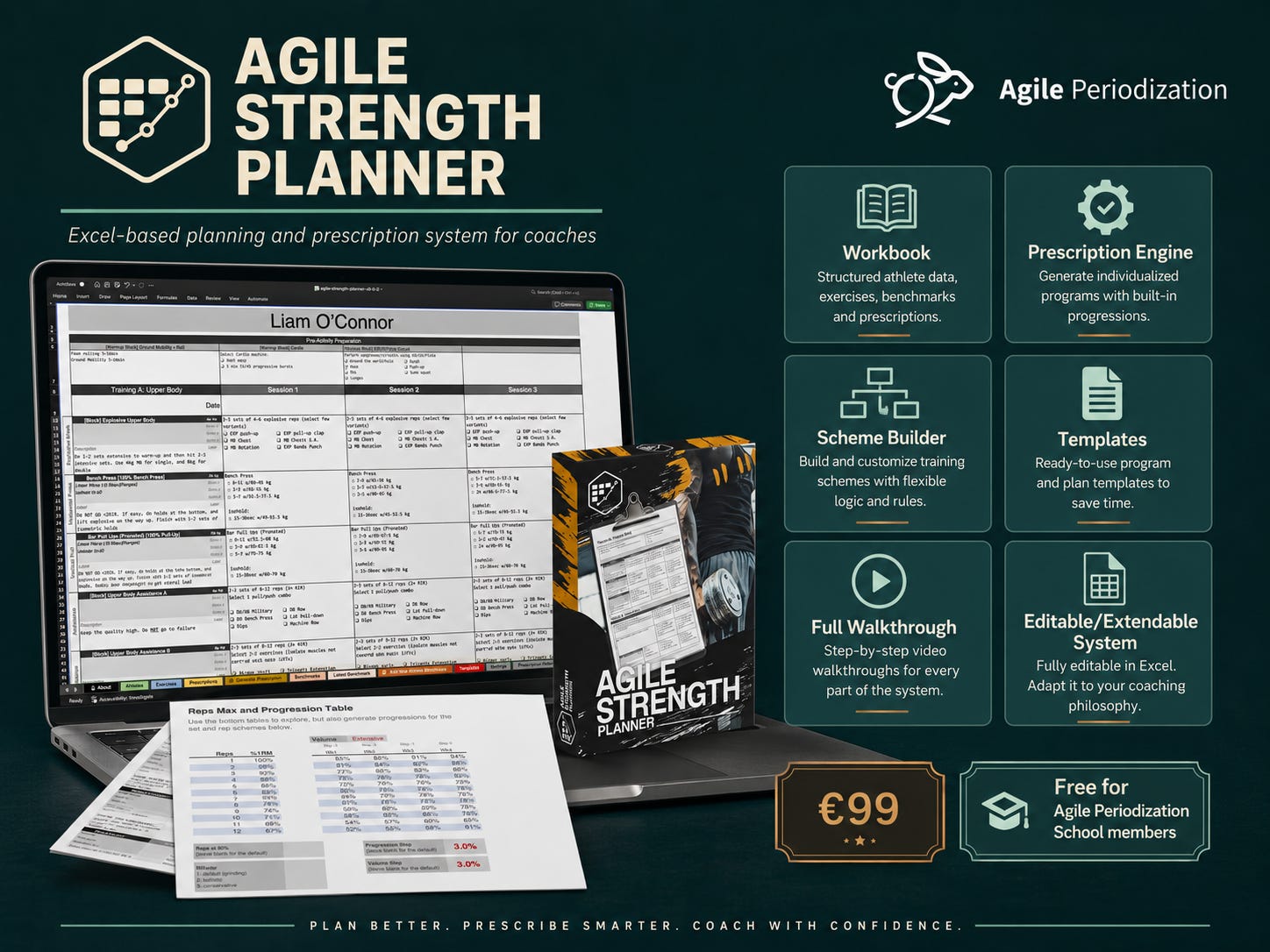
The current Agile Strength Planner package includes the Excel workbook, a library of approximately 200 exercises and movement options, athlete and benchmark tables, the modular Prescription function, the Scheme Builder, individual and team-program templates, printable card layouts, example prescriptions, and instructional videos.
The workbook is intentionally extendable. You can add exercises, create new benchmarks, modify relationships, build your own schemes, and redesign the printouts around your environment. The included material gives you a working system, not a locked black box.
The full package is summarized visually in Figure 8 and contains:
The Agile Strength Planner Excel workbook.
Athlete and historical benchmark management.
Approximately 200 exercises and movement options.
Editable exercise-to-benchmark relationships.
Modular prescription parsing with ranges and coaching cues.
The Scheme Builder / Prescription Generator.
Individual, remote, team, circuit, and buffet templates.
Printable three- and four-step strength cards.
A detailed approximately one-hour walkthrough.
A separate Scheme Builder instructional video.
Eligible bug fixes and minor updates.
The offer, without funnel gymnastics
The price of the Agile Strength Planner is €99.
That price is not based on the number of cells in the workbook. A spreadsheet is cheap. The value is in the relationships, logic, templates, prescription engine, Scheme Builder, examples, and the hours of development that allow you to begin with a working system rather than an empty grid.
The more important calculation is what the tool removes. If it saves you from manually calculating and formatting several programs, rebuilding the same schemes, entering dozens of assistance-exercise maximums, or correcting confusion during team sessions, it can repay the purchase in a small number of coaching hours.
More importantly, it can reduce the cognitive residue that comes from boring administrative work. The coach’s scarce resource is not information. It is attention.
Use that attention to watch athletes, ask better questions, communicate, and make decisions.
Get the Agile Strength Planner
Price: €99
The purchase includes the workbook, templates, Scheme Builder, approximately 200 exercise options, the detailed instructional walkthrough, the separate Scheme Builder video, and eligible minor updates.
View the Agile Strength Planner on Payhip
Free for Agile Periodization Skool members
The Agile Strength Planner is available free of additional charge to Agile Periodization Skool community members. The School is where I share courses, working frameworks, tools, PDFs, discussions, and ongoing updates. It also gives us a place to stress-test the planner with coaches who are using it in different sports and environments.
This is not charity and it is not a trick. The community makes the product better. Coaches report bugs, challenge assumptions, suggest templates, share use cases, and reveal problems I would not see alone. In return, members receive access to the tool and the broader educational ecosystem.
Join the Agile Periodization School
Watch before you buy
I do not want you to purchase the planner based on a polished two-minute sales video and then discover that the workflow does not fit your environment. The detailed walkthrough is intentionally long. It shows the logic, the tables, the templates, the modular function, the exercise options, and the limitations.
Full Agile Strength Planner walkthrough:
Scheme Builder / Prescription Generator:
Watch the videos. Look at the workflow. Decide whether it solves a problem you actually have.
That is a better sales process than manufacturing urgency.
Who this is for
The planner is built for strength and conditioning coaches, personal trainers, team coaches, remote coaches, combat-sport practitioners, and serious professionals who already use Excel and want a faster way to move from a programming idea to a usable gym-floor prescription.
It is especially useful when you:
Work with multiple athletes or groups.
Use percentage-based loading but do not want to test every exercise.
Prefer ranges and quality controls over false precision.
Need exercise options because athletes and environments change.
Want three or four weeks visible on one printed card.
Need team-specific loads without phones in the gym.
Want editable templates rather than a closed application.
It may not be for you if you want a fully cloud-based athlete-management system, automated messaging, a mobile training diary, or a polished app that hides all underlying logic. This is an Excel-based coaching tool. Its strength is transparency, flexibility, and speed of modification.
It also requires a recent desktop version of Microsoft Excel for Mac or Windows with VBA macros enabled. It is not designed for Google Sheets, Apple Numbers, Excel Online, or mobile spreadsheet applications.
The larger idea
The Agile Strength Planner began as a practical answer to a programming problem, but it reflects a larger view of coaching technology.
I do not think the next step is always more data, more dashboards, more fields, and more precision. Sometimes the next step is better compression: a few useful benchmarks, a sensible range, clear quality controls, modular options, a printed card, and a coach who is paying attention.
The model should help us act. The plan should survive contact with reality. The technology should remove friction without removing judgment.
A good tool does not make the coach less important. It frees the coach to do the work that only a coach can do.
Automate the calculations. Preserve the flexibility. Keep the coach in control.