

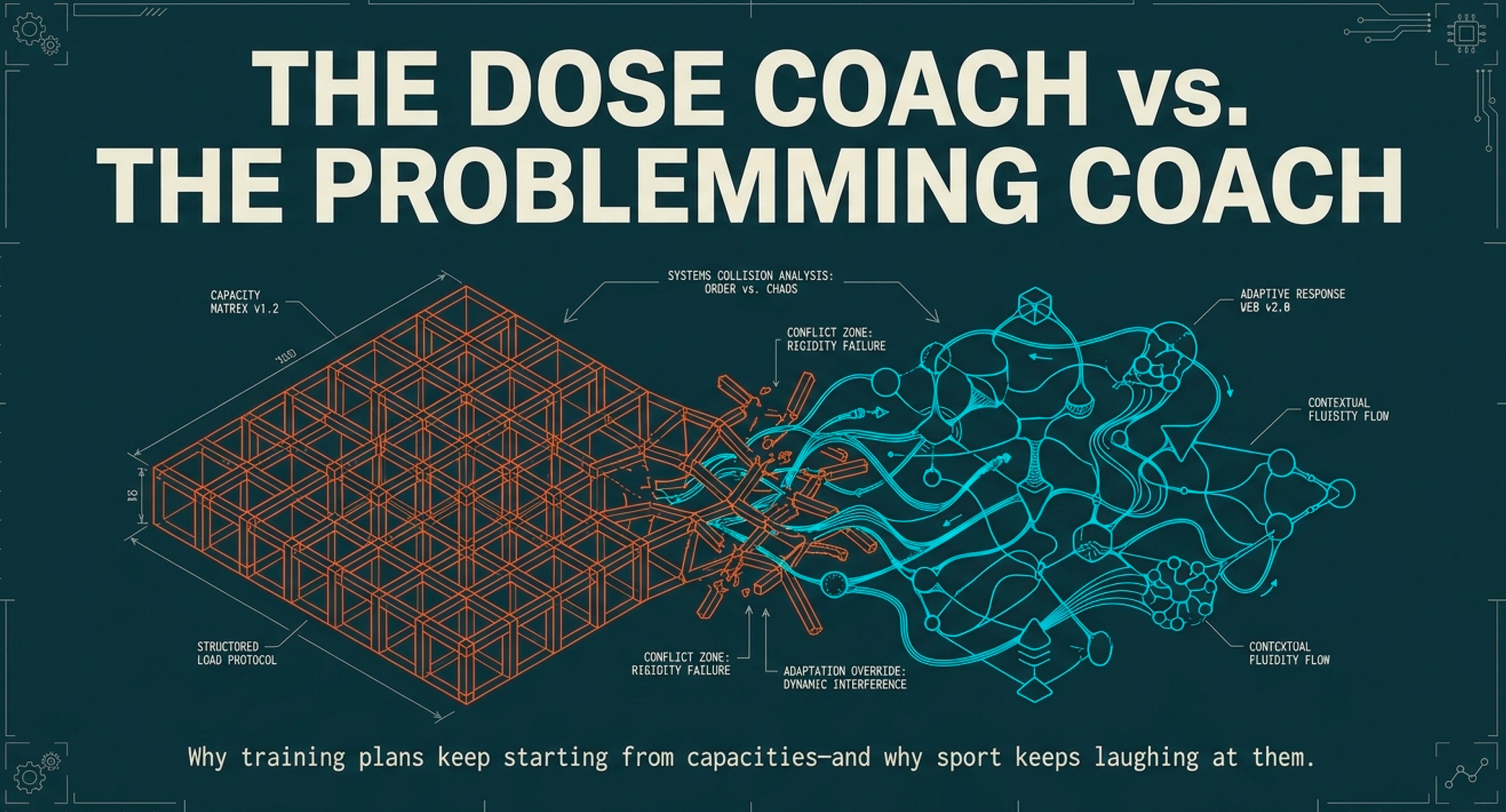
The Dose Coach vs. The Problemming Coach
Why training plans keep starting from capacities - and why sport keeps laughing at them

Two coaches walk into a gym.
Not a joke. More like a small civil war.
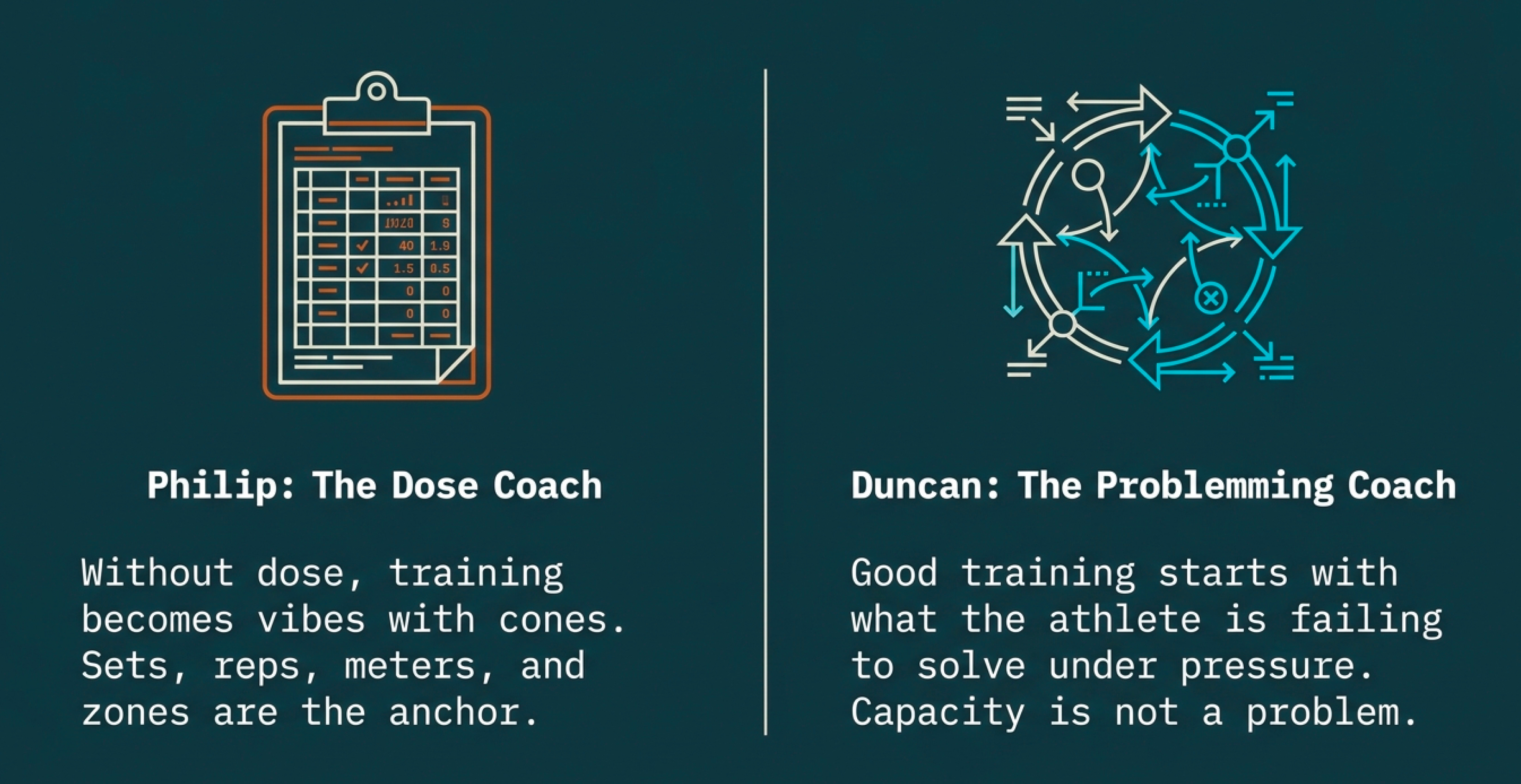
On one side, we have Philip, the Dose Coach. He believes good training starts with the right exposure: sets, reps, meters, zones, intensity, volume, density, progression. He is not wrong. Without dose, training becomes vibes with cones.
On the other side, we have Duncan, the Problemming Coach. He believes good training should start with the problem the athlete needs to solve. Not “today is strength day,” but “what is the athlete failing to solve in the sport, under pressure, against constraints?”
They both care about performance.
They both hate bullshit.
They just disagree about where the plan should start.
Duncan: Let me start with the uncomfortable question. When you design training, what is the basic unit of your plan?
Philip: Easy. It depends on the phase, the sport, the athlete, and the goal. Strength. Speed. Aerobic power. Anaerobic capacity. Technical work. Tactical work. Recovery. You know, the usual stuff.
Duncan: Exactly. The usual stuff. That is my beef.
Philip: Your beef is with strength and speed now? Wonderful. The ecological guys finally went too far.
Duncan: No, my beef is not with strength, speed, endurance, biomechanics, physiology, or load. I like these things. I use them. I test them. I have spreadsheets full of them, which probably tells you I need therapy. My beef is with the fact that these things often become THE planning unit. We start with the dose, the capacity, or the adaptation we want to target. Then we try to dress it up as sport.
Philip: That is a strong accusation. Also slightly rude. I like it. Continue.
Duncan: Take the classical periodization tradition. Tudor Bompa popularized periodization as a structured way to organize training over time, using macrocycles, mesocycles, and microcycles, with different phases targeting different qualities. In that world, we talk about biomotor abilities: strength, speed, endurance, flexibility, coordination, and their combinations. The plan is usually built around developing these qualities in a logical sequence.
Philip: And that is bad?
Duncan: Not bad. Useful. But incomplete. The hidden assumption is that sport performance can be prepared by developing the right substances first, and then applying them later. Build the engine. Build the chassis. Build the muscle. Build the aerobic base. Build power. Then, somehow, the athlete will express it in the game.
Philip: Somehow? Come on. You are caricaturing it. Good coaches always connect physical qualities to the sport.
Duncan: Good coaches do. Systems often do not. Or they say they do, but when Monday comes, the spreadsheet says “strength day.” Tuesday says “aerobic power.” Wednesday says “speed.” The game problem becomes the delivery vehicle for a preselected physiological target. We start with the substance and then look for a sport-looking wrapper.
Dose, capacity, problem
At this point, the editor interrupts.
Because before this becomes another philosophical cage fight between two coaches who both need coffee, we need a few definitions.
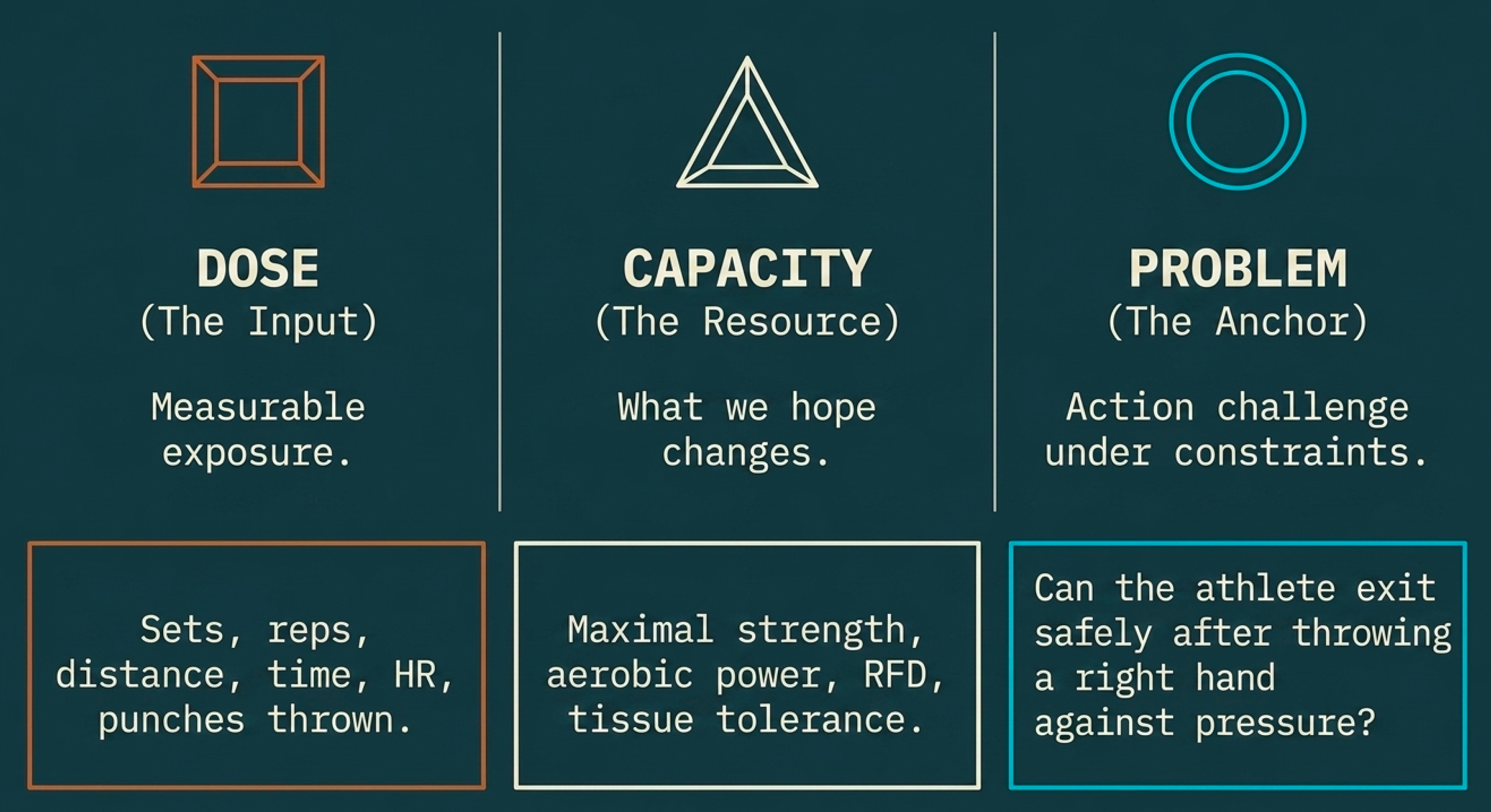
By dose, we mean the quantity and character of exposure we prescribe: sets, reps, distance, time, intensity, density, heart rate, lactate, accelerations, high-speed running, number of punches, number of shots, number of takedown attempts, sparring rounds, and so on. Dose is the measurable exposure.
By capacity, we mean the quality or resource we want to improve: maximal strength, aerobic power, repeat sprint ability, rate of force development, mobility, tissue tolerance, buffering capacity, and so on. Dose is what we give. Capacity is what we hope changes.
By problem, we mean the performance situation the athlete must solve. Not a vague “improve performance” slogan, but a specific action challenge under constraints.
Can this boxer exit safely after throwing the right hand when the opponent pressures forward?
Can this swimmer maintain stroke length when fatigue changes the water feel?
Can this midfielder receive under pressure with the body orientation that allows the next action?
Can this MMA fighter stand up from half guard against a heavy top player without giving the back?
A problem includes what the athlete perceives, what options are available, what action is invited, what the opponent does, what the environment allows, and what the athlete can actually do.
Now back to our two friendly enemies.
Philip: So problems are sport situations.
Duncan: Yes, but not only situations. They are situations with demands, information, consequences, and constraints. A problem includes what the athlete perceives, what options are available, what action is invited, what the opponent does, what the environment allows, and what the athlete can actually do.
Philip: That sounds elegant. But here is my first attack. Problems are not independent of capacities. A fighter cannot solve the “stand up from bottom” problem if they have no hip strength, grip endurance, trunk stiffness, or neck tolerance. A footballer cannot exploit space behind the line if they cannot sprint. A swimmer cannot maintain technique if they lack the physical capacity to resist fatigue. So your “problem-first” language risks becoming hand-wavy. The athlete solves problems with a body.
Duncan: Correct. This is the best criticism of my position. And it is why I do not want to replace dose worship with problem worship. I want a better hierarchy. My current synthesis is this: problem is the anchor, dose is the regulator.
Philip: That is better. I can work with that.
Duncan: The problem tells us what the training is for. Dose helps us manage exposure, progression, fatigue, and adaptation. Dose matters, but it should not become the king. It should serve the problem.
Philip: Give me an example.
The heavy bag is not the enemy
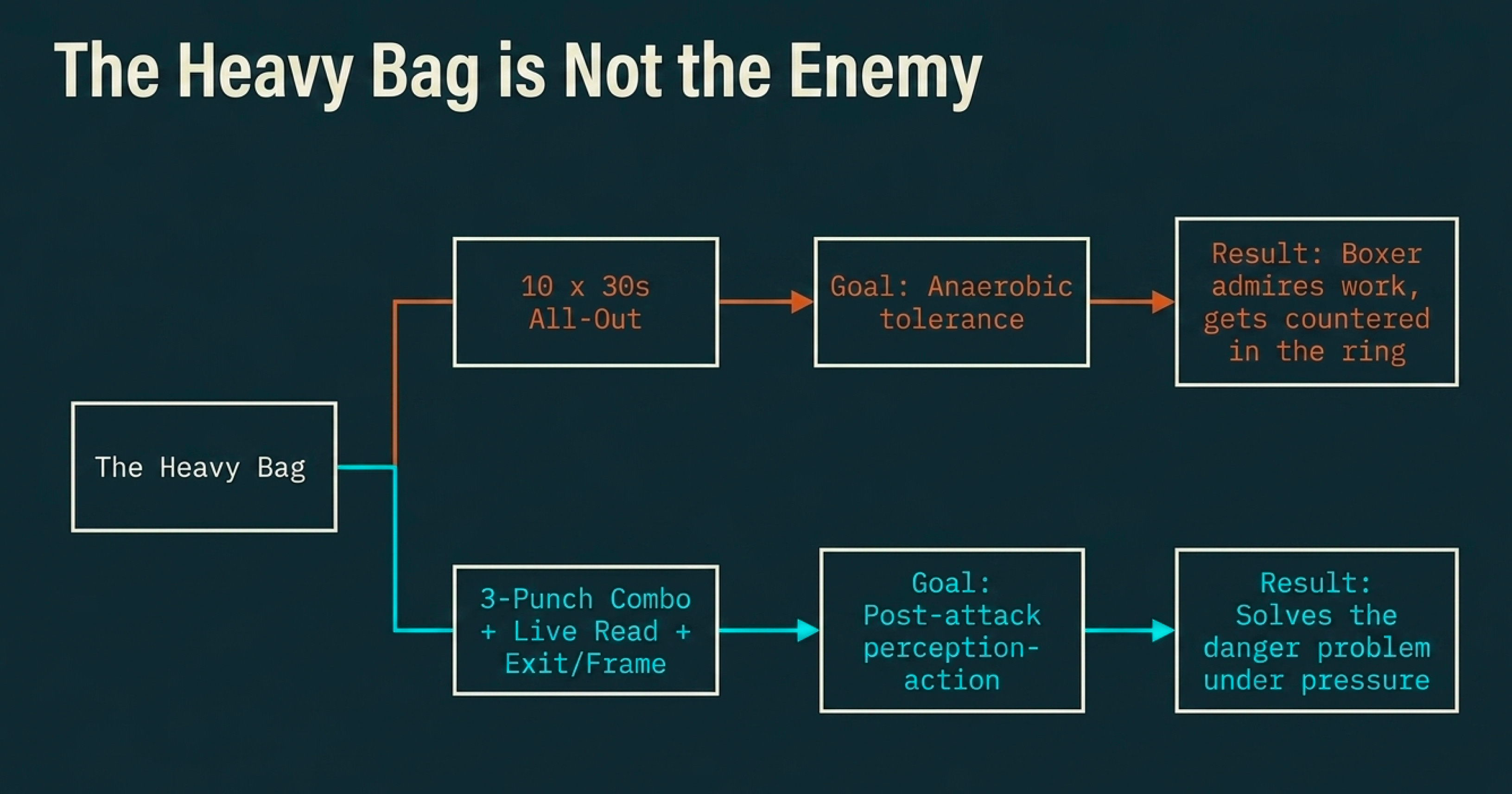
Duncan: Let’s use boxing. A dose coach says: “Today we need anaerobic conditioning. Let’s do 10 x 30-second all-out heavy bag punch-outs with 30 seconds rest.” That might be useful. It is simple, hard, measurable, and everyone feels like Ivan Drago by the end.
Philip: Nothing wrong with that.
Duncan: Nothing wrong if the problem is physical output tolerance under fatigue. But what if the real problem is that the boxer throws long combinations and gets countered because they admire their own work? Then the issue is not just punch volume. The problem is perception-action coupling after attack. Can they punch, read the return, exit, frame, clinch, angle, or counter the counter?
Philip: So your session changes.
Duncan: Exactly. I might still use a hard conditioning element, but now the task has a problem. For example: boxer A attacks with a two- or three-punch combination; boxer B has one live counter option; boxer A must finish with an exit, frame, or re-attack depending on what they perceive. We can dose the rounds. We can manipulate space. We can manipulate fatigue. But the anchor is not “anaerobic lactic tolerance.” The anchor is “solve the post-attack danger problem under pressure.”
Philip: But if you make everything problem-based, don’t you lose control of the physical stimulus?
Duncan: Sometimes. This is where dose fights back. Representative tasks can be messy. Small-sided games may not expose players to enough high-speed running. Live wrestling rounds may overload the neck, fingers, and nervous system before you get the technical learning you wanted. Sparring may create too much chaos for a novice. A swimmer doing only “authentic swimming problems” may not accumulate enough targeted exposure to a specific stroke constraint. So yes, the problem-first coach needs dose intelligence.
Philip: Good. Because a bad constraints-led coach can become just as ideological as a bad periodization coach.
Duncan: Exactly. That is why I want complementarity, not revolution cosplay.
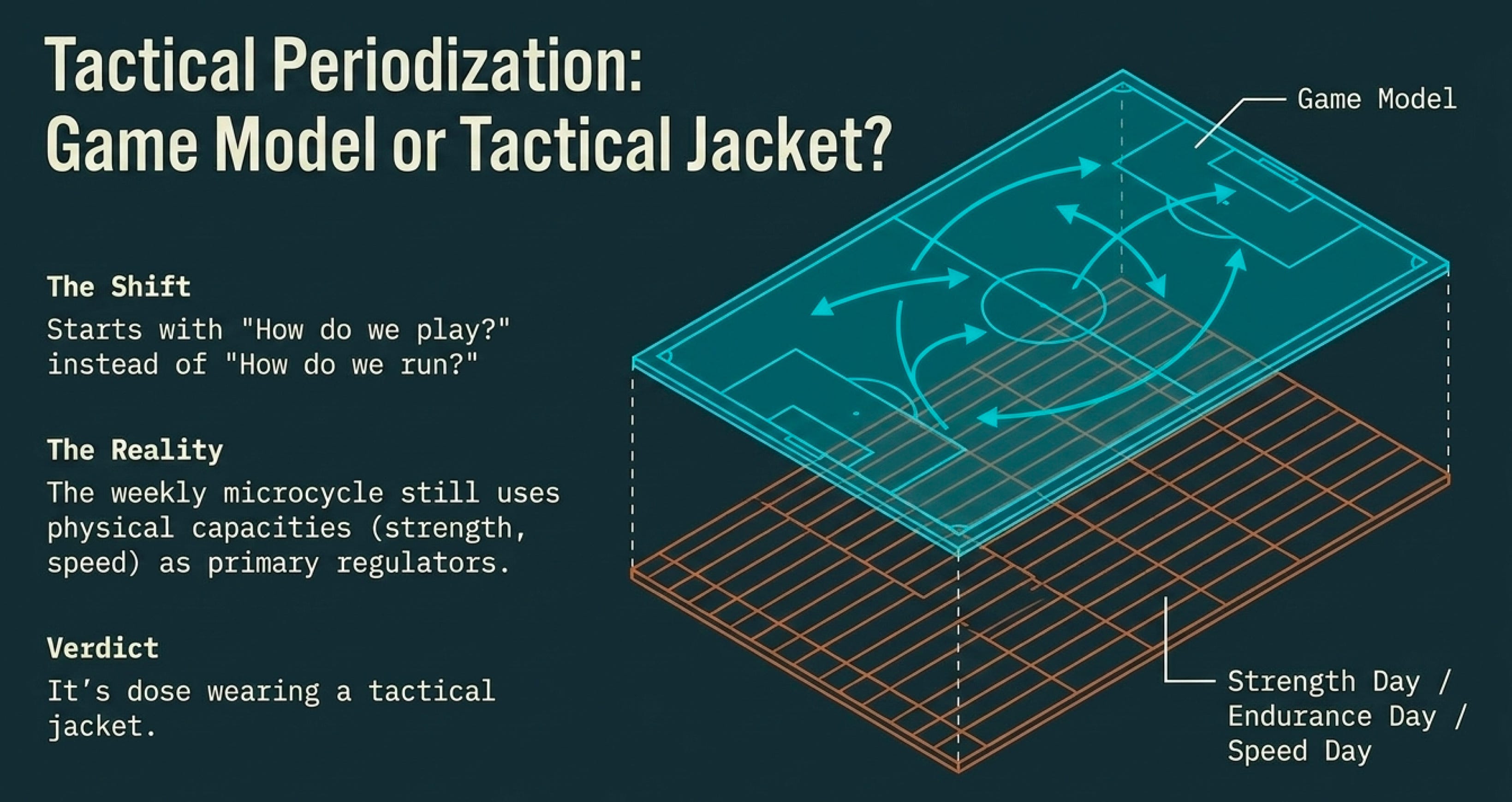
Tactical Periodization: game model or dose in a tactical jacket?
Now the conversation moves toward football.
This is where things get interesting, because Tactical Periodization already tried to move beyond generic physical preparation. Instead of starting with isolated biomotor abilities, it starts with the game model - the way the team wants to play.
That is a big step forward.
But does it fully escape the dose logic?
Not completely.
Philip: Let’s talk about Tactical Periodization. You always poke that bear. Tactical Periodization was developed in football as a methodology where the game model is central. It says the tactical dimension organizes everything. Physical, technical, psychological, and strategic elements are trained through the game idea. That seems close to your problem-first view.
Duncan: It is a big step forward. I respect it. Starting from the game model is much better than starting from generic biomotor abilities. Instead of asking, “How do we train endurance?” Tactical Periodization asks, “How do we play?” That is a major shift.
Philip: So what is the problem?
Duncan: The problem is that, in practice, the microcycle often still gets described as strength day, endurance day, speed day. The exercises are game-based, yes. The spaces, rules, player numbers, and tactical intentions are manipulated, yes. But the weekly logic often keeps a residual capacity structure underneath. It becomes: today we train strength through small spaces and high accelerations; tomorrow endurance through larger tactical games; then speed with more space and recovery.
Philip: But isn’t that the whole beauty? The physical quality is trained through tactical content.
Duncan: Yes. That is the good part. My critique is more precise: Tactical Periodization is not pure problem-first planning. It is a hybrid. It uses the game model as a top-level organizer, but the practical weekly rhythm often keeps strength, endurance, and speed as regulatory categories. That is not a crime. It may be smart. But we should not pretend the capacity logic disappeared. It put on a tactical jacket.
Philip: Nice line. Maybe too nice.
Duncan: I will probably overuse it on a slide.
Closed skills: when dose is closer to the problem
Not all sports are equally messy.
This matters.
In closed or unopposed skills, the environment is more stable. Nobody is trying to deceive you. Nobody shoots for your legs when you breathe badly. Nobody presses you from your blind side. The performance problem is still real, but it is more predictable.
Think swimming, sprinting, rowing, weightlifting, archery, or a cycling time trial.
In these sports, the dose perspective often has more power because the performance demands are more stable and repeatable. But even here, dose is not the same thing as the problem.
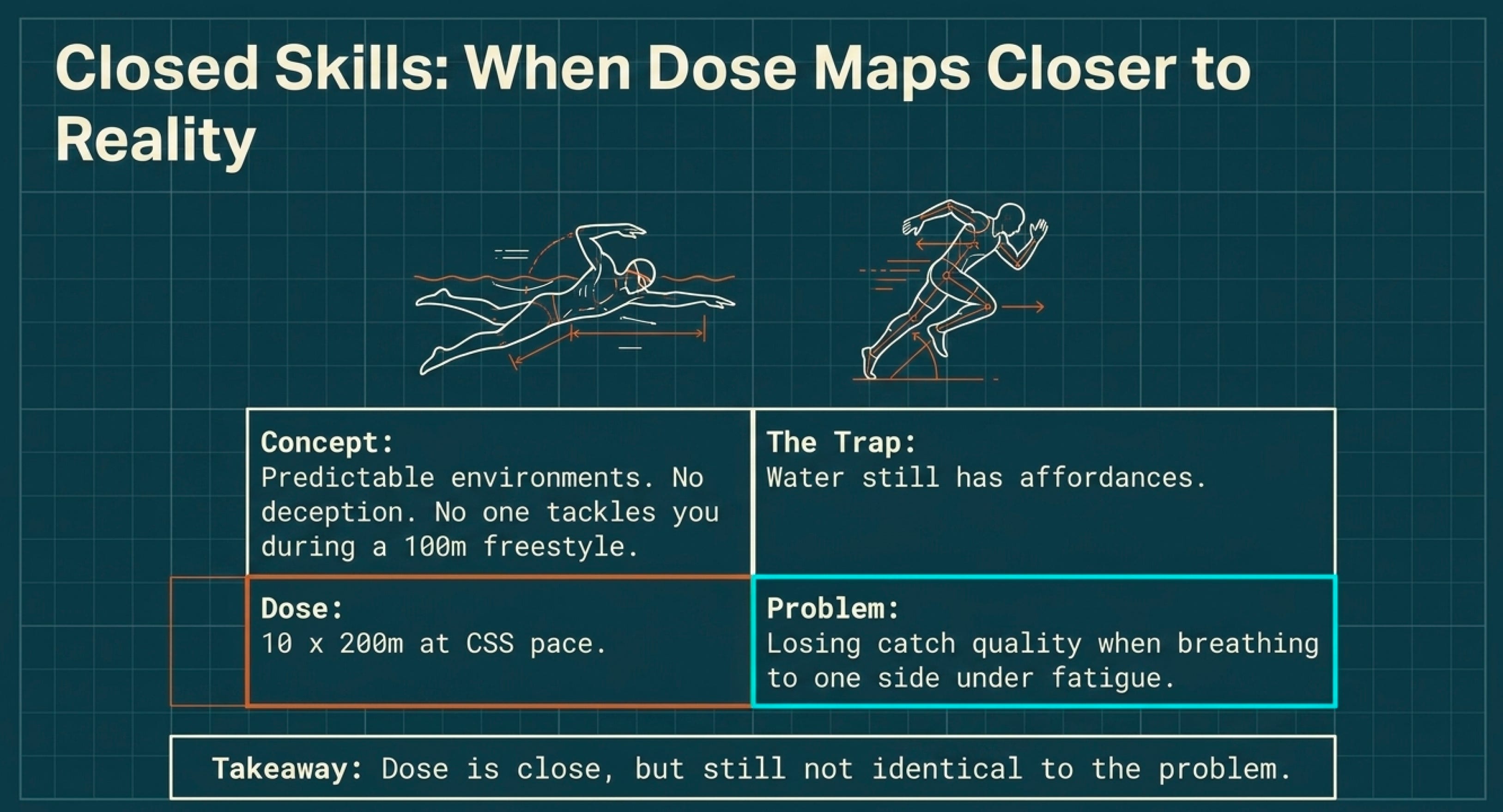
Philip: Let’s talk about open and closed skills. Because this matters. In a closed or unopposed skill, like swimming a 100-meter freestyle, sprinting, weightlifting, or a rowing erg test, the environment is more stable. There is no opponent trying to deceive you. The performance problem is still real, but it is more predictable.
Duncan: Yes. And that is why dose-based planning has more power there. If you are preparing a swimmer, the problems include start, breakout, stroke mechanics, pacing, turns, fatigue resistance, and race execution. But the world is not changing every second because another human is trying to manipulate your perception.
Philip: So in swimming, a coach can more reasonably say: “We need to develop aerobic base, race-pace tolerance, power, stroke efficiency, and lactate tolerance.” The dose maps more cleanly to the performance problem.
Duncan: More cleanly, but not perfectly. Andrew Sheaff’s Constraints-Led Approach to Swim Coaching is useful here because it reminds us that even swimming is not just physiology plus technique correction. The swimmer is solving movement problems in water. Water is an environment with affordances. Stroke mechanics emerge from the swimmer interacting with task and environmental constraints. If you only prescribe meters and intensities, you may miss the problem the swimmer is actually solving.
Philip: Give me a swimming example.
Duncan: A dose coach might say: “We need threshold work. Do 10 x 200 meters at CSS pace.” Fine. Useful. But a problem coach asks: “What is breaking down at threshold pace?” Maybe the swimmer loses catch quality when breathing to one side. Maybe stroke rate rises while distance per stroke collapses. Maybe the turn destroys rhythm. Maybe the swimmer can hit the split but cannot manage the transition from breakout to clean swimming. The dose is 10 x 200. The problem is what happens inside those 200s.
Philip: So in closed skills, dose might be closer to the problem, but it is still not identical to the problem.
Duncan: Exactly. In sprinting, “max velocity day” is a useful category. But the problem might be: the athlete cannot project out of acceleration without popping up; or they overstride at top speed; or they lose rhythm under pressure; or the hamstring history changes their willingness to attack the ground. If we only say “speed day,” we are naming the capacity, not the action problem.
Open skills: when the problem is alive
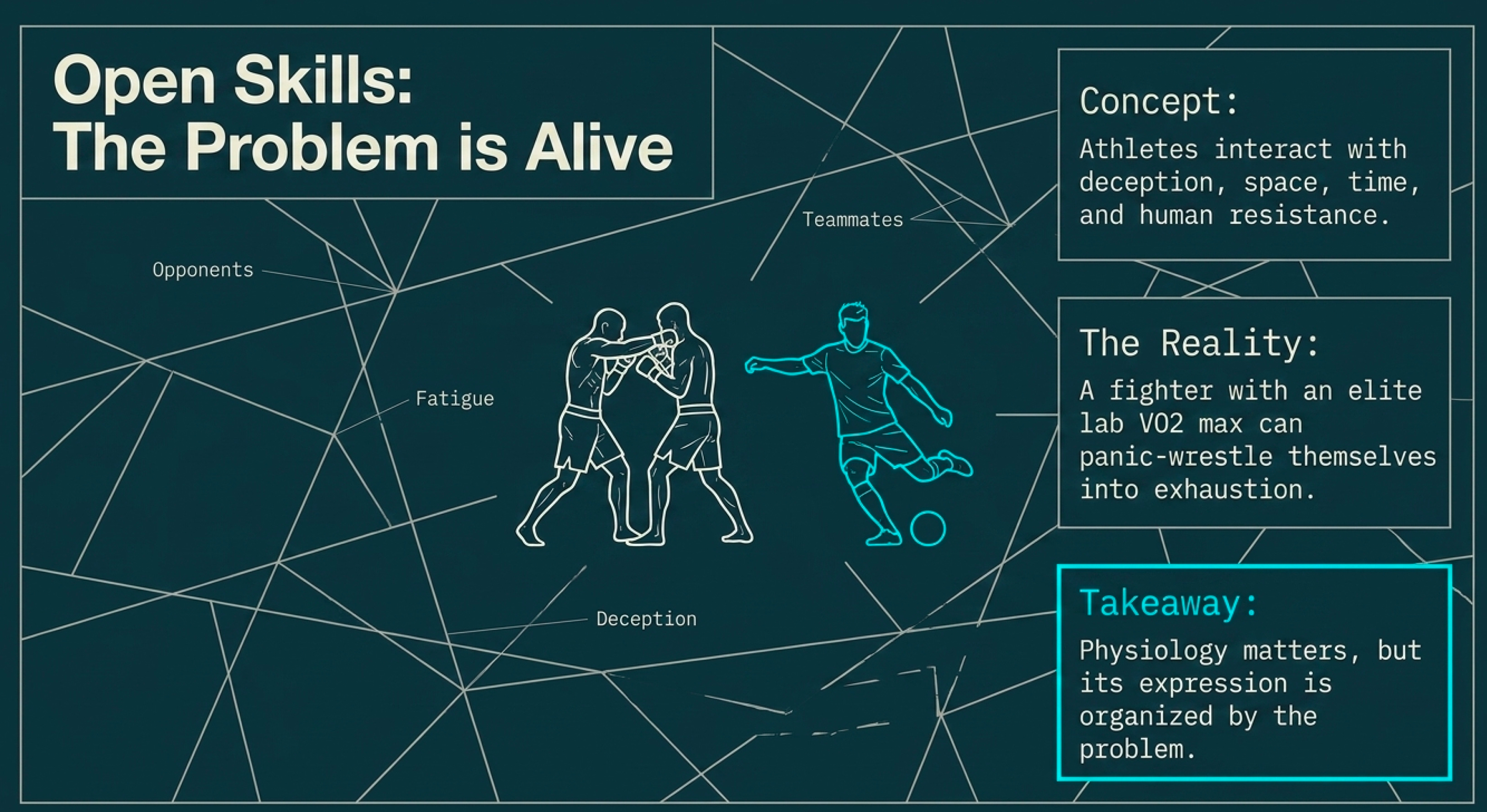
In open, opposed sports, the gap between dose and problem gets bigger.
MMA, boxing, football, basketball, rugby, tennis, judo, wrestling.
Here the athlete does not just execute a movement. The athlete interacts with opponents, teammates, space, time, rules, score, fatigue, emotion, and deception.
The problem is alive.
Duncan: In open, opposed sports, the gap gets bigger. MMA, boxing, football, basketball, rugby, tennis, judo, wrestling. Here the athlete does not just execute a movement. They interact with an opponent, teammates, space, time, rules, score, fatigue, emotion, and deception. The problem is alive.
Philip: Alive is a good word.
Duncan: In MMA, “conditioning” is not just VO2max, lactate, or repeat sprint ability. It is also whether the athlete can manage effort while hand-fighting, pummeling, defending takedowns, striking off breaks, and making decisions while tired. A fighter may test well on the bike and still panic-wrestle themselves into exhaustion. Another fighter may have average lab numbers but understand when to rest inside the clinch, when to frame, when to breathe, when to explode, and when to make the opponent carry weight.
Philip: That is tactical and technical economy.
Duncan: Yes. Form, not just substance. The physiology matters, but its expression is organized by the problem.
Philip: Let me defend the dose perspective again. Without dose, coaches drift into vibes. “Today we solved problems.” Great. What problem? How much exposure? How hard? How often? How did you progress it? How do you know if the athlete adapted? Did you fry them cognitively? Did you underdose the sprint exposure? Did you overload contacts? Did you actually train anything, or did you just create a chaotic session and call it ecological?
Duncan: That criticism is fair and necessary. Problem-first planning needs operational discipline. Otherwise it becomes poetry with cones.
Philip: I hate poetry with cones.
Duncan: Me too. The Constraints-Led Approach and ecological dynamics are not excuses for random chaos. In that framework, the coach designs constraints to invite functional movement solutions. The athlete explores. The behavior emerges from the interaction of performer, task, and environment. But the coach still needs intention, progression, observation, and feedback.
Ecological dynamics in plain English
Let’s pause again.
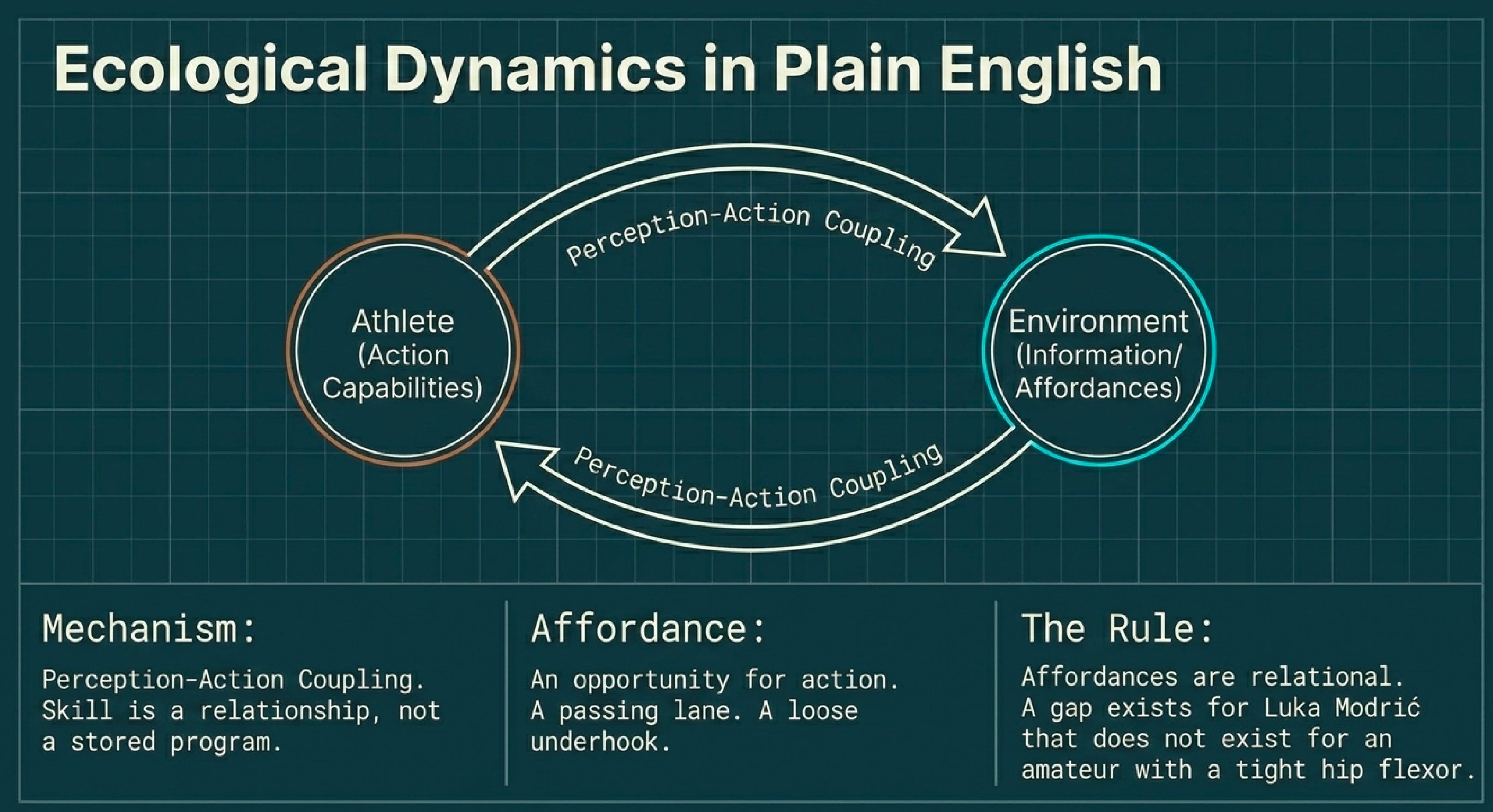
Ecological dynamics is a way of understanding skill as an athlete-environment relationship. Instead of thinking the athlete stores perfect movement programs in the brain and then executes them, ecological dynamics emphasizes perception-action coupling.
The athlete perceives information in the environment and acts in relation to it.
Skill is not just producing the “correct movement.” Skill is becoming attuned to useful information and acting effectively under constraints.
An affordance is an opportunity for action. A gap affords penetration if you can reach it. A loose underhook affords a body lock if you can connect your hands and position your head. Open water affords a breathing opportunity if your stroke rhythm allows it.
The key part is that affordances are relational. They depend on the athlete’s action capabilities.
A passing lane that exists for Luka Modrić may not exist for me after two beers and a tight hip flexor.
Philip: So again, capacities matter.
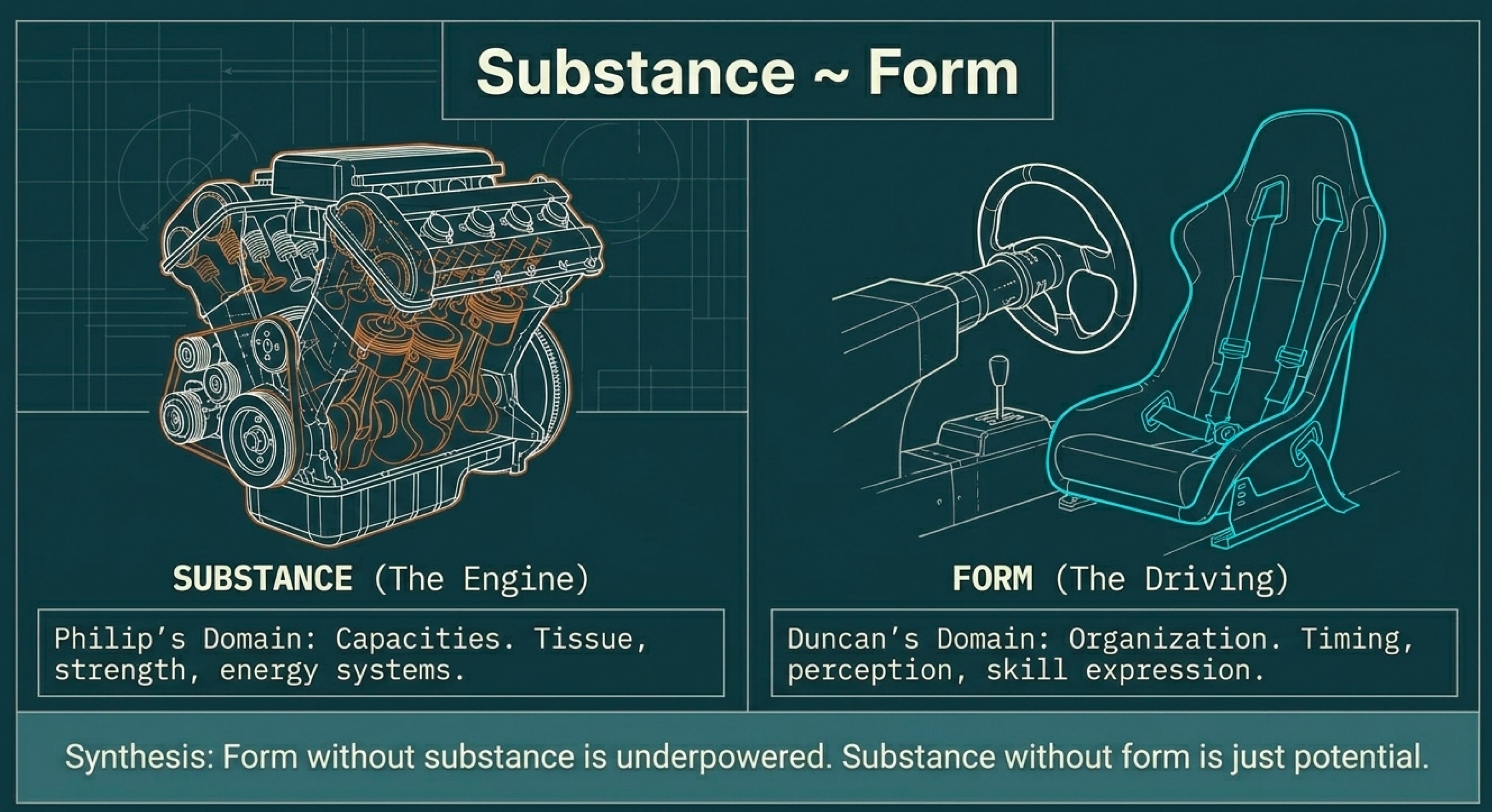
Duncan: Yes. This is why “problem versus dose” is not the final synthesis. The final synthesis is Substance ~ Form. Substance is the capacity: engine, tissue, strength, power, energy systems, range of motion. Form is the organization: timing, perception, decision, coordination, tactical use, skill expression. Traditional planning has been very good at substance. Ecological and problem-led approaches remind us that substance without form is just potential.
Philip: And form without substance?
Duncan: Often fragile, underpowered, or unavailable. Beautiful intentions with no horsepower.
Philip: That is probably the synthesis: horsepower and driving.
Duncan: Yes. But here is the historical imbalance. Coaches, sport scientists, and textbooks have spent decades getting very fluent in the language of dose. Sets, reps, zones, lactate, GPS, force plates, velocity loss, acute:chronic ratios, energy systems, biomotor abilities. We have many tools for describing the body as a Place of Things.
Philip: Place of Things?
Duncan: My phrase for the descriptive world, which I took from Jordan Peterson: metrics, categories, capacities, structures, mechanisms. It is where we describe what seems to be there. The Forum for Action is the lived coaching world: what should we do now, with this athlete, in this context, under these constraints? The trap is assuming that description automatically gives prescription.
Philip: The Is/Ought Gap.
Duncan: Exactly. “His aerobic capacity is low” does not automatically tell you what to do. “Her groin squeeze is down 15%” does not automatically tell you whether to rest, modify, retest, or ignore it. “The fighter fades in round three” does not automatically mean more intervals. Maybe it is pacing. Maybe it is anxiety. Maybe it is poor clinch efficiency. Maybe it is weight cut. Maybe it is tactical stupidity wearing a heart-rate monitor.
Philip: I know that athlete.
Duncan: We all do.
Thesis, antithesis, synthesis
At this point, the argument starts to become useful.
The goal is not to declare one coach the winner. The goal is to see what each coach protects us from.
The Dose Coach protects us from vague coaching theater.
The Problemming Coach protects us from sterile programming theater.
Both are needed.
But they are not equal starting points.
Philip: Let’s build the thesis, antithesis, and synthesis clearly.
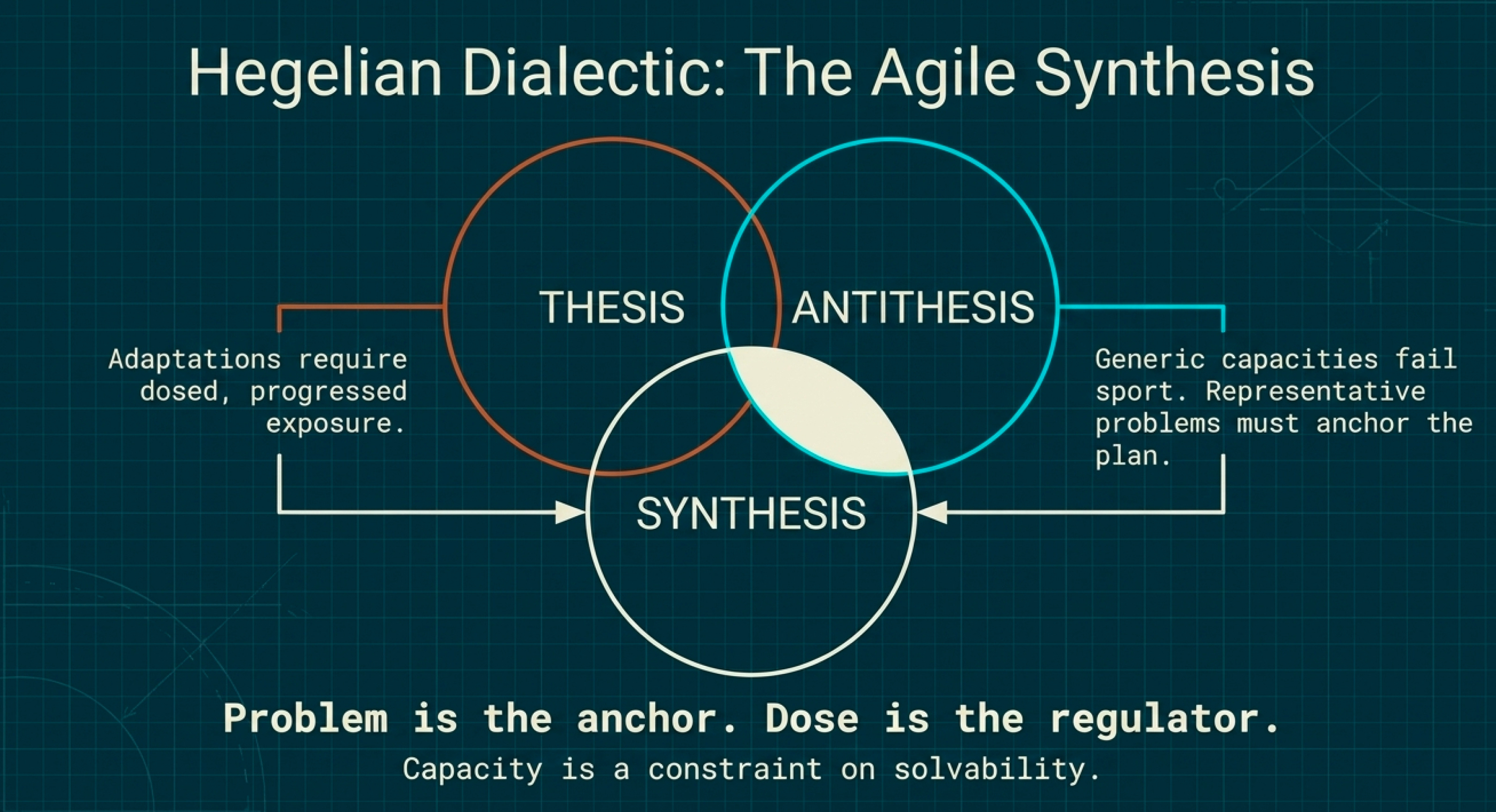
Duncan: Thesis: the dose coach says training must be planned around the adaptations we need. The athlete needs capacities. Capacities require exposure. Exposure must be dosed, sequenced, progressed, and monitored. Without dose, you cannot manage load, adaptation, or risk.
Philip: Correct. The antithesis?
Duncan: The problem coach says sport performance is not a shopping list of capacities. It is problem-solving under constraints. If you plan from generic capacities first, you risk creating athletes who are better at training but not better at solving the actual performance problems. The representative problem should anchor the plan.
Philip: And synthesis?
Duncan: Problem is the anchor. Dose is the regulator. Capacity is not the enemy. It is a constraint on solvability. But the reason we care about capacity is that it changes what problems the athlete can solve, how often they can solve them, under what fatigue, against what opponent, and with what margin for error.
Philip: That is good. But let me push one more time. Sometimes the problem is the capacity.
Duncan: Yes. In closed sports especially, or in return-to-play, or with clear physical bottlenecks, the capacity can be the primary problem for a while. If a sprinter cannot tolerate high-speed exposure, the problem is not tactical. If a swimmer cannot hold body position because of insufficient strength or mobility, that capacity limitation is part of the problem. If an MMA athlete’s neck gets destroyed in every wrestling exchange, neck strength and tissue tolerance are not optional.
Philip: So problem-first does not mean “everything must look like the game.”
Duncan: Exactly. That is another strawman we need to kill. Problem-first means we know why we are moving away from the game. Sometimes we decontextualize to protect the athlete, isolate a bottleneck, increase repetitions, reduce complexity, or target a mechanism. But we do not forget the return path. We do not build a temple around the isolated drill.
Philip: So a heavy bag punch-out can stay?
Duncan: Of course. I love a good punch-out. But now it has a job. Is it building local shoulder endurance? Psychological willingness to keep output? Trunk stiffness under fatigue? Breathing rhythm? Finishing behavior? Or are we just making the athlete tired because tired looks serious on Instagram?
Philip: You are going to lose followers with that line.
Duncan: Good. Via negativa.
What changes in practice?
Let’s bring this down from the clouds.
The question is not whether you should use physiology, biomechanics, load monitoring, or testing. You should. The question is whether these tools organize your thinking, or whether the performance problem organizes your thinking and the tools serve it.
That difference sounds subtle.
It is not.
Philip: Suppose I coach football. How would your problem-first lens change a week?
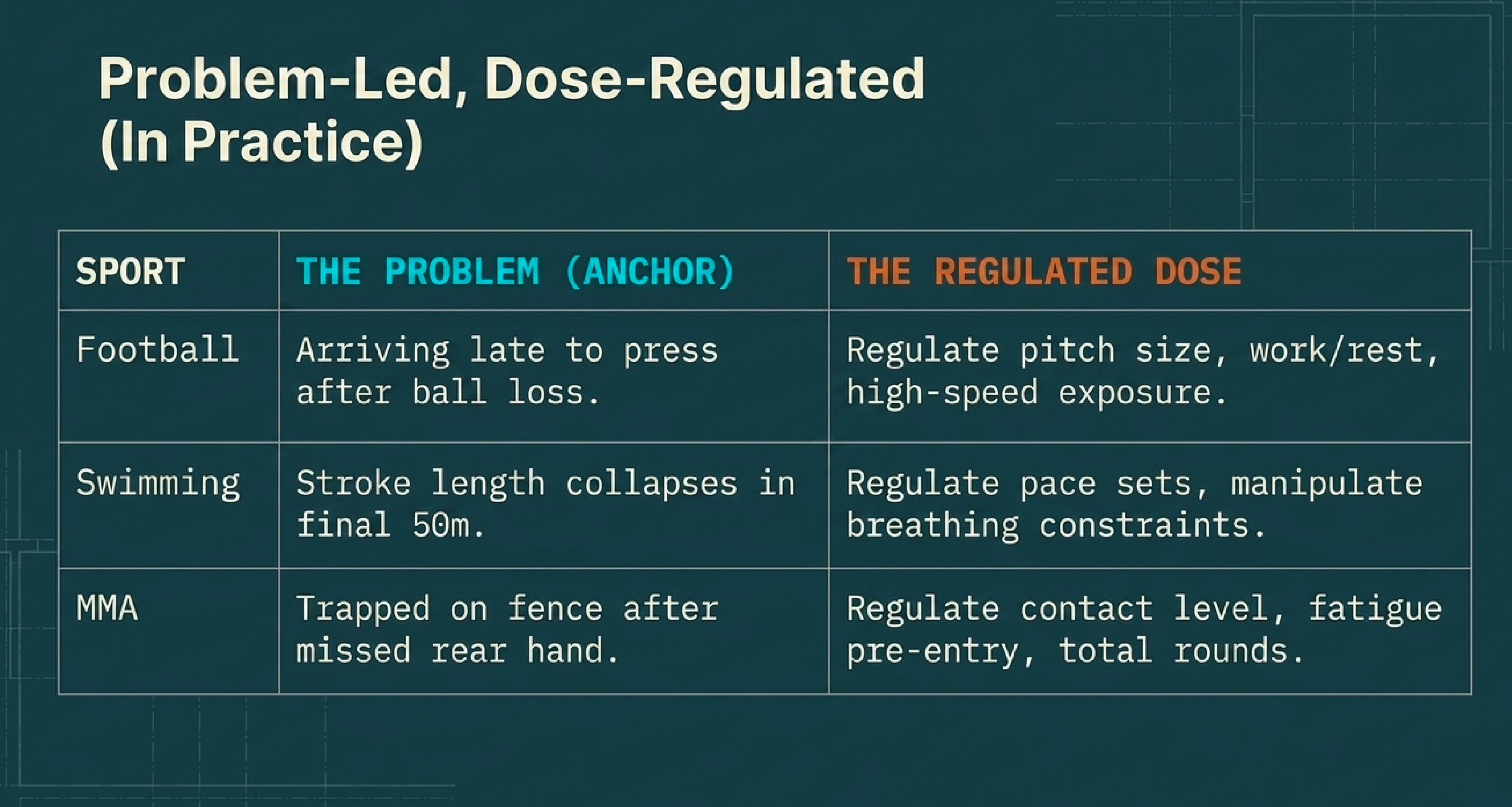
Duncan: Start with the game problem. Not “we need aerobic power,” but “we cannot press after losing the ball because our distances are too big and the first defender arrives late.” That is a tactical-performance problem with physical consequences. Now you design tasks that preserve the key information: ball loss, immediate pressure, nearby support, space behind, counter threat, time pressure. You can manipulate pitch size, numbers, restart rules, scoring incentives, and work-rest. Then you regulate dose: total duration, density, high-speed exposure, accelerations, player load, cognitive load, and recovery.
Philip: And if the session underdoses sprinting?
Duncan: Add sprint exposure. But add it because the problem and match demands require it, not because Thursday is “speed day” in the holy calendar.
Philip: Suppose I coach swimming.
Duncan: Start with the race problem. “The swimmer loses stroke length in the third 50 of the 200 freestyle.” That can be physiological, technical, perceptual, pacing-related, or psychological. You might use threshold sets, race-pace sets, resisted swimming, constraints on stroke count, breathing pattern manipulation, turn-focused repeats, or video feedback. But the anchor is the race problem: maintain effective propulsion and rhythm under fatigue. The dose is shaped around that.
Philip: Suppose I coach MMA.
Duncan: Start with the fight problem. “Our athlete gets trapped against the fence after missing the rear hand.” Now we can design striking-to-wrestling transition tasks. Start semi-live: rear hand entry, opponent pressures, athlete must angle, frame, underhook, or circle. Progress constraints: smaller space, more live counters, fatigue before entry, different opponent styles. Dose the rounds, intensity, contact level, and total exposures. Add physical work if the bottleneck appears: neck, grip, hip extension, repeat effort, trunk, or aerobic recovery. Again: problem as anchor, dose as regulator.
Why dose became king
There is a reason coaches plan with dose.
Dose is visible.
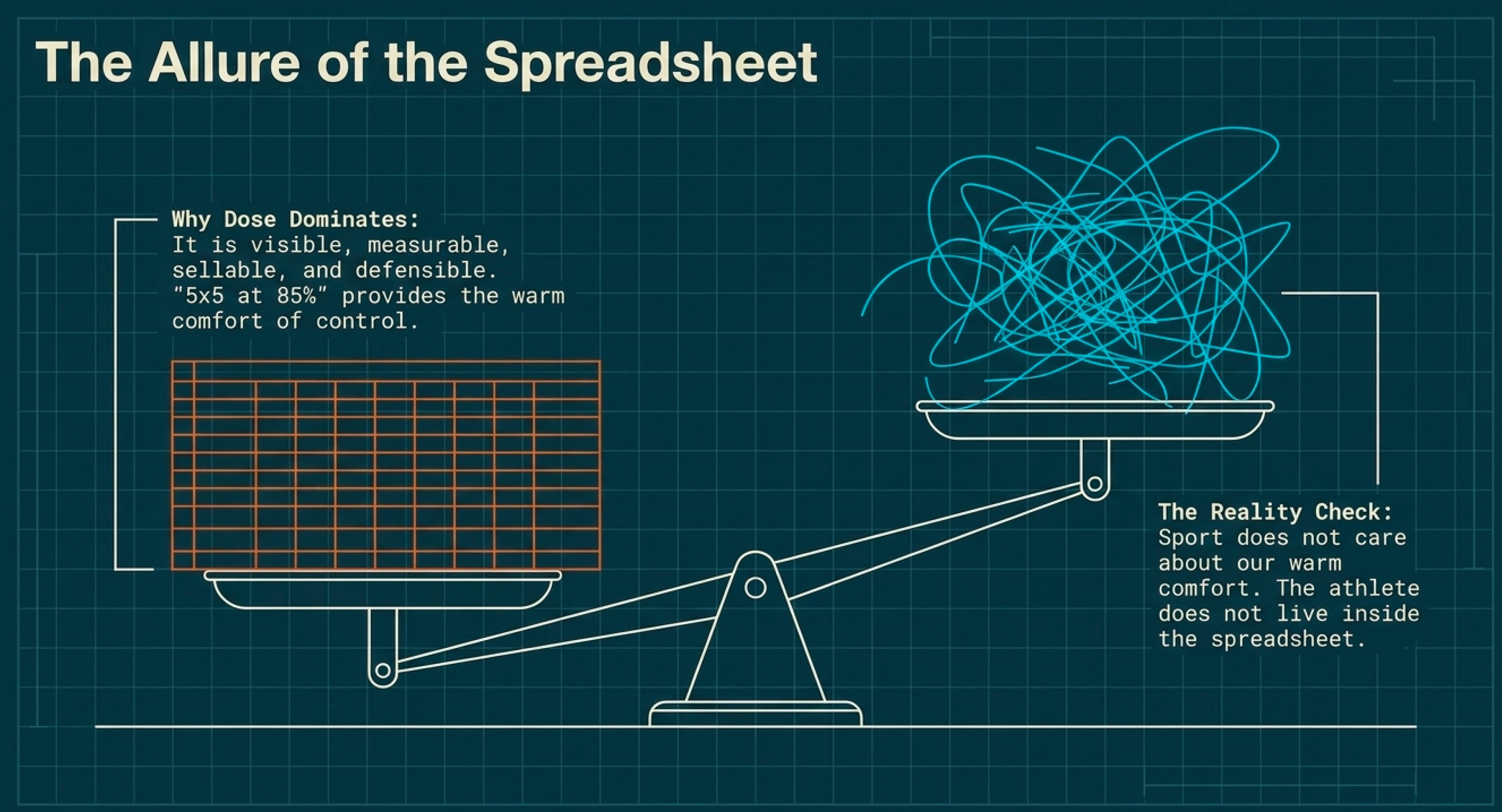
It is easier to write, easier to sell, easier to monitor, and easier to defend. “We did 5 x 5 at 85%” sounds more professional than “we explored exits after failed attacks.” A clean table creates the feeling of control. A beautiful microcycle gives everyone warm comfort.
The problem is that sport does not care about our warm comfort.
The athlete does not live inside the spreadsheet.
Philip: I want to defend old-school planning one last time. Coaches plan with dose because dose is visible. It is easier to write, easier to sell, easier to monitor, and easier to defend. “We did 5 x 5 at 85%” sounds more professional than “we explored exits after failed attacks.”
Duncan: That is the cultural reason dose dominates. Dose gives warm comfort. It creates the feeling of control. The spreadsheet is clean. The chart is clean. The athlete’s behavior is not clean.
Philip: And problem-first planning is harder to package.
Duncan: Yes. Problems require interpretation. You must watch the sport. You must understand the athlete. You must know what information matters. You must decide what to keep representative and what to simplify. You must tolerate ambiguity. This is coaching, not just programming.
Philip: But the dose coach is not useless.
Duncan: Not at all. The dose coach protects us from vague coaching theater. The problem coach protects us from sterile programming theater. We need both. But because the dose perspective has been dominant for so long, we need to pull the steering wheel toward the problem side for a while. Not to crash into the opposite ditch, but to get back to the road.
Philip: Balance in the universe?
Duncan: Exactly. A bit of Thanos for sport science.
The final synthesis
Classical periodization gave coaches a powerful language for organizing training dose and developing capacities. Tactical Periodization moved us closer to the game by placing the game model at the center. Ecological dynamics and the Constraints-Led Approach push us further by asking what problems athletes must solve and how practice environments invite functional solutions.
But we should not turn this into another tribal war.
Dose matters. Capacities matter. Adaptation matters. The problem is not dose itself. The problem is when dose becomes the default language of planning and the actual performance problem becomes an afterthought.
The future, at least in my opinion, is not dose versus problem.
It is problem-led, dose-regulated planning.
Start with the problem. Respect the dose. Watch what happens. Update the plan.
That is coaching.
Practical takeaway
Before you write the next session, ask yourself:
What problem does the athlete need to solve?
Under what constraints?
Against what opposition?
At what speed, fatigue, and consequence?
What capacities limit the solution?
What dose will expose, support, or protect the athlete?
What should I observe next?
That is the shift.
Not from science to vibes.
Not from physiology to philosophy.
But from dose as the king to dose as a servant of the problem.
And maybe, just maybe, that brings a little symmetry back to the coaching universe.
References
Afonso, J., Nikolaidis, P. T., Sousa, P., & Mesquita, I. (2017). Is empirical research on periodization trustworthy? A comprehensive review of conceptual and methodological issues. Journal of Sports Science & Medicine, 16(1), 27-34. DOI not located.
Bompa, T. O., & Buzzichelli, C. (2019). Periodization: Theory and methodology of training (6th ed.). Human Kinetics. DOI not located.
Chow, J. Y., Davids, K., Button, C., & Renshaw, I. (2016). Nonlinear pedagogy in skill acquisition: An introduction. Routledge. DOI not located.
Davids, K., Button, C., & Bennett, S. (2008). Dynamics of skill acquisition: A constraints-led approach. Human Kinetics. DOI not located.
Farrow, D., & Robertson, S. (2017). Development of a skill acquisition periodisation framework for high-performance sport. Sports Medicine, 47, 1043-1054. https://doi.org/10.1007/s40279-016-0646-2
Kiely, J. (2018). Periodization theory: Confronting an inconvenient truth. Sports Medicine, 48, 753-764. https://doi.org/10.1007/s40279-017-0823-y
Newell, K. M. (1986). Constraints on the development of coordination. In M. G. Wade & H. T. A. Whiting (Eds.), Motor development in children: Aspects of coordination and control (pp. 341-360). Martinus Nijhoff. DOI not located.
Otte, F. W., Millar, S. K., & Klatt, S. (2019). Skill training periodization in “specialist” sports coaching: An introduction of the “PoST” framework for skill development. Frontiers in Sports and Active Living, 1, 61. https://doi.org/10.3389/fspor.2019.00061
Pinder, R. A., Davids, K., Renshaw, I., & Araújo, D. (2011). Representative learning design and functionality of research and practice in sport. Journal of Sports Sciences, 29(7), 741-748. https://doi.org/10.1080/02640414.2011.553186
Selye, H. (1950). Stress and the general adaptation syndrome. British Medical Journal, 1(4667), 1383-1392. https://doi.org/10.1136/bmj.1.4667.1383
Sheaff, A. (2023). A constraints-led approach to swim coaching. Routledge. DOI not located.

If you enjoyed this post, join me inside Agile Periodization Skool. Members get access to PDFs, books and book drafts, tools, courses, live Q&As, Agile Coffee, and deeper conversations about training, physiology, planning, and coaching practice with coaches, practitioners, and athletes who take this work seriously.
Agile Periodization Skool: https://www.skool.com/agileperiodization
Agile Periodization Website: https://agileperiodization.online/