

Training for Nothing
The atelic domain in the gym

Somewhere along the way, every workout got a job.
The squat must increase force. The jump must improve reactive strength. The easy run must build the aerobic base. The mobility drill must restore range. The walk must produce steps. The day off must improve readiness for tomorrow.
Nothing is allowed to simply be worth doing.
This is the default grammar of training:
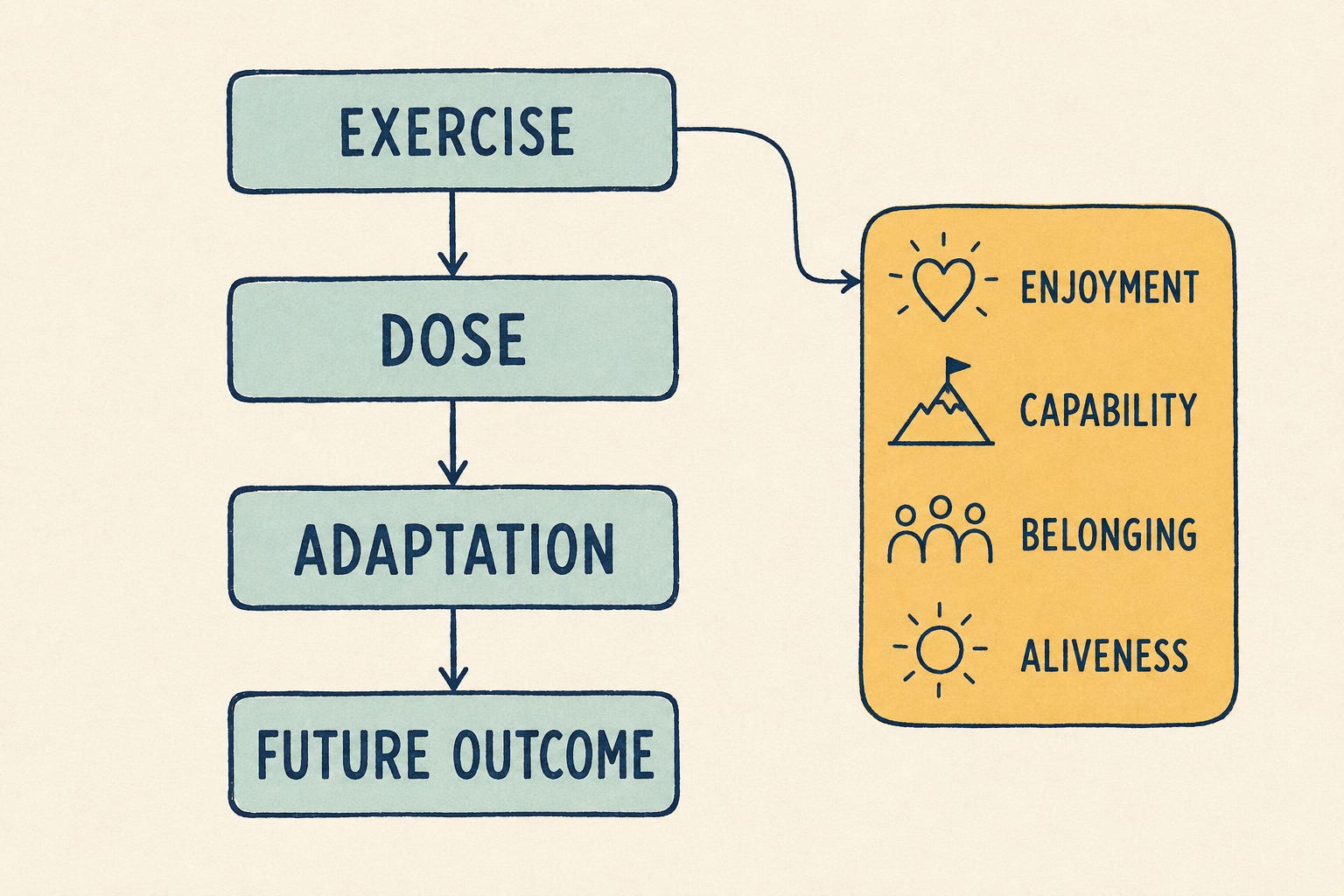
The solid arrows in Figure 1 are not wrong. If you coach athletes, they are part of the job. The problem begins when we pretend they are the whole job.
In Archetypes in the Gym, I argued that the same gym means different things to different people. In Domains in the Gym, I described performance, robustness, looks, and health/longevity as clusters of aspirations. I also threw fun, belonging, structure, ritual, community, and therapy-like grounding into the miscellaneous drawer called “other.”
I knew that drawer was doing too much work.
Oliver Burkeman’s Four Thousand Weeks gave me a useful label for what was hiding inside it. He describes a friend who can make running meaningful only by turning it into training for a future 10K. She cannot merely go for a run. He contrasts this with walking in the countryside, listening to music, or talking with friends—activities whose value is not postponed until some later result arrives.
Burkeman is joining a much older argument about leisure. Aristotle reversed our modern hierarchy and treated worthwhile leisure as an end for which work was a means. In The Decline of Pleasure, Walter Kerr described a culture that could barely read, socialize, or spend a weekend without making the activity useful. John Gray later asked what happens to play when everything must lead somewhere else. Different periods, different politics, same unpleasant suspicion: we have made instrumentality the admission price for using our own time.
The word is atelic.
Atelic comes from the Greek telos: an end, aim, or terminal point. This distinction matters because atelic training is not training without ideas, structure, or intelligence. It is activity that does not need a finish line to justify the time spent doing it.
This essay opens that “other” drawer. But it also makes the map slightly more annoying—which usually means more useful. The atelic cluster can be treated as another practical domain, yet it is not quite the same kind of domain as performance or health. Those domains mostly point toward a future state. Atelic value describes what the activity is while it is happening.
It is less another destination and more another layer of the map.
Domains in the Gym: Clusters of Aspirations

In the previous article, I wrote about archetypes. That was my attempt to answer the question of who is walking into the gym. A powerlifter, a bodybuilder, a team-sport athlete, a fighter, an endurance athlete, a rehab athlete, and a recreational client can all step into the same room and use the same equipment, but they are not there for the same reaso…
Telic, atelic, and the finish-line problem
The philosopher Kieran Setiya, whom Burkeman draws on, distinguishes between telic and atelic activities.
A telic activity aims at a terminal state:
run a 10K under 40 minutes;
add 20 kilograms to a squat;
regain a specified range of motion;
make the starting team;
complete a training block;
learn a particular movement solution.
The activity succeeds by helping to bring about its own ending. Once the target has been reached, that project is finished. Another one may immediately replace it—which is partly the problem.
An atelic activity has no terminal state that exhausts its value:
running;
lifting;
playing football;
hiking;
moving with friends;
practicing a craft;
being an athlete.
You can stop doing these things. You cannot finish them in the same sense that you can finish a 10K plan or a rehabilitation milestone.
This does not make the activity aimless. A hike has a route. A game has rules and a score. A lifting session has exercises, sets, and rest periods. An atelic activity can be difficult, effortful, competitive, and highly organized. The distinction concerns where its value comes from, not whether it has local structure.
Nor must we choose one category forever. The same run can be telic and atelic at different levels:
Training for Sunday’s 10K is telic.
Being a runner is atelic.
Today’s interval session may serve the first while still expressing the second.
Setiya’s argument is not that telic projects are bad. Writing a book, preparing for a competition, and helping an athlete return to sport all require them. His criticism is directed at excessive investment in telic activity—at letting projects dominate the relationship with everything we value. The mistake is not having finish lines. The mistake is living at one.
Sport makes this especially easy. There is always another competition, selection, benchmark, season, contract, or testing day. The future keeps offering the present a perfectly respectable reason to disappear.
Four distinctions we should stop mixing
Atelic is close to several familiar motivation concepts, but it is not a fancy synonym for any of them.
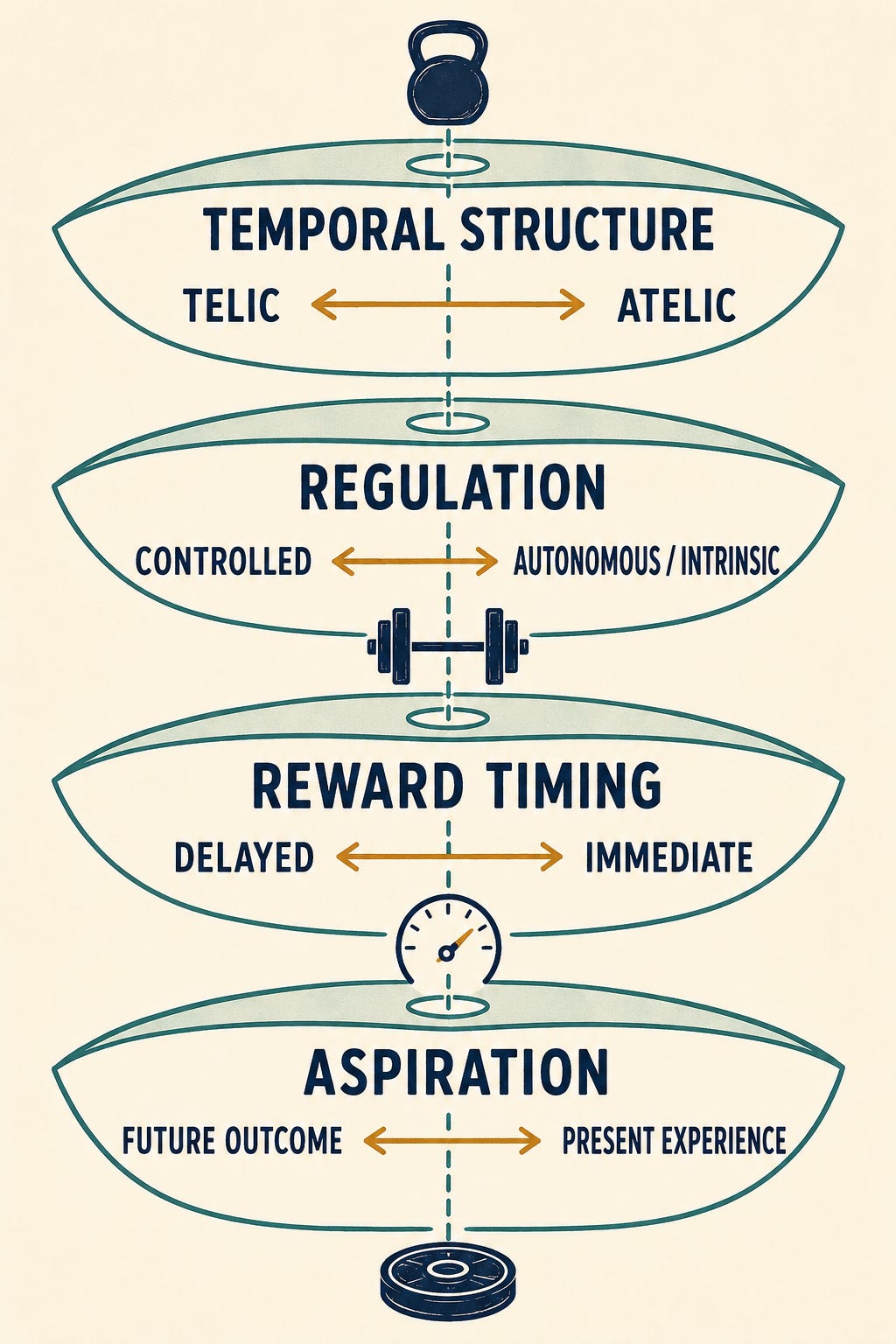
Figure 2 separates four questions that are usually mashed together:
Telic versus atelic describes the temporal structure of an activity: does it aim at a state that would complete it?
Controlled versus autonomous regulation describes why the person is acting: pressure, guilt, endorsement, interest, or enjoyment.
Delayed versus immediate reward describes when some value is experienced.
Training domain describes the aspiration being served: performance, robustness, looks, health, or experience in the present.
A telic goal can be autonomously chosen. An athlete may genuinely love the project of qualifying for a championship. An atelic activity can be controlled: someone may take a daily walk only because a watch, coach, or guilty conscience demands it. A session may have a delayed performance payoff and also be enjoyable now.
These constructs overlap. They are not interchangeable.
This distinction prevents two common bits of conceptual bullshit.
The first is treating atelic activity as lazy, easy, or unserious. Play can be brutally demanding. Hiking can be uncomfortable. Lifting can be enjoyable precisely because the load asks a clear question and the person answers it.
The second is assuming that enjoyment magically removes instrumental value. A run done for its own sake still produces a physiological dose. A playful small-sided game still changes perception, coordination, and conditioning. The effect may be real. It is simply not the activity’s admission ticket.
“Evidence-based” is not the enemy. Tunnel vision is.
The phrase evidence-based training sometimes behaves as if every exercise must present a passport at the border:
What variable do you target? What dose do you deliver? What adaptation do you expect? How does this transfer?
These are good questions. I ask them. You should probably ask them too.
But they privilege what can be connected to a future outcome. A workout that helps an athlete feel capable, autonomous, connected, or simply alive is harder to defend in a spreadsheet. So these values are demoted to soft benefits, adherence tricks, or pleasant noise around the “real” intervention.
This is not a necessary feature of science. Motivation research has been telling us for decades that people participate in physical activity for multiple reasons. The Motives for Physical Activity Measure–Revised, for example, distinguishes fitness, appearance, competence/challenge, social connection, and enjoyment. Self-determination theory further distinguishes controlled from more autonomous forms of motivation and emphasizes the experiences of autonomy, competence, and relatedness1.
So the evidence is not missing. The reduction often happens when evidence enters applied training culture. We retain the variable that looks most like a dose-response mechanism and drop the lived experience because it seems vague.
That is scientific tunnel vision, not science.
The Ten Commandments of Problemming

There comes a time in every coach’s life when he must climb the mountain, look into the clouds, receive revelation, and return to the village with a message that nobody asked for. This is that moment. I have descended from Mount Common Sense, carrying stone tablets, slightly dehydrated, probably under-recovered, and ready to annoy both traditional coach…
There is also good evidence that immediate rewards matter. In exercise settings, enjoyment and competence motives have been associated with better attendance and adherence. Across several goal-pursuit studies, Kaitlin Woolley and Ayelet Fishbach found that immediate rewards predicted persistence more strongly than delayed ones, and that making goal-directed activities more enjoyable could increase persistence.2
Useful. But watch the conceptual sleight of hand:
Enjoyment matters because it improves adherence.
We have just defended present value by converting it into a future training effect.
That may be strategically true. It is still incomplete. Defending music only because it makes people exercise longer is like defending friendship because it expands your professional network. The side effect may exist. It is not the whole value of the thing.
Enjoyment can improve adherence.
It does not need adherence’s permission.
The atelic cluster of aspirations
In my earlier domain map, performance, robustness, looks, and health/longevity mostly answered this question:
What do I want training to produce?
The atelic cluster asks a different one:
What makes this worth doing now?
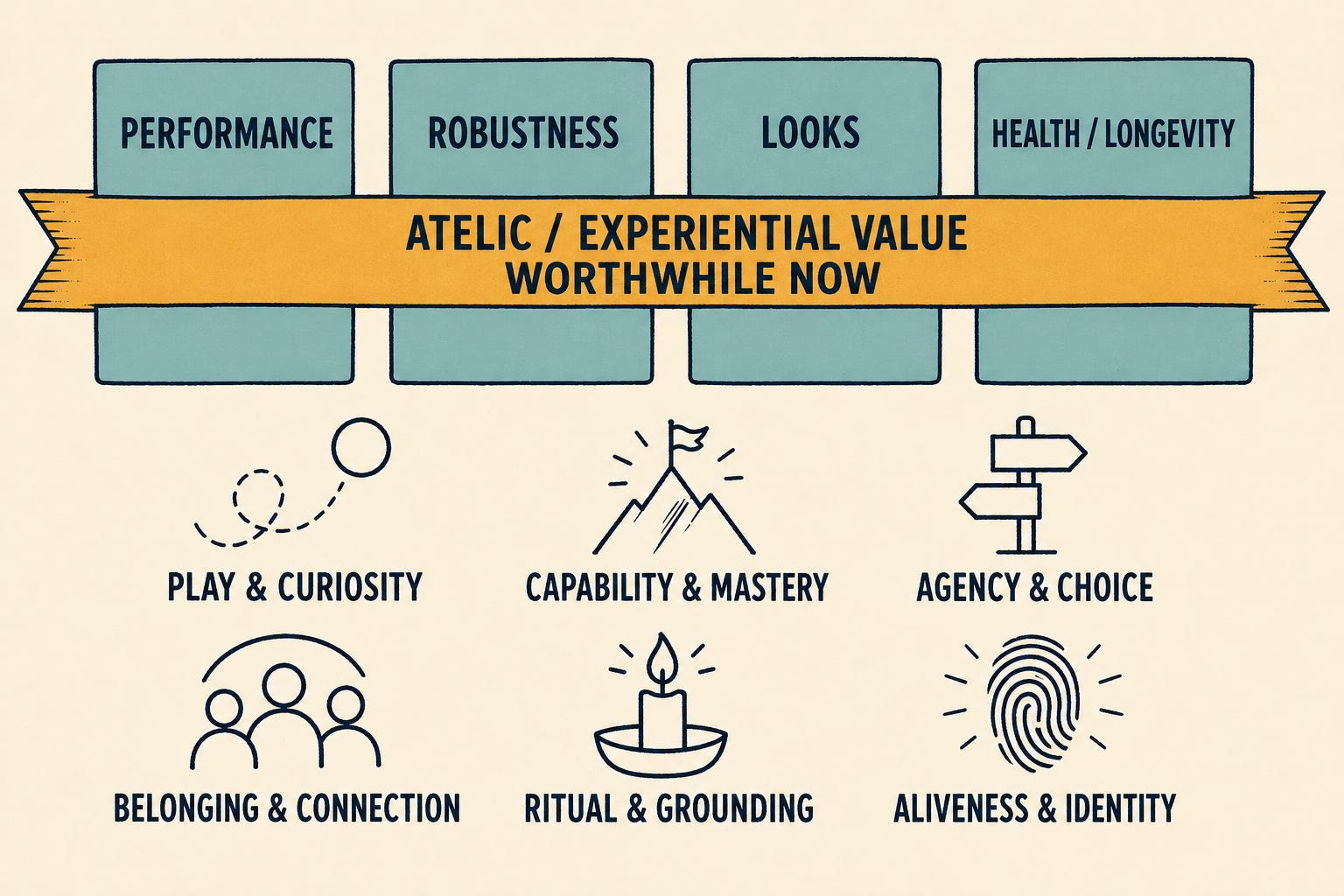
The cluster in Figure 3 contains at least six recurring aspirations:
Play and curiosity. I want to explore, improvise, and see what happens.
Capability and mastery. I want to experience myself as someone who can do difficult things—not merely own a future result.
Agency and choice. I want some authorship over how I move and train.
Belonging and connection. I want to share effort, ritual, jokes, and time with other people.
Ritual and grounding. I want a stable practice that gives shape to the week and brings attention back to the body.
Aliveness and identity. I want to feel like an athlete, lifter, runner, player, or simply a capable human being now.
These are not necessarily one psychological construct. I am not proposing an Atelic Factor that we should validate, norm, and place in an app by Friday. This is a practitioner’s cluster: a bundle of related aspirations that are often experienced together and routinely ignored together.
And because they are cross-cutting, the same session can serve one of the familiar domains while carrying very different present value.
Two people can perform the same exercise with the same external load. One experiences surveillance, compliance, and countdown. The other experiences competence, rhythm, ownership, and connection. On the spreadsheet, the prescription is identical. In human terms, it is not the same intervention.
Alchemy in the gym
This is where Rory Sutherland’s Alchemy becomes useful. Sutherland’s recurring point is that value is not exhausted by an engineering description of the product. Context, perception, expectation, and meaning can change the value people experience even when the physical object barely changes. His TED talk on perceived value makes the point more directly: changing perception can create value rather than merely fake it.3
Training people occasionally treat this as heresy. Steel is steel. Load is load. Work is work.
Yes. And a restaurant meal is macronutrients.
The mechanical description is real. It is not complete.

A coach can change the experienced value of a session through:
meaningful choice between roughly equivalent options;
music, rhythm, and the social arrangement of the room;
visible progress without turning every action into a test;
a session arc that feels coherent rather than randomly assembled;
rituals that mark entry into and exit from training;
opportunities to help, watch, teach, and be taught;
language that emphasizes capability rather than permanent deficiency.
None of this violates physiology. It changes the product the person is actually consuming.
It can also change the physical intervention indirectly. Experience affects attention, effort, persistence, communication, and willingness to return. The prescribed dose and delivered dose are not always the same. But even if the physical dose remained identical, the experiential value would still count.
This does not give us permission to rescue a stupid program with neon lights and a playlist. Psychological value is not frosting applied to poor training. Nor should “fun” become a covert manipulation for squeezing more work from people. If enjoyment matters only because it helps us capture another dose, we have repeated the same instrumental logic with better marketing.
The harder claim is simpler:
The lived experience of training is part of its value, not merely a delivery system for adaptation.
A two-ledger view of training value
Instead of forcing every session onto one scale, keep two ledgers:
Future payoff: What might this activity change later?
Present value: What makes the activity worthwhile while it is happening?
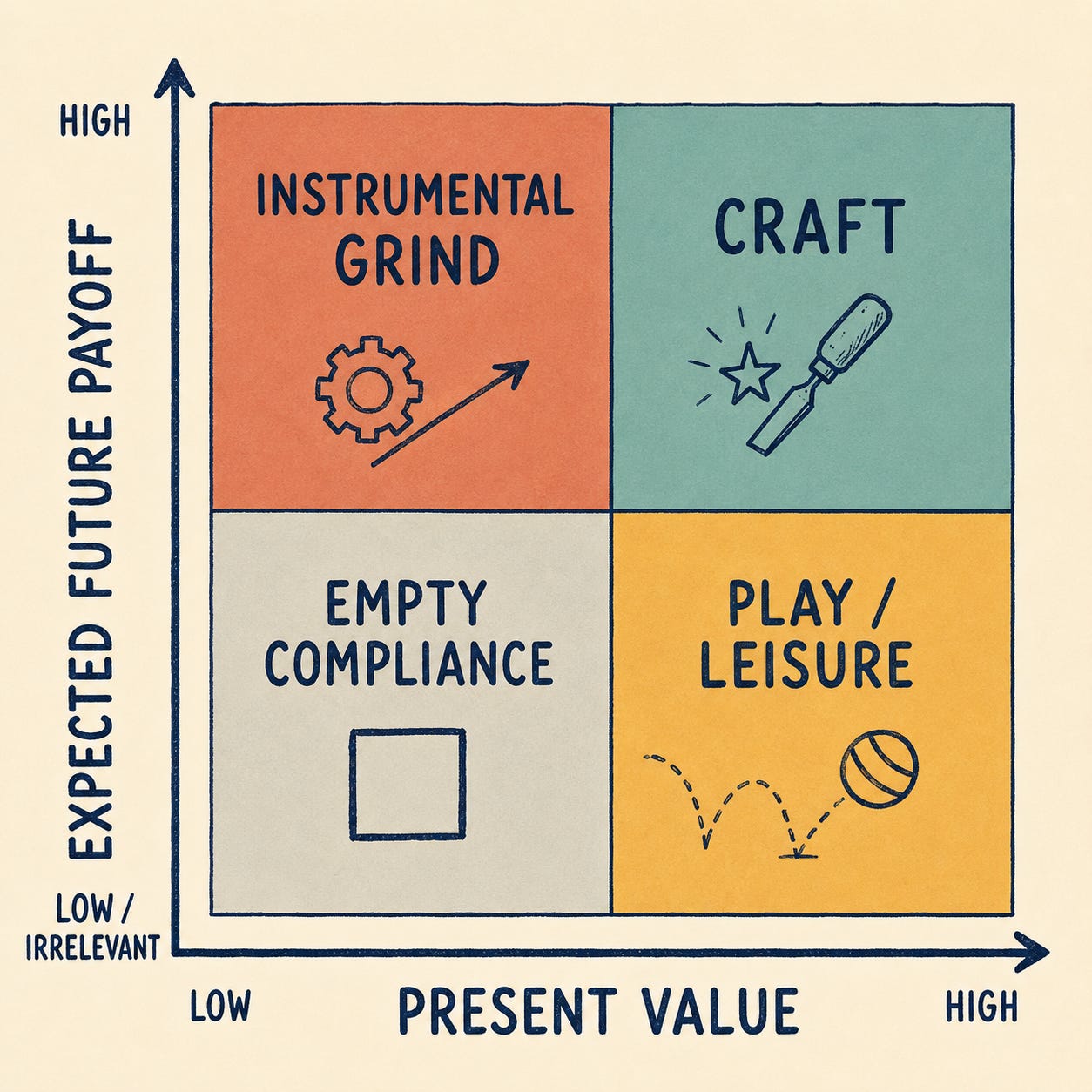
Figure 4 is not a moral ranking.
Instrumental grind is sometimes necessary. Rehabilitation has tedious parts. Technical change can require constrained repetition. Peaking for a competition involves work that would be absurd as a permanent lifestyle. The problem is not visiting this quadrant. The problem is renting an apartment there.
Craft combines future direction with present absorption, interest, or meaning. This is often the sweet spot: the athlete works toward something and finds value in the work itself.
Play and leisure may produce useful second-order effects, but the future payoff is not the reason they must be defended. This quadrant is legitimate even if the measured adaptation is small, uncertain, or zero.
Empty compliance has neither compelling present value nor credible future payoff. We retain a surprising amount of it because it looks serious.
The matrix also exposes a coaching mistake: assuming everything must sit in the top-right corner. Not every hard session can be delightful. Not every playful activity needs to transfer. Trying to optimize every experience for every outcome is how we turn life back into project management.
Bus benches, park benches, and two gears
It turns out I have already been writing around Burkeman’s distinction. I just used barbells and benches rather than philosophy vocabulary.
Dan John popularized the Bus Bench~Park Bench distinction in training.4
On a bus bench, you expect a particular bus, going to a particular destination, at a particular time. Applied to training, this means a clearly bounded phase with a priority, a timetable, and an expected result. You are trying to improve something specific, and you have accepted that the work will be judged partly by whether it does so.
On a park bench, there is no scheduled arrival. You sit, pay attention, and let the experience unfold. Applied to training, this does not mean doing nothing, avoiding effort, or wandering around the gym while updating Instagram. It means showing up and training without demanding that a particular adaptation arrive on the 14:35 bus.
In Strength Training Manual, I folded Dan John’s two benches into a broader Push~Pull model. The book uses Push the Ceiling~Pull the Floor. Push tries to force adaptation through a more aggressive progression. Pull adjusts progression to the athlete’s observed rate of adaptation. Push goes deeper into the unknown and accepts more risk, cost, and recovery. Pull expands the known territory more slowly while keeping a route back home.
I later used Raise the Floor~Push the Ceiling, and more recently Cruising~Blasting, as plainer shorthand for the same planning tension.
Cruising is the default gear. It slow-cooks qualities, accumulates repeatable exposures, preserves options, and keeps the athlete in the game. The dose is conservative enough to recover from and robust enough to survive imperfect weeks. Progression responds to feedback instead of treating the spreadsheet as a court order. You do not need to prove fitness at every session. You raise the floor beneath what the athlete can reliably do.
Blasting is a temporary campaign. You narrow the problem, choose a priority, accept more strain, and push for adaptation or realization. A pre-competition block for a strength specialist, a concentrated phase, or a short attack on a clear limitation can all be blasting. It has a reason, a timetable, a recovery bill, and—most importantly—an exit.
The manual already points toward the present argument: Push fixates more on the destination, while Pull gives more weight to process and the enjoyment of the journey. Burkeman makes me tighten that claim. A Pull/Cruise plan can still be defended only as the more sustainable route to later performance. That is clever programming, but it is still instrumental. The stronger claim is that the journey itself is one of the things the program should protect.
Most of the time, cruise. Occasionally, blast.
Do not blast every quality simultaneously unless your periodization model is based on panic.
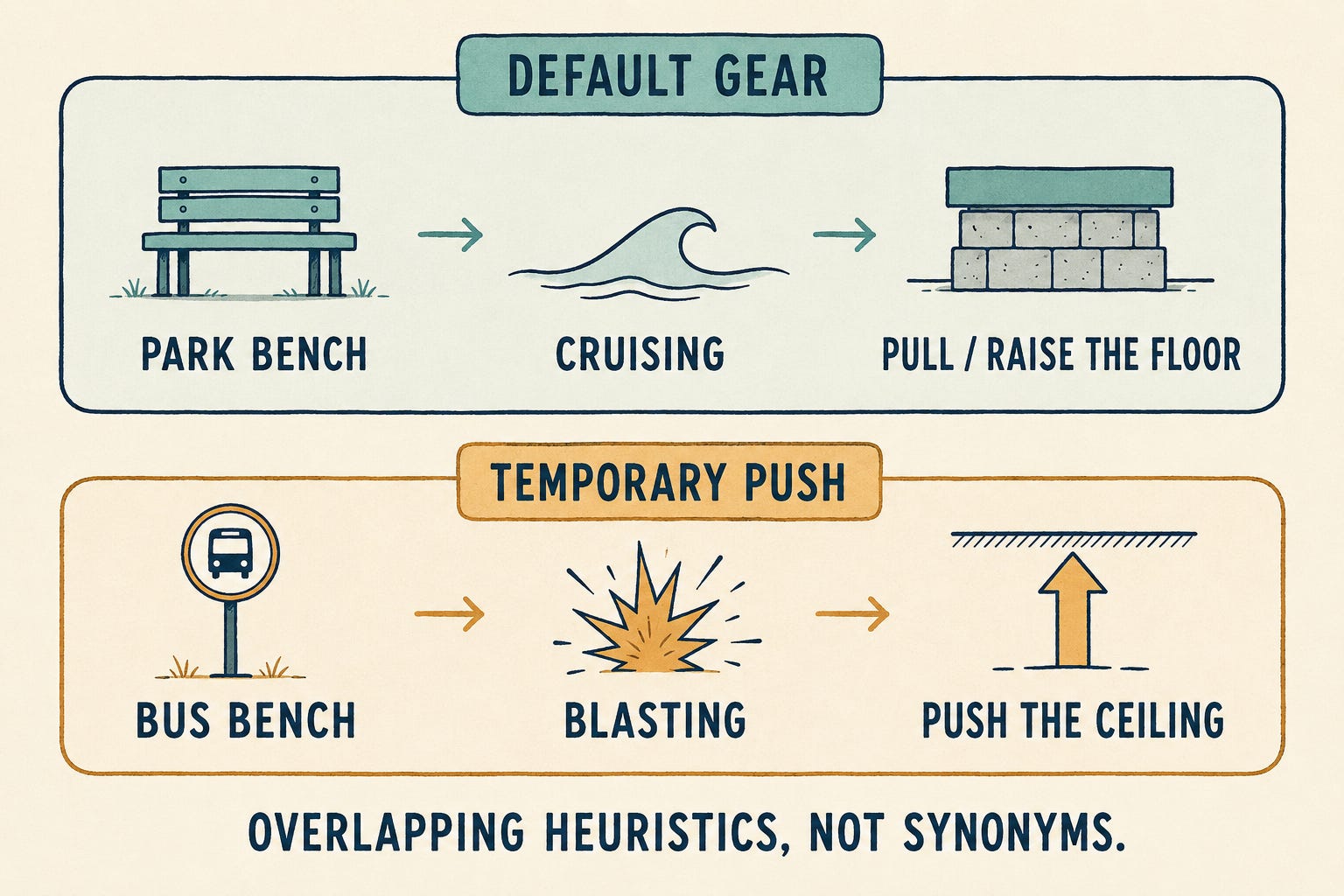
The alignment in Figure 5 is useful, but it is not an identity.
Bus Bench, blasting, and pushing the ceiling are strongly telic. They organize training around a future state and make the route more direct, concentrated, and time-sensitive.
Park Bench, cruising, and pulling or raising the floor are more continuous, process-oriented, and tolerant of uncertainty. They create better conditions for present value because the session does not have to keep auditioning for its place in the program.
But they can still be thoroughly instrumental. If I cruise only to accumulate work capacity, reduce variance, and prepare for the next blast, cruising remains a means to an end. If I raise the floor only because it eventually permits a higher ceiling, the floor is still working for the ceiling.
The atelic question cuts across both gears:
If the expected adaptation failed to appear, would this session still have contained anything worth doing?
A hard blast can have atelic value when the athlete loves the challenge, the craft, or the temporary experience of going all in. An easy cruise can be empty compliance performed by someone counting the minutes until release. Intensity does not decide the category. The athlete’s relationship to the activity does.
This also prevents a common category error in periodization. In the manual, I argued that most work for strength-generalists—team-sport athletes who use strength rather than compete in it—should live on the Park Bench/Pull side. Strength specialists have clearer reasons to use short Bus Bench/Push phases before competition. Both groups need both gears in different proportions. The problem begins when every week becomes a bus bench and every bus is supposedly the last one before greatness.
Park Bench work gives the training process somewhere to live between campaigns. Cruising builds continuity. Raising the floor makes performance less dependent on heroic days. Then, when there is a defensible reason, we blast one or two priorities and see what the athlete can realize.
The floor supports the ceiling. It should not spend its entire life staring upward.
Obliquity: when the result arrives sideways
John Kay’s Obliquity adds another distinction. In complex systems, important goals are often reached more effectively indirectly than by marching straight at the metric.
Kay separates high-level objectives, intermediate goals, and basic actions. In a simple and well-understood problem, we may be able to define the objective, specify the means, perform the action, and collect the result. Nice work if you can get it.
In the problems that matter most, the hierarchy is rarely so polite. High-level objectives are loose and multidimensional. Goals conflict. Other people react to what we do and why they think we are doing it. Our model of the system is incomplete. Most importantly, the means help us discover and revise the ends.
Obliquity is therefore a disciplined process of experiment, discovery, and successive adjustment. It is not aimless improvisation with an academic-sounding alibi.
I explicitly imported this distinction into Strength Training Manual. Table 2.1 (page 47 in Strength Training Manual) contrasts direct and oblique decision-making, and I linked the direct route to top-down planning and the oblique route to bottom-up planning. Agile Periodization still provides direction through release and phase planning, but the working program remains a provisional vehicle for learning. Act. Observe. Update. Do not confuse a plan with advance knowledge of the result.
Direct pursuit can also distort the behavior that produced the desirable outcome in the first place.
Chase a test score too aggressively and you start training the test.
Chase fatigue and the session becomes a competition in looking tired.
Chase technical perfection and the athlete stops exploring.
Chase recovery and a day off becomes another performance task.
Chase adherence and “fun” becomes a manipulation technique.
The oblique route begins with a direction and a provisional action. Train consistently. Try a workable dose. Solve an interesting movement problem. Play. Collect feedback. Revise the next step and, when necessary, revise the goal itself.
That process may be enjoyable and worthwhile in the present, but it does not have to be. An oblique program can still feel miserable. A direct task can still be satisfying. This is exactly why obliquity and atelic value need separate labels.
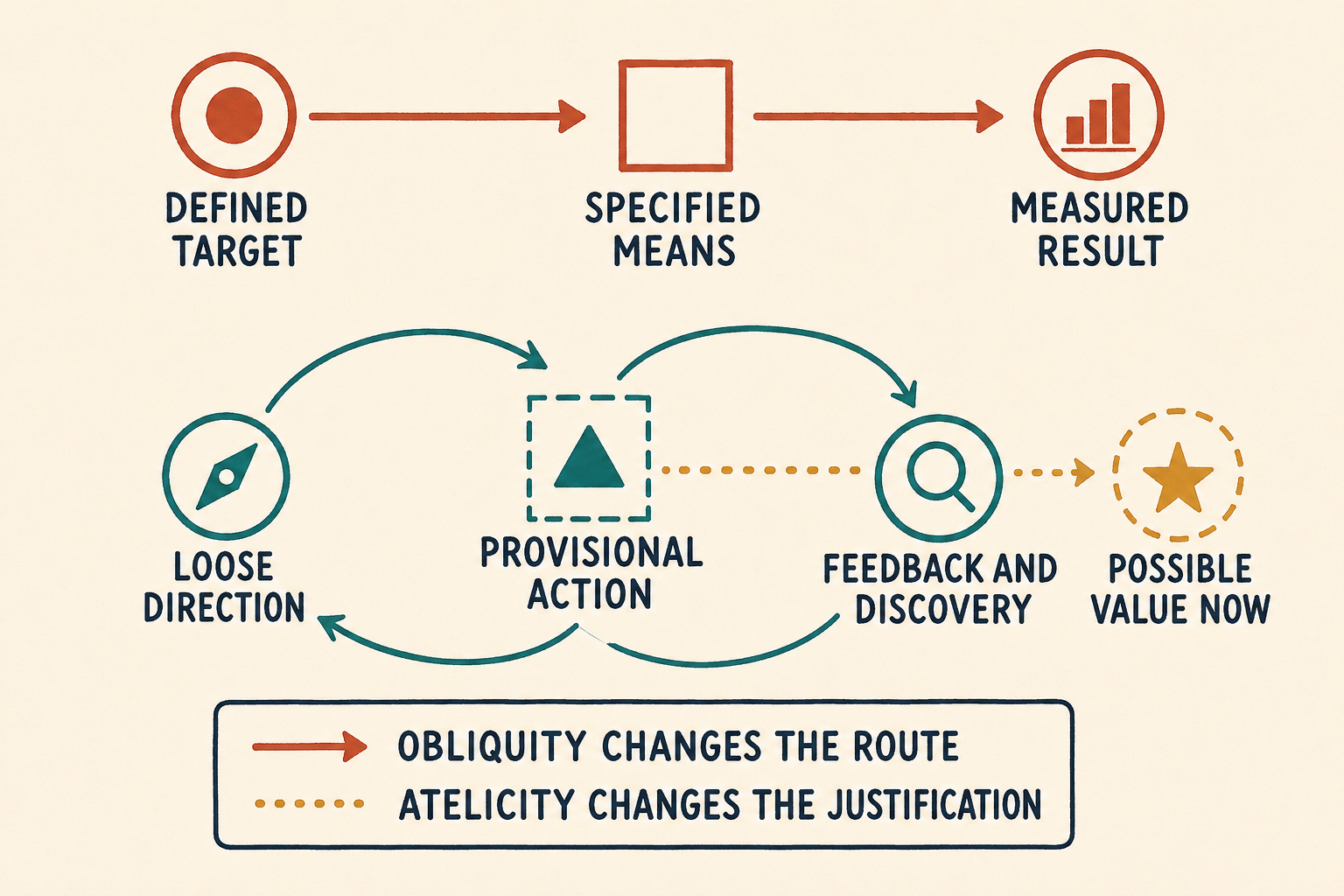
Figure 6 shows why oblique and atelic must not be treated as synonyms.
Kay does not argue that directness is always stupid. In the book’s concluding chapter, he reserves it for environments that are stable and for objectives that are transparent and sufficiently one-dimensional. If you know the problem and the relevant cause-and-effect structure, take the direct route. When the athlete, sport, calendar, and adaptation refuse to behave like a vending machine, iterate.
The conceptual stack becomes easier to manage if we keep three questions separate:
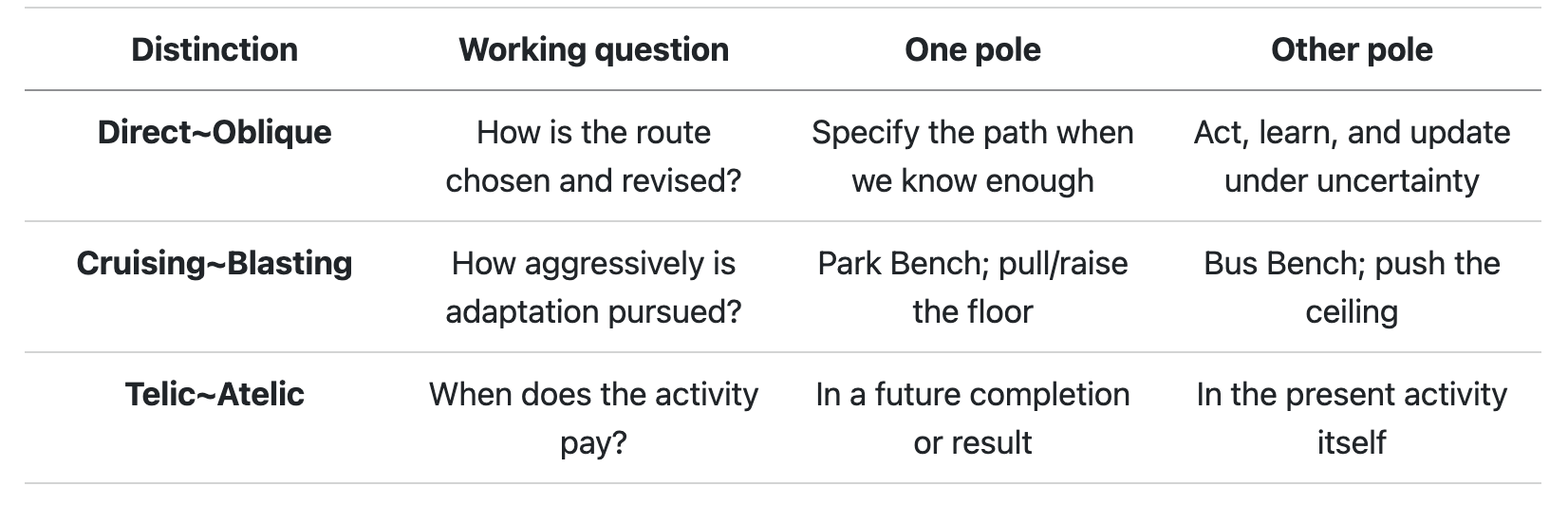
Table 1 is the antidote to collecting complementary pairs as if they were Pokémon.
Obliquity remains telic. The future outcome still matters; Kay is questioning the route toward it and showing how the route may reshape the goal. Atelic value makes the stronger claim that the activity can be worthwhile now, whether or not the outcome ever arrives.
Put more bluntly:
Obliquity says the shortest route to an outcome may not be the most effective. Atelicity says the route can still be worth walking even if the outcome never arrives.
This distinction matters because instrumentalism is very good at eating its critics.
We tell athletes to play because play improves skill. We tell them to enjoy training because enjoyment improves adherence. We tell them to rest because rest improves readiness. We tell them to cruise because cruising prepares the next blast. Each statement may be empirically defensible. Collectively, they turn play, enjoyment, rest, and cruising back into employees of future performance.
Sometimes the best way to push the ceiling is to spend a long time raising the floor without staring at the ceiling. That is obliquity.
Sometimes raising the floor is simply a satisfying way to train, even if the ceiling refuses to move. That is atelic value.
We need both ideas. The first makes planning less naive. The second keeps planning from annexing the whole activity.
Deliberate practice and playful practice
Skill acquisition offers the cleanest sporting example.
The classic concept of deliberate practice is telic by design. Practice tasks are selected to improve performance. They target a gap, demand attention, involve repetition or adjustment, and use feedback to move the performer toward a better solution5.
Deliberate play, in the sport-development literature, was positioned differently: informal, player-led, flexible, and pursued for immediate enjoyment rather than for explicit improvement.6 Skill may improve as a second-order effect, but the game is not justified by a promise of later expertise.
That contrast is useful as a prototype. Reality, as usual, refuses to respect our boxes.
In a study of 208 competitive youth athletes, Arne Güllich and colleagues found high enjoyment in both coach-led practice and youth-led play. Motives for both were multidimensional, and effort and enjoyment were largely unrelated. Their conclusion was that the features of practice and play should be treated more as dimensions than as rigid categories.
Good. That is closer to what coaches actually see.
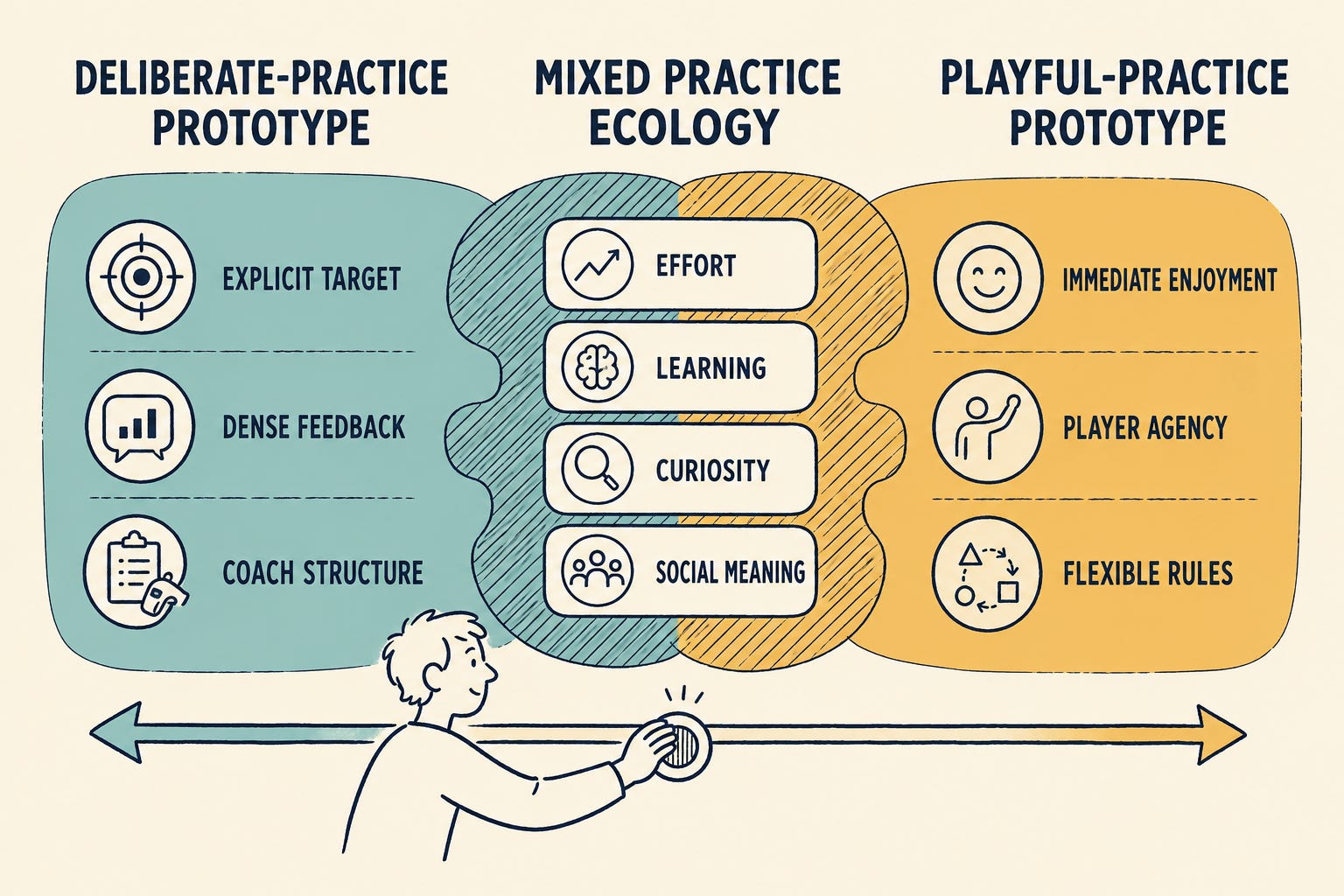
The practical mistake is to treat play as sugar sprinkled on the skill-acquisition vegetables.
The continuum in Figure 7 is deliberately porous. A tightly designed task can be enjoyable, and playful activity can produce serious learning. The point is to vary the dimensions consciously instead of assigning moral superiority to one label.
The coach designs a “fun” game, but secretly every element is optimized for scanning frequency, decision density, high-speed running, or representative information. The athletes may enjoy it, and the design may be excellent. Yet we should be honest: this is still a telic training task wearing a colorful hat.
Protected play is different. Participants have some authorship. Rules can bend. The activity is allowed to develop in ways the coach did not preselect. It may teach something. It may reveal something. It may simply be a good fifteen minutes.
This does not require abandoning deliberate practice. It requires a practice ecology containing both:
targeted work where improvement is explicit;
game-like work where improvement and enjoyment coexist;
protected play that is not hijacked by hidden conditioning targets;
occasional exploration where the athlete can search for solutions without every attempt being corrected.
The useful coaching variables are not practice or play? but:
How explicit is the improvement target?
Who controls the task and its rules?
How dense is the feedback?
How much exploration is permitted?
Is immediate enjoyment incidental, designed, or the point?
Sometimes the session needs to be a lesson. Sometimes it should be a laboratory. Sometimes people should just play the bloody game.
When recovery becomes another job
Recovery is where instrumental thinking performs its best magic trick: it turns not-training into more training.
The athlete finishes the session and begins a second shift:
complete the recovery protocol;
hit the mobility target;
close the activity ring;
improve the sleep score;
perform the breathing drill;
prepare tomorrow’s meals;
consume “educational” content while doing all of the above.
Then we call this downtime.
To be clear, sport requires recovery. The consensus literature describes recovery as a multifaceted process, and the balance between stress and recovery matters for performance and health.7 Sleep, nutrition, load management, and sensible restoration are not capitalist propaganda. They are part of training.
But that is precisely the point: recovery is still telic. It is justified by what it restores for the future.
Rest and leisure can be different. Burkeman traces how leisure was gradually demoted from something worth choosing for itself to replenishment for more work. Sport reproduces the same hierarchy whenever a day off is allowed only because it increases readiness for the next hard day.
Research on the psychology of rest in athletes gives this distinction some empirical texture. In a qualitative study of university field-hockey athletes and staff, David Eccles and Alexander Kazmier found that wakeful rest included experiences such as not thinking about sport, often supported by activities and environments outside the normal training context.8 That is not just lower physical load. It is detachment from the sporting project.
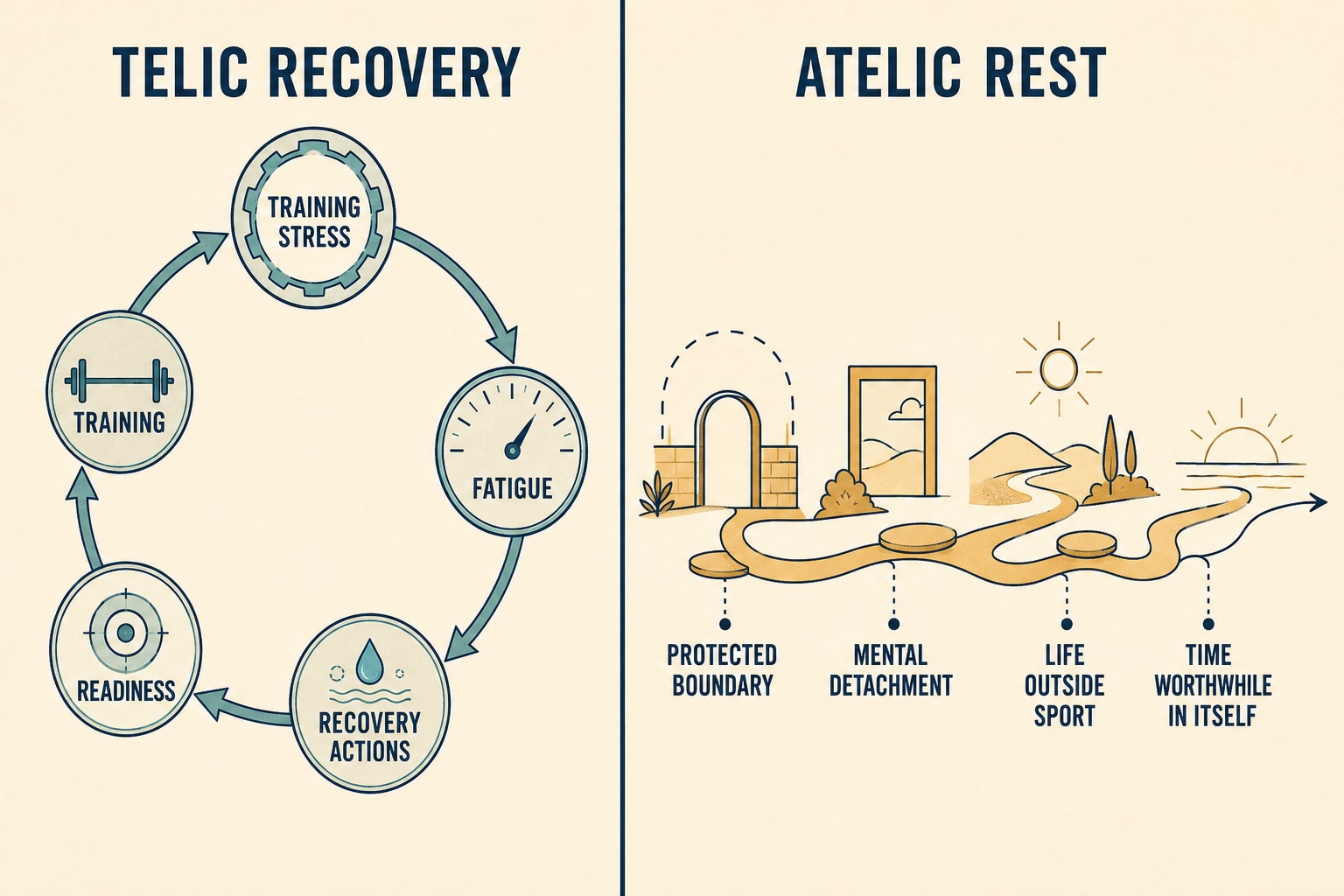
Figure 8 does not ask us to choose between recovery and rest. Athletes need both.
The distinction does ask us to stop labeling every recovery task as leisure. A deload is a training-load manipulation. A regeneration session is a session. A day filled with mandatory recovery modalities is not necessarily a day off, even if all the activities occur at low intensity.
This is where an unscored period becomes useful:
no requirement to produce steps;
no readiness test;
no mandatory mobility circuit;
no demand to watch sport, study sport, or think about sport;
no need to convert the time into self-improvement;
no requirement to enjoy it correctly.
Watching a movie can simply be watching a movie. A hike can be taken without turning it into zone 2 with better scenery. Music does not need to become an ergogenic aid. The moment may have useful after-effects, but it does not owe us any.
Paradoxically, such time may need structure. Drawing on Judith Shulevitz’s essay “Bring Back the Sabbath”, Burkeman makes the point that people do not always drift effortlessly from striving into genuine rest. Rules, habits, advance preparation, and a shared norm can protect the interruption.
Schedule the boundary. Do not optimize its contents.
Periodization is telic by design
Periodization is sport’s explicit version of time management. It converts a finite calendar into phases, blocks, sessions, and doses, each expected to earn its place by contributing to something later.
Periodization arranges present actions in relation to future demands. Competition provides a date. The plan works backward. Blocks, phases, and sessions become means.
This is not a criticism. It is almost a definition.
The Programming Pyramid also moves from broad human foundations toward sport- and athlete-specific decisions. That map helps decide what training should do. It does not tell us that every minute of the athlete’s life must become training material.
The danger is total periodization:
the offseason becomes a corrective block;
the holiday becomes an altitude opportunity;
leisure becomes active recovery;
a hobby becomes psychological skills training;
sleep becomes a score;
social life becomes either a recovery resource or a threat to readiness.
At that point, the athlete is never off the clock. The plan has eaten the person it was supposed to serve.
Atelic value should therefore enter planning in two ways.
First, as a design criterion inside training. A session can have a clear adaptation target while also supporting capability, agency, connection, and enjoyment. This is not guaranteed, but it can be considered.
Second, as a protected limit around training. Some periods should not be captured by the plan at all. They may include play, hobbies, relationships, wandering, or simple inactivity. Their contents are not prescribed. Their non-prescription is the feature.
This applies across time scales:
Within a session: bounded choice, exploratory repetitions, or an unscored segment.
Within a microcycle: a genuine day away from sport tasks, not merely a low-load checklist.
Within a longer block: space for playful practice and variation that does not require immediate transfer.
Within a transition period: enough detachment for the athlete to inhabit roles other than performer.
Across a career: an identity that contains sport without being fully consumed by it.
Do not ask me for the optimal percentage of atelic time. That would be impressively on-brand and completely miss the point.
A practical audit: two questions and one boundary
We do not need another readiness dashboard. We need a better conversation.
For each important session, ask:
What should this change later?
What could make it worthwhile today?
Then add a third question at the planning level:
What should remain unmeasured and unclaimed by the program?
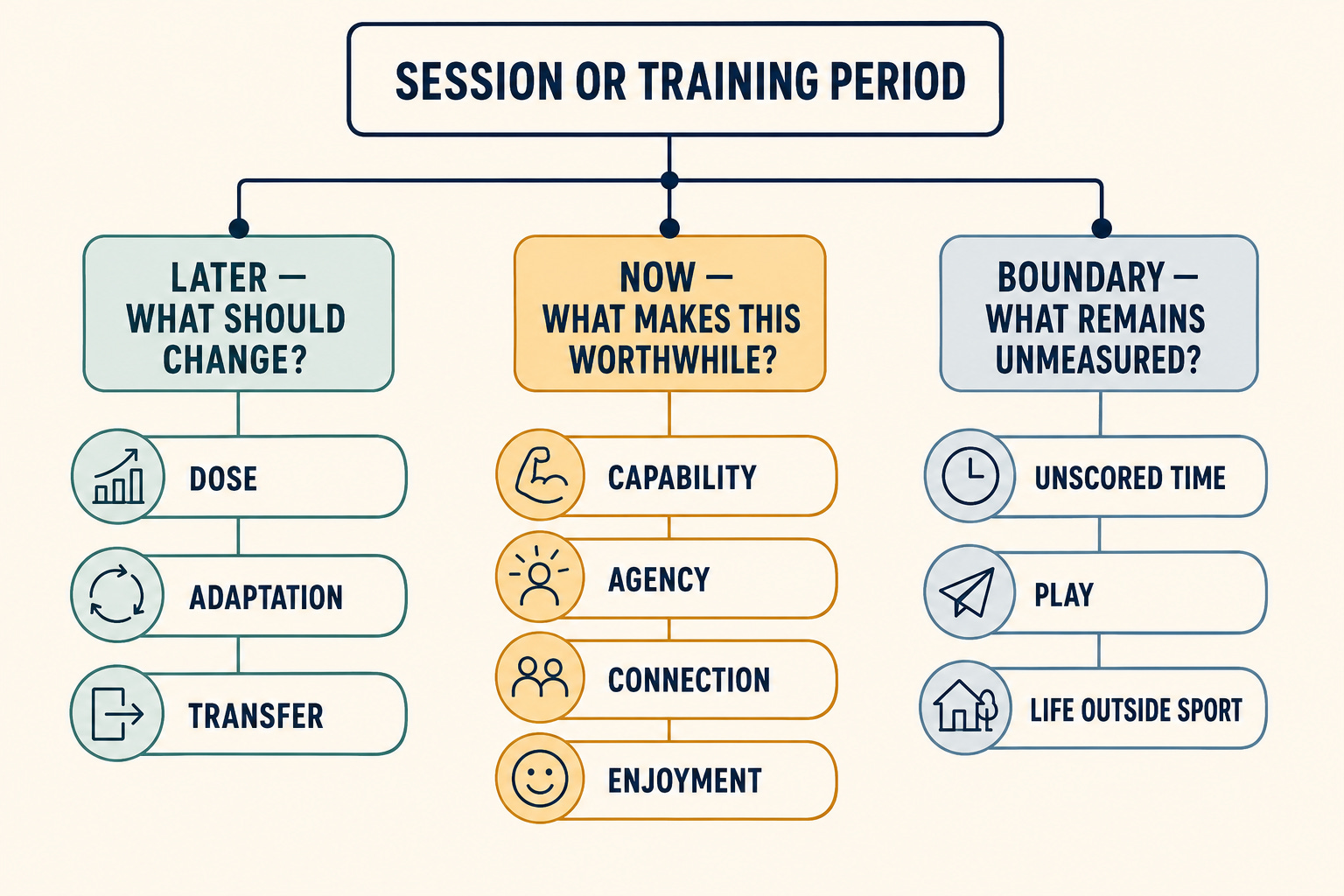
The first question protects training from becoming random entertainment. The second protects it from becoming technically sound and practically dead. The third protects the person from the appetite of the system.
The branches in Figure 9 should not be collapsed into one composite score. They are prompts for judgment and conversation, not the Atelic Readiness Index™.
Consider a standard gym session for a field-sport athlete. The primary work has a clear performance rationale. The coach retains the exercises and loading that matter. But the athlete chooses between two roughly equivalent accessory options, trains one section with a teammate, and finishes with a short movement block that is not scored or converted into a competition. The core dose survives. The athlete also gets authorship, connection, and a chance to move without auditioning for the spreadsheet.
That is not a revolution. It is a better product.
Now consider the opposite case. A technically demanding session must remain tightly controlled because the timing, feedback, or risk requires it. Fine. Do not fake playfulness. Explain the purpose, do the work, and avoid pretending that every session must be entertaining.
The aim is not permanent fun. The aim is a training ecology in which the present is not always sacrificed to the future.
Useful warning signs include:
“fun” is mentioned only as a way to improve adherence;
every game hides a conditioning or skill KPI;
every day off contains a recovery checklist;
every hobby is praised for helping performance;
every session is judged mainly by fatigue, load, or future transfer;
the athlete cannot name anything training gives them now;
coaches become anxious when an activity has no measurable justification.
If all value must arrive later, later becomes an increasingly crowded place.
The run does not need an alibi
The 10K matters. A personal best can organize effort, sharpen commitment, and create a memorable test. Competition is one of sport’s great inventions.
But the finish line cannot carry the value of every step that precedes it.
If each run matters only because it prepares the next race, crossing the line merely creates a vacancy for another project. The runner must keep manufacturing future accomplishments to defend the time she spends running.
The atelic alternative does not abolish the race. It changes the relationship:
I am training for a 10K, and this run is already part of my life—not a down payment on it.
The same applies in the gym. We can train for performance, robustness, looks, and health. We can use dose, adaptation, transfer, and periodization. We should.
But we can also lift because lifting is a way of inhabiting capability. We can practice because solving movement problems is interesting. We can play because the game is worth playing. We can rest without turning rest into unpaid employment for tomorrow’s self.
The program should help build the future athlete without consuming the present person.
The finish line is useful.
It is a lousy place to live.

If you enjoyed this post, join me inside Agile Periodization Skool. Members get access to PDFs, books and book drafts, tools, courses, live Q&As, Agile Coffee, and deeper conversations about training, physiology, planning, and coaching practice with coaches, practitioners, and athletes who take this work seriously.
Agile Periodization Skool: https://www.skool.com/agileperiodization
Agile Periodization Website: https://agileperiodization.online/
References and further reading
Aristotle. Politics, Book VIII.
Balk, Y. A., de Jonge, J., Oerlemans, W. G. M., & Geurts, S. A. E. (2019). Physical recovery, mental detachment and sleep as predictors of injury and mental energy. Journal of Health Psychology, 24(13), 1828–1838.
Burkeman, O. (2021). Four Thousand Weeks: Time Management for Mortals. Farrar, Straus and Giroux.
Côté, J., Lidor, R., & Hackfort, D. (2009). ISSP position stand: To sample or to specialize? International Journal of Sport and Exercise Psychology, 7(1), 7–17.
Eccles, D. W., & Kazmier, A. W. (2019). The psychology of rest in athletes: An empirical study and initial model. Psychology of Sport and Exercise, 44, 90–98.
Ericsson, K. A., Krampe, R. T., & Tesch-Römer, C. (1993). The role of deliberate practice in the acquisition of expert performance. Psychological Review, 100(3), 363–406.
Güllich, A., Faß, L., Gies, C., & Wald, V. (2020). On the empirical substantiation of the definition of “deliberate practice” and “deliberate play” in youth athletes. Journal of Expertise, 3(1), 1–19.
Gray, J. (2002). Straw Dogs: Thoughts on Humans and Other Animals. Farrar, Straus and Giroux.
John, D. (n.d.). Ramping up—Training rules for the big push. On Target Publications.
Jovanović, M. (2017). Anti-glycolytic training for CrossFit?. Complementary Training.
Jovanović, M. (2020). Strength Training Manual: The Agile Periodization Approach. Volume One and Two: Theory (First paperback ed., second release; ISBN 979-8604459898). Author.
Kay, J. (2010). Obliquity: Why Our Goals Are Best Achieved Indirectly. Profile Books.
Kellmann, M., et al. (2018). Recovery and performance in sport: Consensus statement. International Journal of Sports Physiology and Performance, 13(2), 240–245.
Kerr, W. (1962). The Decline of Pleasure. Simon & Schuster.
Ryan, R. M., & Deci, E. L. (2000). Intrinsic and extrinsic motivations: Classic definitions and new directions. Contemporary Educational Psychology, 25(1), 54–67.
Ryan, R. M., Frederick, C. M., Lepes, D., Rubio, N., & Sheldon, K. M. (1997). Intrinsic motivation and exercise adherence. International Journal of Sport Psychology, 28, 335–354.
Setiya, K. (2014). The midlife crisis. Philosophers’ Imprint, 14(31), 1–18.
Shulevitz, J. (2003, March 2). Bring back the Sabbath. The New York Times Magazine.
Sutherland, R. (2019). Alchemy: The Dark Art and Curious Science of Creating Magic in Brands, Business, and Life. William Morrow.
Teixeira, P. J., Carraça, E. V., Markland, D., Silva, M. N., & Ryan, R. M. (2012). Exercise, physical activity, and self-determination theory: A systematic review. International Journal of Behavioral Nutrition and Physical Activity, 9, 78.
Woolley, K., & Fishbach, A. (2016). For the fun of it: Harnessing immediate rewards to increase persistence in long-term goals. Journal of Consumer Research, 42(6), 952–966.
See Ryan and Deci (2000) for the motivation continuum and basic psychological needs, and Teixeira et al. (2012) for a systematic review of self-determination theory in exercise and physical activity.
See Ryan et al. (1997), Woolley and Fishbach (2016), and their follow-up study, Immediate Rewards Predict Adherence to Long-Term Goals.
I am borrowing Sutherland’s argument about psychological value, not claiming that perception replaces physiology. Meaning can be valuable in itself and can also alter behavior, which may then alter the delivered training dose.
John credits Bishop George Niederauer with the underlying Bus Bench~Park Bench image and applies it to training. See his “Ramping Up—Training Rules for the Big Push”.
Ericsson, Krampe, and Tesch-Römer’s (1993) original framework defined deliberate practice around performance improvement, effort, repetition, correction, and tasks designed to stretch current capability.
Côté, Lidor, and Hackfort (2009) summarize the developmental argument for sampling and deliberate play. The categories are influential, but should not be treated as natural kinds.
See Kellmann et al. (2018) for the sport-recovery consensus statement. The claim here is not that recovery work is unimportant, but that its logic remains future-oriented
Eccles and Kazmier (2019) used interviews with 18 university field-hockey athletes and four staff members to build an initial descriptive model. The evidence is qualitative and context-specific, but the distinction between physical inactivity and psychological detachment is useful