

What Agile Periodization Actually Is

Let me say this right away: Agile Periodization is not another sexy periodization model for coaches who are bored with the old ones. It is not “my version” of linear periodization. It is not block periodization with a trendy name. It is not conjugate periodization for people who read philosophy. And it is definitely not random training dressed up in business jargon.
Agile Periodization exists because most discussions about periodization start from the wrong premise. They assume the main challenge is to discover the correct template for organizing training in advance. Should we go from volume to intensity? Should we organize the year into blocks? Should we train multiple qualities concurrently? Should we use residual training effects to justify concentrated loads? Should we periodize strength one way and speed another? These are the usual questions. But underneath them is a deeper one, and most people either ignore it or take it for granted: what kind of world are we assuming when we plan training like this?
That is the issue.
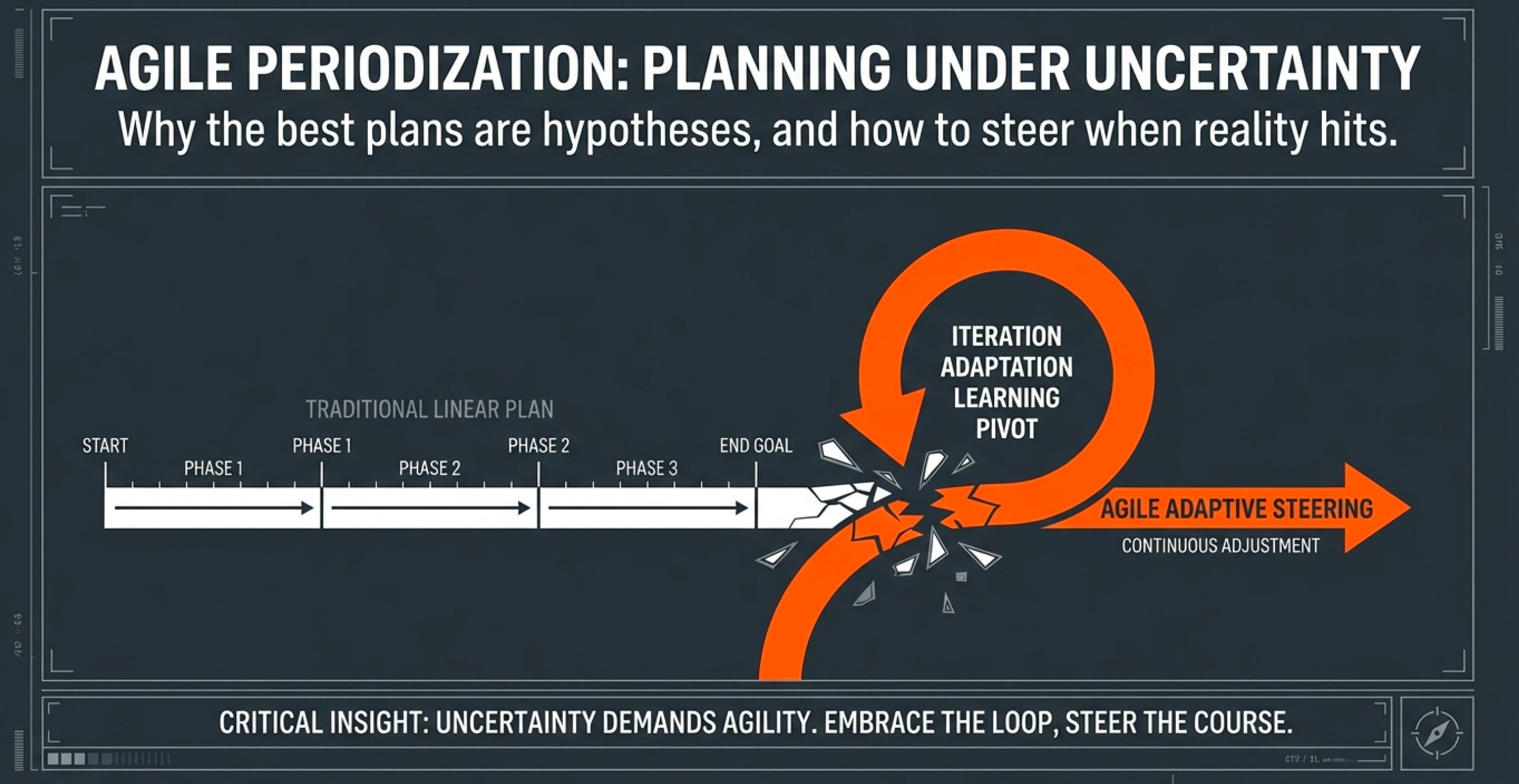
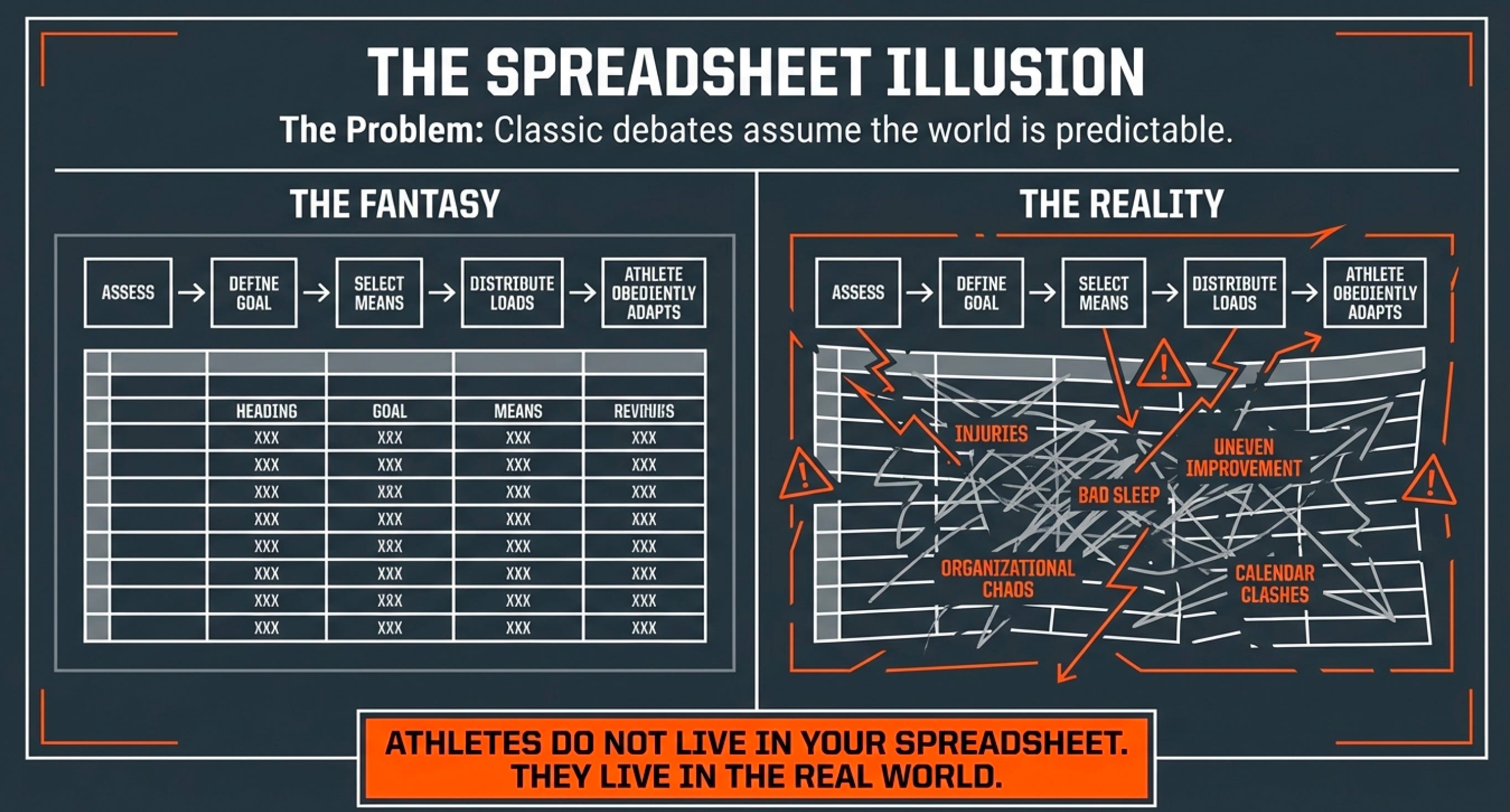
Most classical periodization models assume, either openly or quietly, that the world is predictable enough for the coach to plan adaptation in advance with reasonable confidence. You assess the athlete, define the goal, select the means, arrange the phases, distribute the loads, and then the body obediently follows the script. Of course, nobody says it that naively, because coaches know reality is messy. But that is still the hidden picture. Training is treated like a design problem solved up front. If you are smart enough, experienced enough, and scientific enough, then you can write the future before it happens.
That is a nice fantasy. It also happens to be wrong.
Athletes do not live in your spreadsheet. They live in the real world. They get hurt, they get stale, they get stressed, they sleep badly, they improve unevenly, they respond differently to the same loading pattern, and sometimes they simply do not adapt the way your cherished model says they should. In team sports, it gets even worse. You are not just dealing with physiology. You are dealing with coaches, calendars, travel, tactics, politics, injuries, substitutions, fixture congestion, organizational nonsense, and all the other beautiful features of applied sport. Yet somehow we still have people talking as if the central problem is choosing between linear, block, and undulating periodization, as though once that choice is made the hard part is over.
It is not over. It has barely started.
This is why I built Agile Periodization around a different starting point. The problem is not how to create the perfect long-term plan. The problem is how to plan when uncertainty is unavoidable, feedback is incomplete, and adaptation is only partly predictable. That is why Agile Periodization is not primarily a content model. It is a planning framework. It is about how to think, how to decide, and how to update. That is a different level of discussion, and frankly one the field has badly neglected.
The irony is that good coaches already behave this way. They just do not always admit it. They say they use block periodization, or linear periodization, or conjugate, but if you actually watch them coach for six months, what do they do? They adjust. They shorten horizons. They react to new information. They abandon exercises that stop working. They compress or extend phases. They manage around injuries and schedule congestion. They change volume because the athlete is fried. In other words, they do not blindly execute a model. They steer. Agile Periodization simply takes that reality seriously instead of pretending that the annual plan deserves more respect than the athlete’s actual response.
That is why one of the core ideas here is that a training plan is a hypothesis, not a truth. It is your best current guess. That is all. Maybe a very educated guess, maybe informed by physiology, training theory, past experience, and specific knowledge of the athlete, but still a guess. The problem in our field is that coaches often become emotionally attached to their guesses. The plan stops being a tool and becomes a badge of identity. Now they are not just coaching the athlete; they are defending a worldview. This is how you end up with endless arguments about which model is “best,” as if human adaptation is waiting to reward the coach who chose the right camp.
It is nonsense.
The world does not care what tribe you belong to. The athlete does not adapt because your model is elegant. And physiology is not obligated to respect your categories. This is one of the biggest mistakes in sports science and coaching culture more generally: confusing a clean explanation with a true one. Once you draw a nice phase structure and give each block a purpose, it starts to feel like you understand the process. But fitting a neat story onto training does not mean you have captured the real causal structure of adaptation. Other fields have this problem too. People regularly mistake well-fitting models for explanations, when often they are just descriptions with good manners.
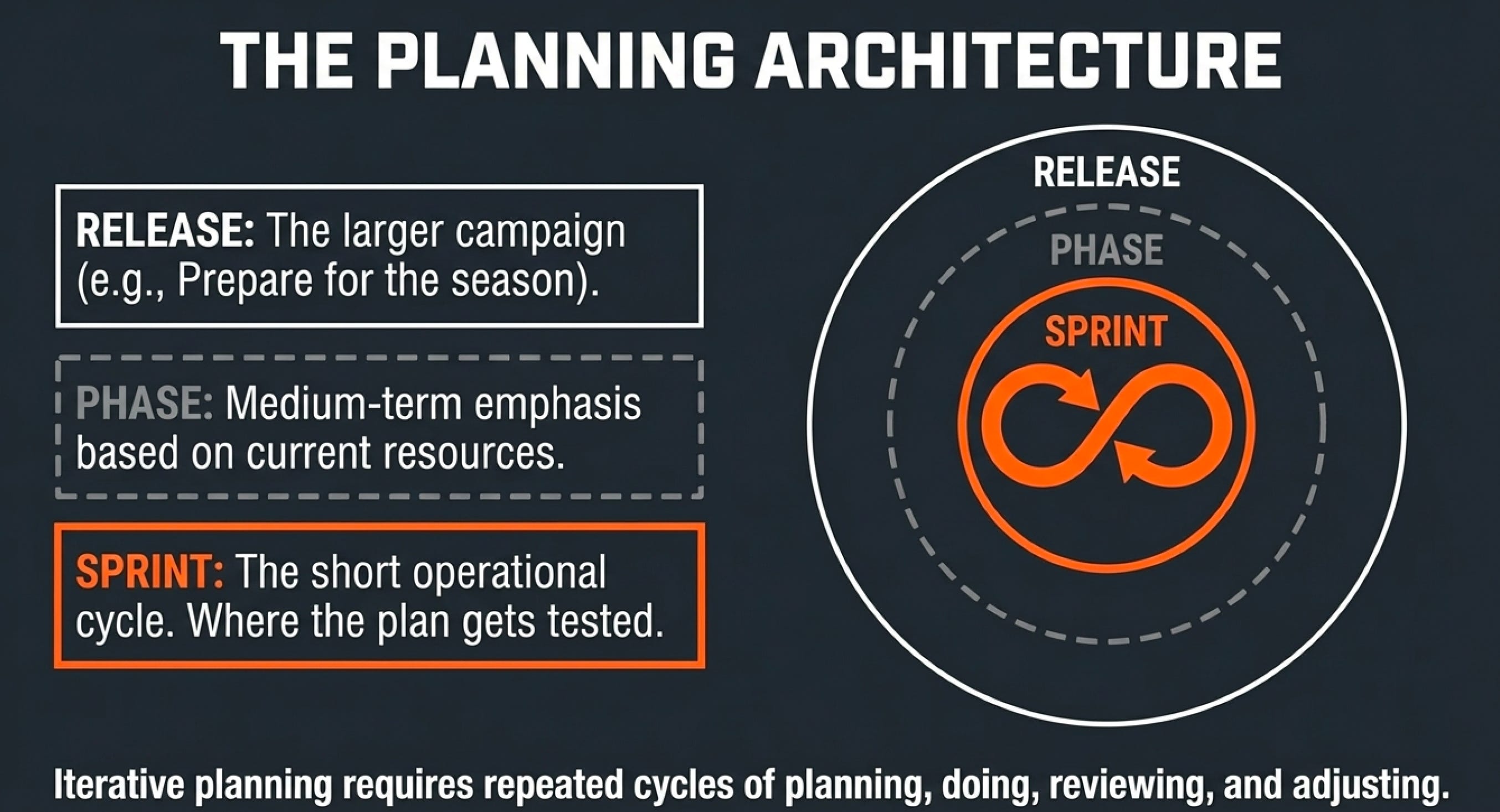
So Agile Periodization begins with intellectual humility. Not fake humility. Real humility. The kind that says: I need direction, but I do not have certainty. I need structure, but I also need review points. I need to plan, but I must plan in a way that allows me to change course when the evidence changes. That is what “agile” means here. It does not mean chaotic. It does not mean soft. It does not mean “let’s just see how we feel today.” It means iterative planning under uncertainty. It means the process is built around repeated cycles of planning, doing, reviewing, and adjusting.
This is why I use the hierarchy of release, phase, and sprint. The release is the larger campaign. Prepare for the season. Prepare for the meet. Build general qualities in the off-season. Return an athlete to competition. A phase is a medium-term emphasis within that campaign. Nothing mystical. Just a period where certain priorities dominate because, at this moment, that seems like the best use of time and resources. Then the sprint is the short operational cycle where the work happens and, more importantly, where the learning happens. This is critical. A sprint is not just where training gets delivered. It is where the plan gets tested.
And that is where most traditional periodization models are weak. They are very good at telling you what should happen. They are much weaker at telling you what to do when it does not. This is because they are heavily biased toward top-down planning. The coach starts with the big picture, cascades that down into phases and weeks, and then assumes execution is the main challenge. But the real coaching challenge is not merely top-down design. It is the interaction between top-down intent and bottom-up reality. You need both. You need to know where you are going, but you also need to know what the athlete is actually showing you. And most importantly, you need a process that lets those two levels talk to each other.
That is the first layer.
But there is a second layer, and I think this is where the whole conversation becomes much more interesting. Most coaches in S&C and sport science talk as if planning is mainly about dosing. How much volume? How much intensity? What density? What external load? What internal load? What zone? What exposure count? What RPE? What sprint meters? What jump numbers? All of that matters. I am not dismissing it. In fact, if you are a strength coach or a sport scientist, you live there most of the time. That is your professional neighborhood. You are in the business of prescribing, distributing, monitoring, and adjusting dose.
But dose planning is not the whole planning problem.
There is another level above it, and that level is what I have been calling problemming.
I am using that ugly word on purpose because it makes the move visible. This is not just “problem-solving.” Coaching is, first and foremost, problem-setting. You do not merely react to what appears; you design the environment so that the right things appear. You make the relevant problems unavoidable, again and again, so athletes are forced to build solutions that survive reality.
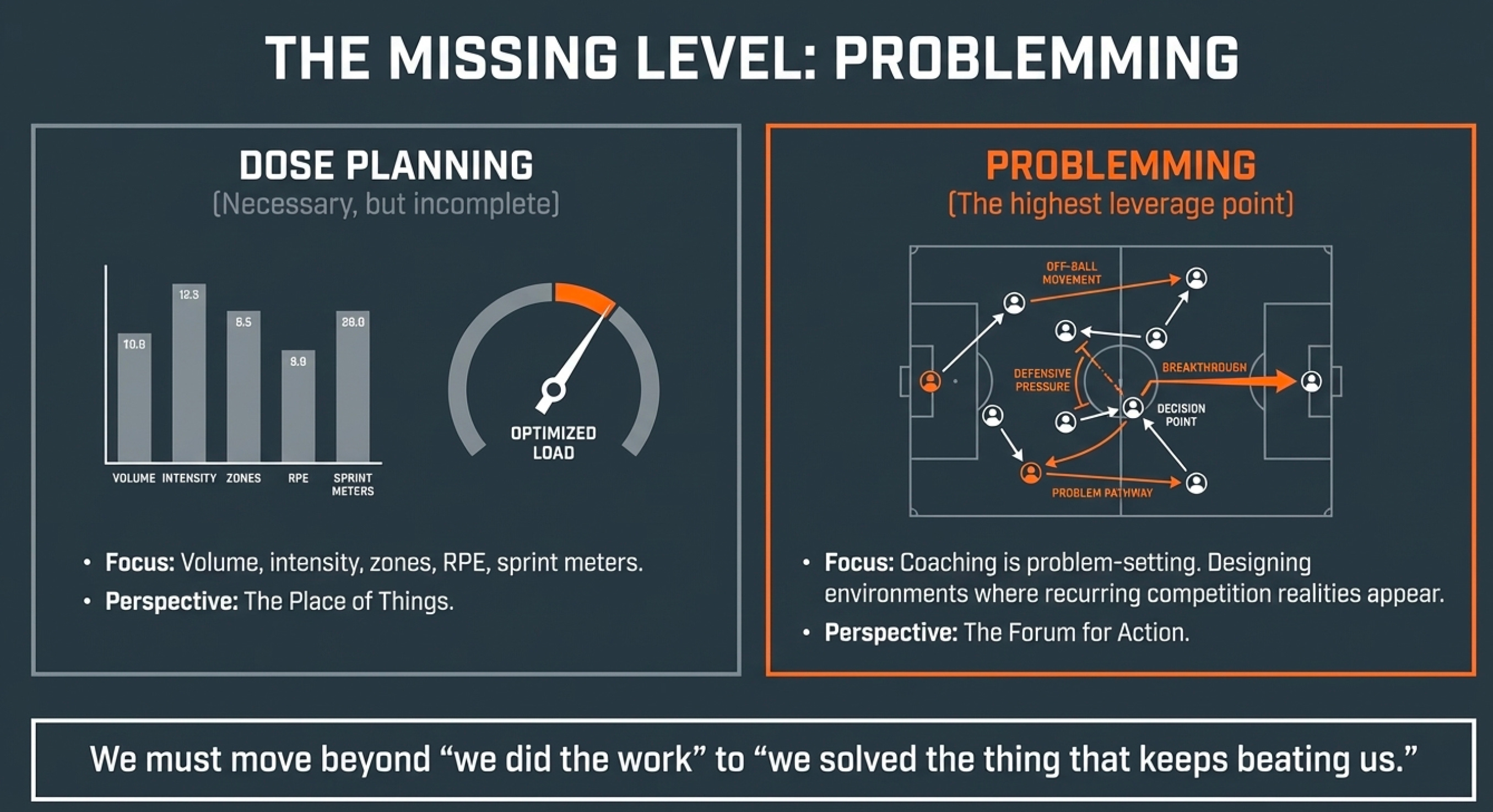
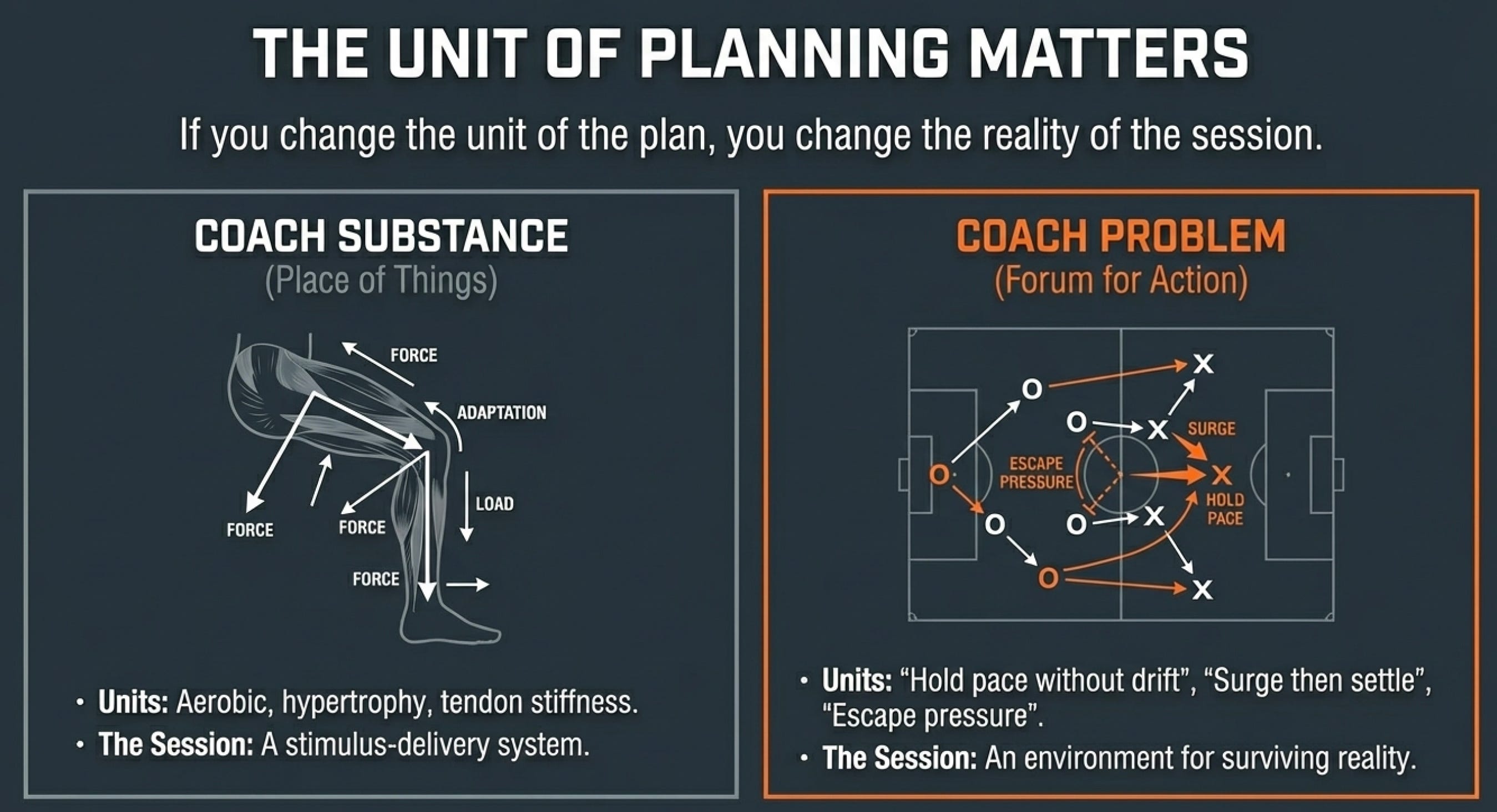
This is where the distinction between Coach Substance and Coach Problem becomes useful. Coach Substance lives in the place of things. He thinks in mechanisms, tissues, capacities, and dose. He sees endurance and thinks of thresholds, VO₂ kinetics, running economy, W′, and intensity domains. He sees strength and thinks of motor units, force-velocity profiles, hypertrophy, tendon stiffness, and load progression. He is not wrong. He is just incomplete. The problem is that when this way of thinking is overextended, the training session becomes a delivery device: here is the stimulus, here is the dose, here is the progression, here is the metric. When done well, this is disciplined and measurable. When done poorly, it becomes a sophisticated form of self-deception. We did the work starts replacing we solved the thing that keeps beating us.
Coach Problem lives in the forum for action. He starts from what athletes actually experience in competition: the recurring, ugly, robust phenomena that decide outcomes whether you like them or not. He asks different questions. Where do athletes lose position? Where do they lose pace? Where do they lose composure? Where does decision-making collapse under fatigue? Where do they surge and then freeze? Where do they fail to re-stabilize? Where do they look physically prepared in training but become tactically stupid in the contest? He builds training backward from those problems, not because he hates physiology, but because he refuses to let physiology become a religion.
This is why I think the missing sentence in most periodization discussions is the simplest one: the unit of planning matters.
If the unit of planning is “aerobic,” “anaerobic,” “strength,” “power,” “hypertrophy,” or “tendon,” then the coach will naturally design sessions as stimulus-delivery systems. If the unit of planning is “hold pace without drift,” “surge then settle,” “recover after a burst without freezing,” “maintain skill under incomplete information,” “escape pressure and reset,” “keep stroke integrity when discomfort rises,” then the coach is working in a different universe. One unit is an internal construct. The other is a competition-relevant demand. One belongs mostly to the place of things. The other belongs to the forum for action.
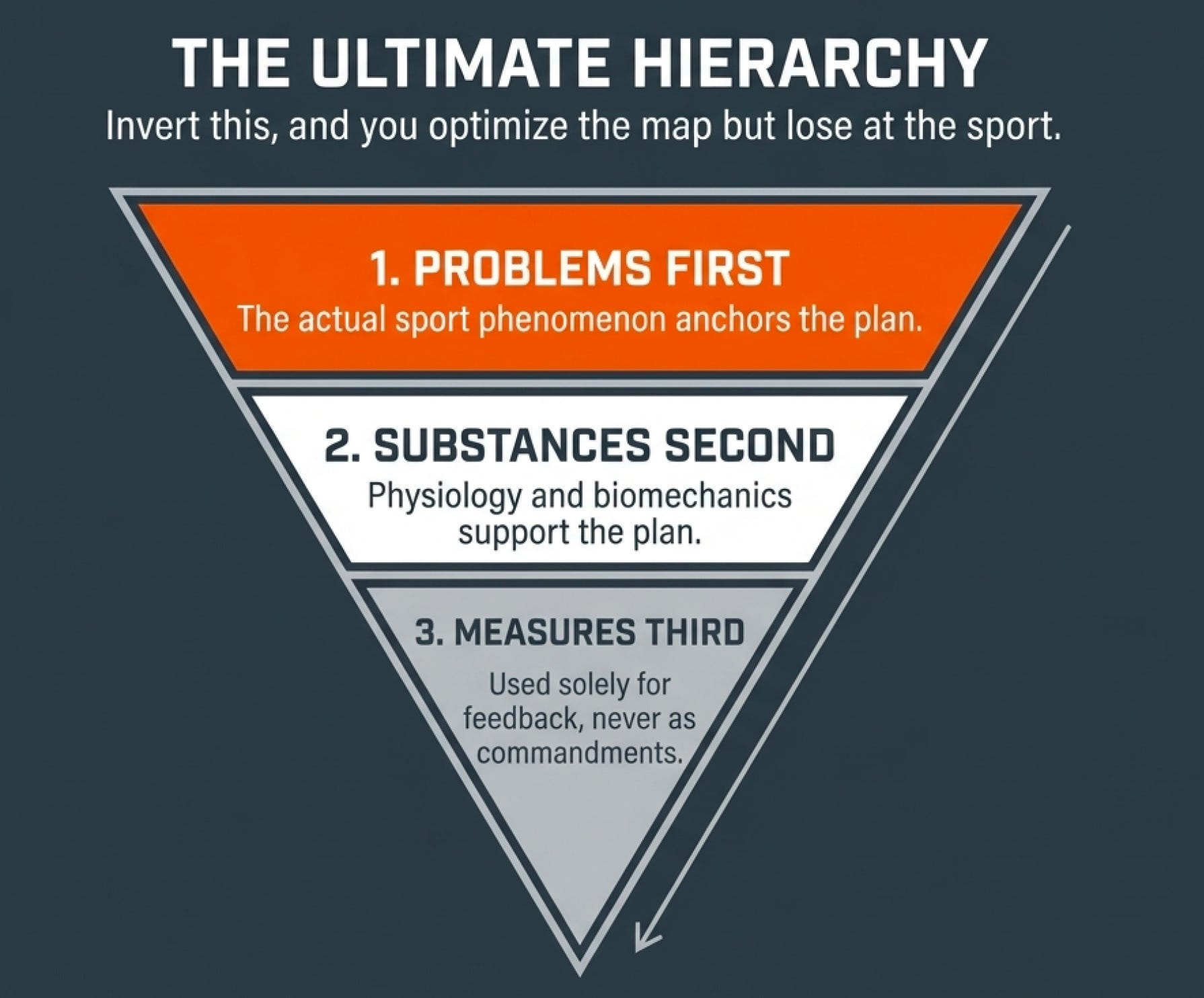
Now, let me be very clear, because this is where people become stupid. Problemming is not anti-physiology. It is not vibes over science. It is not “forget the mechanisms.” It is a hierarchy. Problems first, substances second, measures third. The sport phenomenon anchors the plan. Physiology, biomechanics, and tissue work support that plan where necessary. Measures are used as feedback, not commandments. If you invert that hierarchy and start with measures, then build the plan to satisfy them, you end up optimizing the map. You can become a world champion of training and still lose at sport.
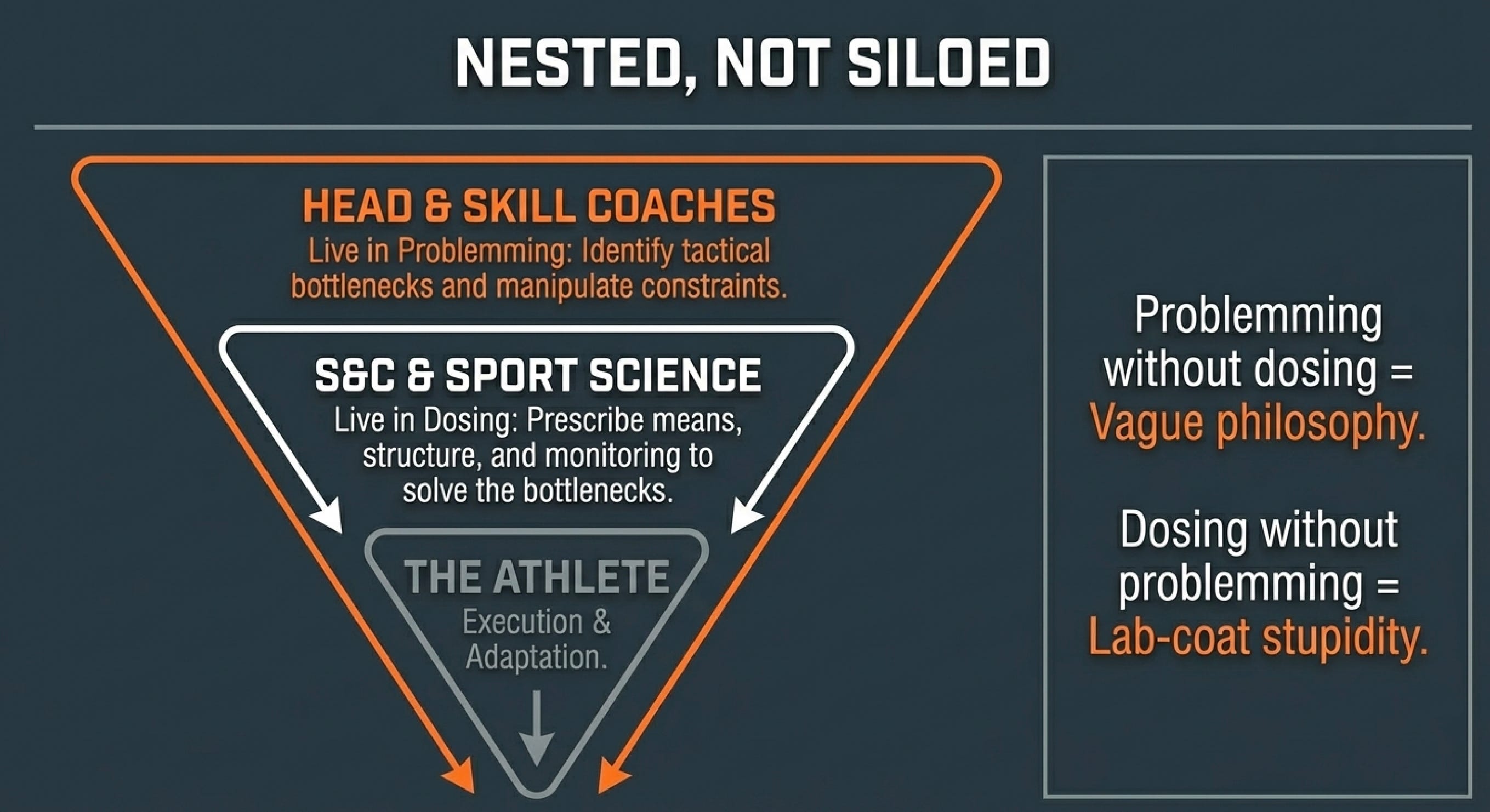
This also explains something important about staff roles. Head coaches and skill coaches naturally live under problemming. S&C coaches and sport scientists naturally live under dosing. That is not a bug. That is fine. The head coach wakes up thinking about game problems, tactical bottlenecks, recurring failures, and unwanted patterns. The skill coach manipulates constraints, tasks, timing, and information so those problems become visible and trainable. The S&C coach and the sport scientist usually enter with the question: fine, what dose, what means, what structure, what monitoring, what loading logic make sense here? We need all of that. Problemming without dosing becomes vague philosophy. Dosing without problemming becomes lab-coat stupidity.
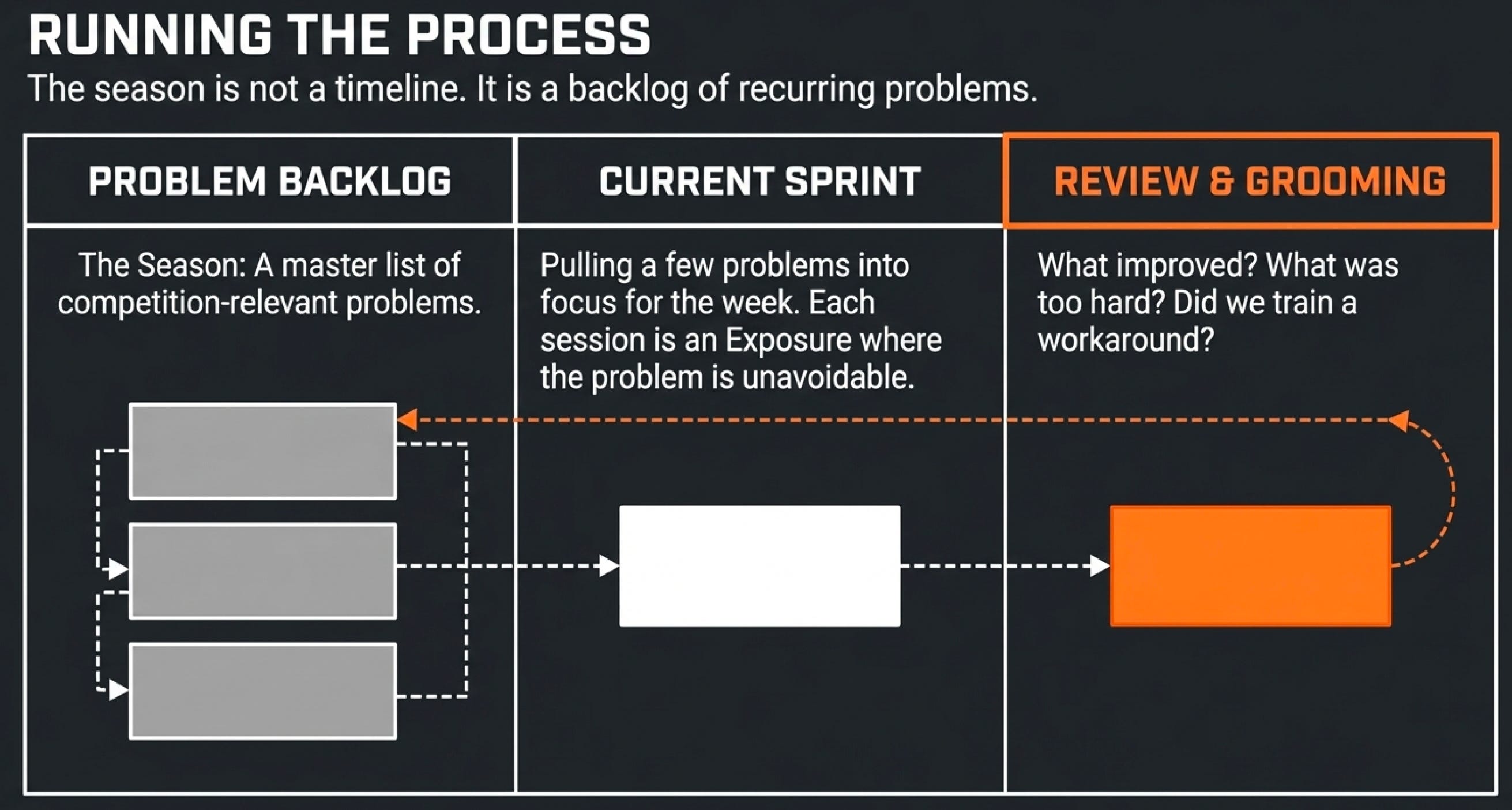
This is where Agile Periodization becomes more than load management. Load management is one slice of the whole picture. Problemming is the higher-order frame within which dosing operates. In agile language, the season becomes a backlog of problems. Not an infinite backlog of every problem under the sun, but the handful of recurring, competition-relevant problems that actually decide outcomes. Each week you pull a few problems into focus. That is your sprint. Each session becomes an exposure: a designed environment in which the problem is unavoidable and the athlete must attempt solutions. Then you review. What improved? What did not emerge? What was too hard? What was too easy? Did we actually set the problem well, or did we accidentally train a workaround? Then you groom the backlog. You rewrite problems. You delete vanity work. You keep what transfers.
This is also where the mental model of substance~form becomes indispensable.
A lot of coaches get trapped by one pole. The form people obsess over what looks like the sport. They want exercises, drills, and environments that resemble the contest as much as possible. Everything must be “specific.” The substance people obsess over the underlying capacities, qualities, and tissue adaptations. Everything must be explained through mechanisms. Both camps are partly right, and both become idiotic the moment they absolutize their pole.
Form without substance becomes fragile. Substance without form becomes detached.
A session can look beautifully specific and still fail to build anything durable. A block can build impressive underlying capacity and still fail to transfer because the relevant problem never shows up. This is why substance~form is not a contradiction to solve, but a tension to manage. The problem-setting coach starts with form at the level of competition problems, but uses substance where needed to support, protect, and stabilize performance. The mistake is not choosing one side temporarily. The mistake is turning one side into an ideology.
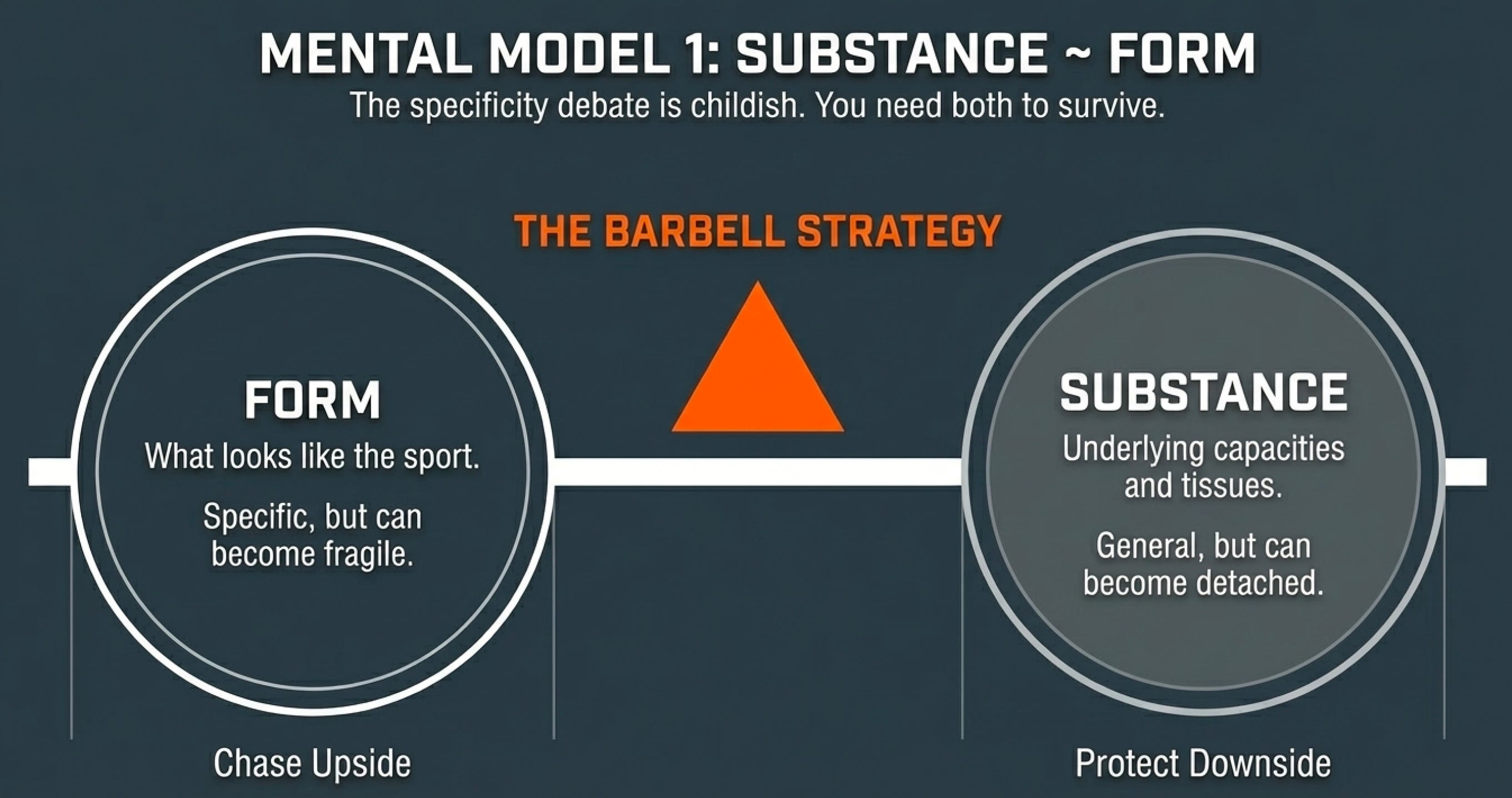
This is also why the old specificity argument is so often childish. “Players never squat in the game.” Wonderful insight. They also never lie on a physio table with dry needles in them, but somehow that does not stop people. The real issue is not surface resemblance. The real issue is whether the method serves the problem. Sometimes a squat is substance in service of form. Sometimes a highly specific drill is form with no substance. Sometimes a general intervention protects the downside so the athlete can keep expressing specific skill. That is why I find the barbell strategy such a useful mental model here. One side of the barbell chases upside through highly specific work. The other side protects you from downside through more general, robustifying, preparatory work. You need both, because sport rewards expression but punishes fragility.
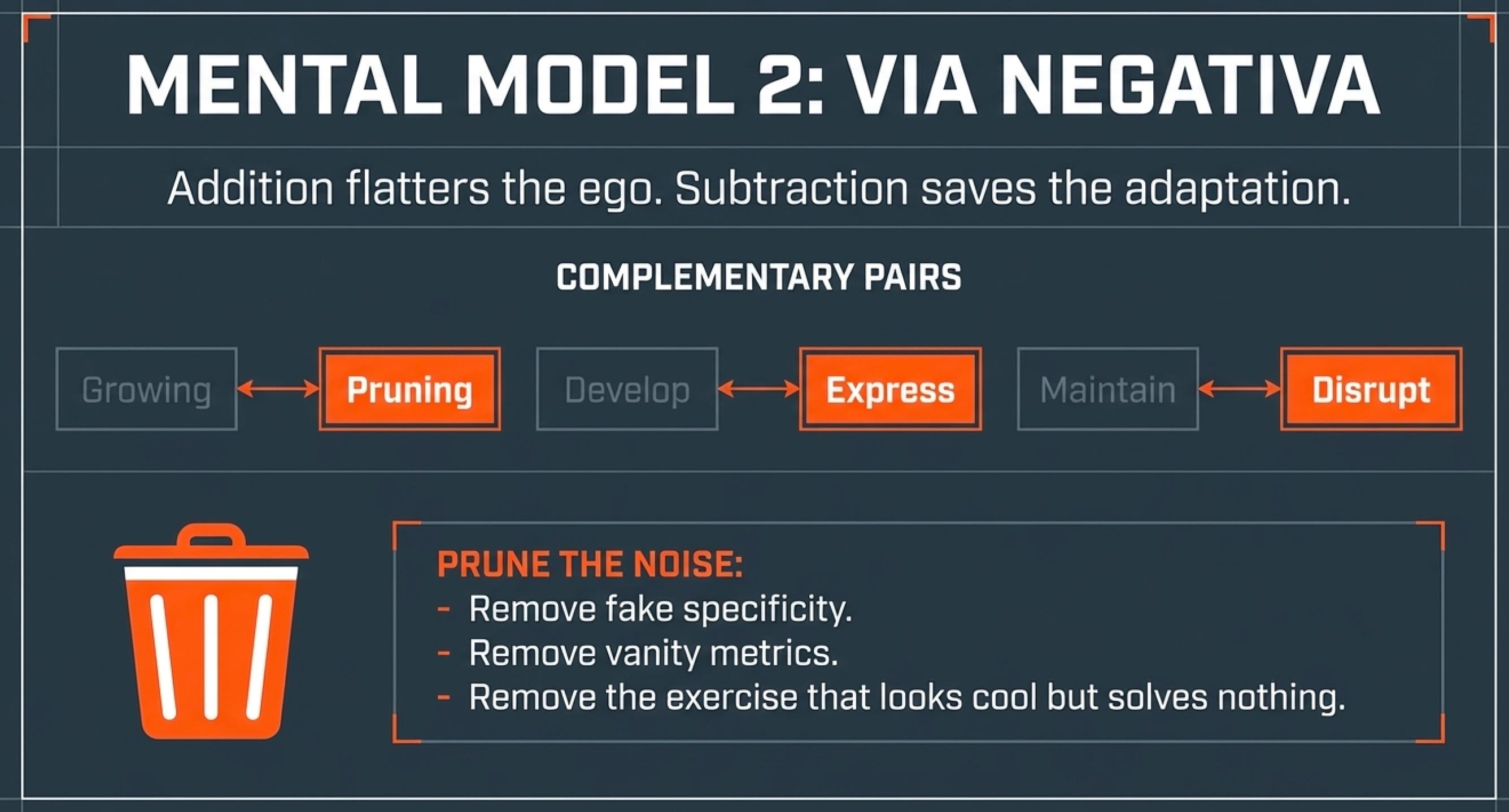
And that leads directly to another mental model that coaches underuse: via positiva and via negativa.
Coaches are addicted to via positiva because it flatters the ego. Add another drill. Add another exercise. Add another monitoring device. Add another corrective. Add another layer of complexity. Addition looks like expertise because it is visible. It gives the impression that the coach is doing a lot.
But some of the best coaching is via negativa.
Not adding, but subtracting.
Not finding another clever intervention, but stopping the stupid thing that keeps ruining adaptation.
Not chasing more, but removing the junk that makes the process noisy, fragile, and self-defeating.
Sometimes the most powerful change you can make is not to add a new dose, but to subtract the nonsense. Remove junk volume. Remove fake specificity. Remove vanity metrics. Remove the exercise that looks cool but solves nothing. Remove the session that exists only because “we always do it.” Remove the ambiguity between what the head coach thinks the problem is and what the performance staff is dosing. Remove the complexity that makes everyone feel sophisticated while making nobody better.
That is why I like complementary pairs such as growing~pruning, develop~express, maintain~disrupt, weaknesses~strengths, and structure~function. These are not clever labels. They are reminders that coaching is almost never either/or. The real work lies in recognizing which pole you are overusing, and which one the current situation is demanding. The via positiva coach keeps building until the system bloats. The via negativa coach prunes until the signal becomes clear again. The art is in knowing when to do which.
This is one reason I push back against the obsession with “optimal” planning. Coaches and sports scientists love that word. Optimal taper. Optimal sequencing. Optimal loading. Optimal volume landmarks. But optimal for what world? Usually for a simplified, sanitized, cooperative world where all the relevant assumptions hold steady. Real coaching is rarely like that. Real coaching lives in the domain of constraint, uncertainty, and interference. That is why robustness matters more than optimality. A robust plan may not be theoretically perfect under one idealized scenario, but it keeps working when the athlete misses sessions, when fatigue behaves differently than expected, when the competition schedule changes, when recovery is compromised, or when some part of your original model turns out to be wrong. In practice, robustness is worth far more than elegance. You can’t PR on elegance.
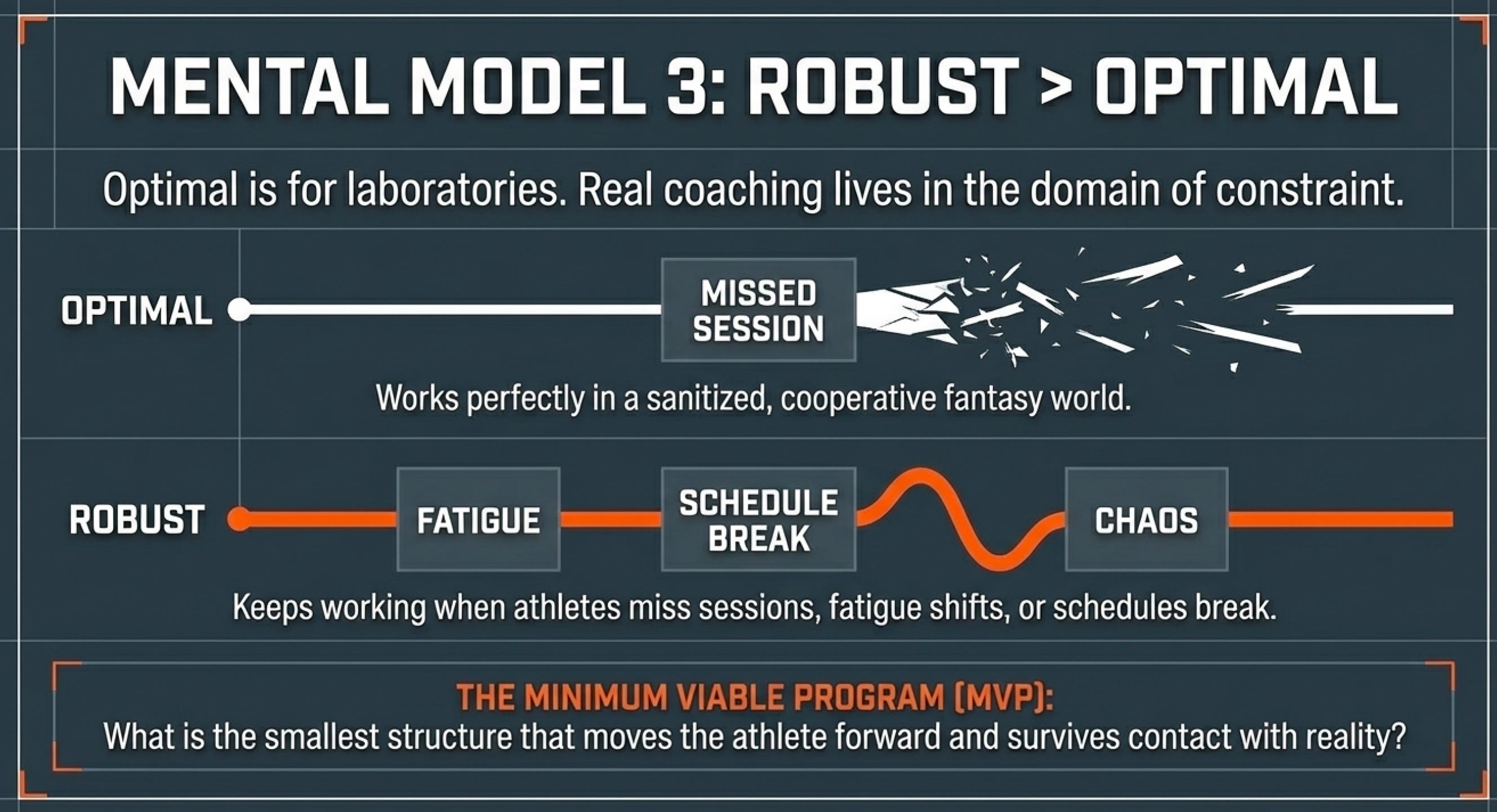
This is also why the minimum viable program matters so much. Coaches love to design ideal programs for imaginary environments. Four gym sessions, monitoring technology, perfect compliance, excellent facilities, supportive sport coaches, disciplined athletes, and enough time to build every quality in the correct sequence. Wonderful. Now wake up. Most coaching environments are constrained, messy, and politically compromised. You do not start with the ideal plan. You start with what is actually executable. What is the smallest structure that can move the athlete forward, survive contact with the environment, and still give you useful feedback? That is the right question. Not what would be best in paradise, but what is viable here, now, with these people, under these constraints. If you cannot answer that, your planning theory is not practical wisdom. It is daydreaming.
Notice what this does to the whole periodization debate. Once you shift from dogma to decision-making, the old camps become much less interesting. Linear periodization is not wrong. Sometimes it is useful. Block periodization is not wrong. Sometimes it is useful. Conjugate is not wrong. Sometimes it is useful. The problem begins when people stop treating them as tools and start treating them as explanations of reality. A linear progression might be excellent for a novice. A concentrated block might make sense for an advanced athlete chasing a narrow adaptation. A concurrent setup with rotating means might be ideal in another situation. Agile Periodization does not ban any of this. It simply refuses to grant any of them the status of revealed truth.
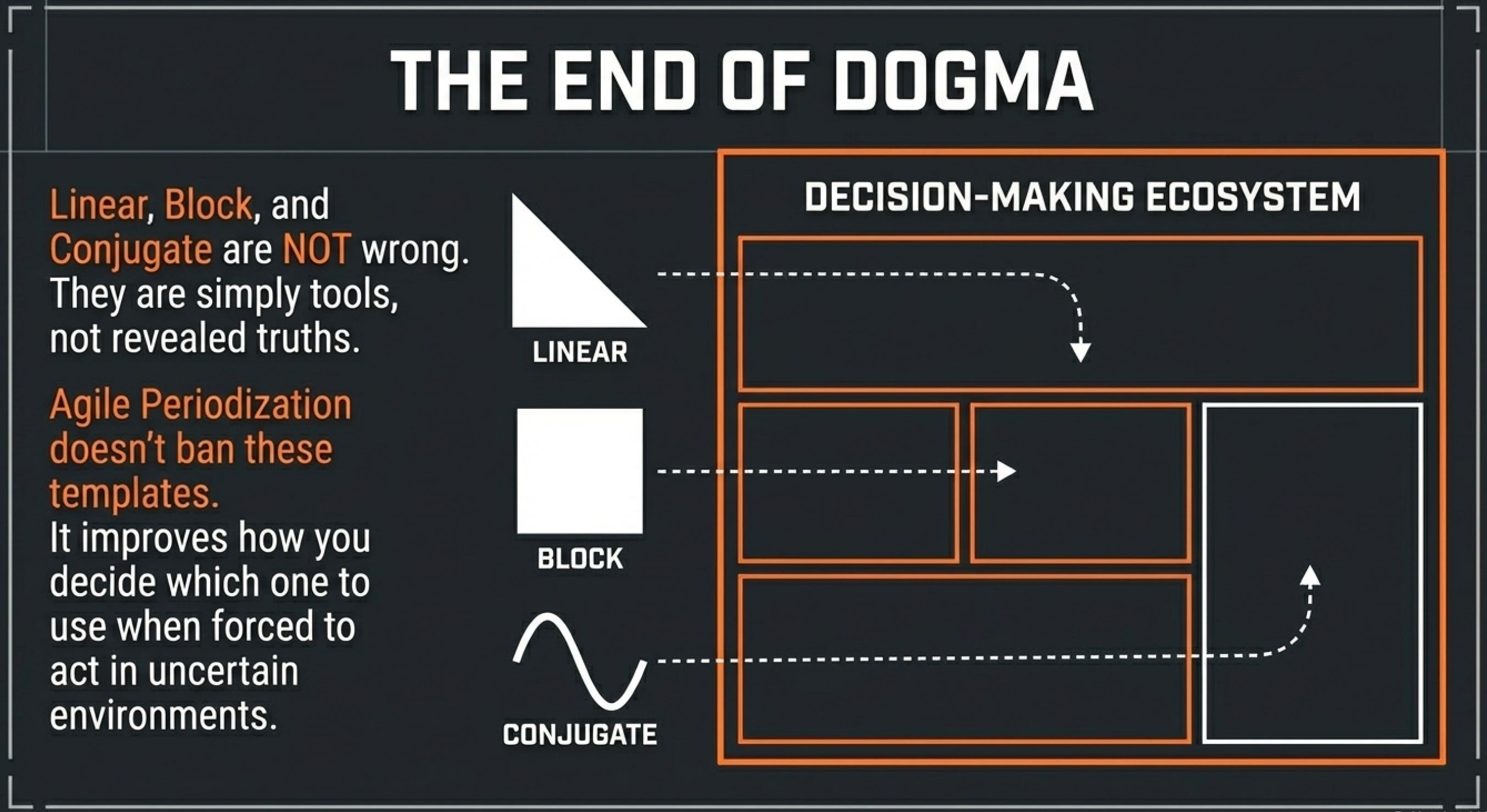
That is why Agile Periodization is less ideological than most training frameworks. It is not trying to prove that one structure is universally superior. It is trying to improve how coaches think when they are forced to make decisions in uncertain environments. That is the level at which most periodization arguments should have been happening all along, but rarely did. Instead, we got stuck arguing over templates, often backed by evidence-based mumbo jumbo that looks more convincing than it is. A couple of short interventions, some poorly controlled studies, a neat graph, and suddenly people are ready to declare one model superior. Superior for whom? Under what constraints? Over what time horizon? In what sport? With what compliance? Against what alternative? These questions rarely get answered with the certainty the conclusions pretend to possess. Again, the problem is not evidence. The problem is overconfidence masquerading as science.
The average practitioner does not need more orthodoxy. He needs a better way to steer. He needs to be able to say: this is the broader goal, this is the current problem backlog, this is the current emphasis, this is the next short cycle of work, this is the dose I think makes sense, this is what I expect, and this is how I will review whether those expectations were justified. That is real planning. Not drawing a 16-week masterpiece and hoping the athlete behaves. Real planning means being prepared to change your mind without losing your direction.
So what is Agile Periodization, in the end?
It is planning that acknowledges reality. It is structure without rigidity. It is sequencing without dogmatism. It is feedback without chaos. It is a framework that accepts the athlete is a complex adaptive system, the environment is uncertain, and the coach’s job is not to predict perfectly but to make progressively better decisions over time.
But now I would add one more sentence, because without it the picture is still incomplete:
Agile Periodization is not just about dosing work. It is about setting the right problems and then dosing the means that help solve them.
That is the hierarchy.
Problems first. Substances second. Measures third.
If you get that backward, you can build beautiful training and still miss the sport. If you get it right, the pieces finally start talking to each other: head coach, skill coach, S&C, sport science, and the athlete himself. Now the plan is no longer a shrine. It is an operating system.
And that, to me, is the point.
Where to go next
If this way of thinking resonates with you, and you want the full framework rather than a Substack version of it, then the next step is simple.
I put together a 10+ hour course on Agile Periodization where I go much deeper into the philosophy, the planning framework, the practical implementation, and the coaching logic behind all of this. You can get it here: Agile Periodization Course.

If you’d rather learn this inside a community, join the Agile Periodization Skool community — you’ll get access to the same material for free there, alongside discussion, application, and ongoing development of the ideas.
And if you prefer the long-form written version, my book is still the best place to go deeper into the foundations: Strength Training Manual: The Agile Periodization Approach.

If you enjoyed this post, join me inside Agile Periodization Skool. Members get access to PDFs, books and book drafts, tools, courses, live Q&As, Agile Coffee, and deeper conversations about training, physiology, planning, and coaching practice with coaches, practitioners, and athletes who take this work seriously.
Agile Periodization Skool: https://www.skool.com/agileperiodization
Agile Periodization Website: https://agileperiodization.online/