

Harder in Which Direction?
The Combat Quadrant for Learning, Transfer, Maintenance, and Capacity

Coaches love the word hard.
Hard sparring. Hard pads. Hard rounds. Hard bag work. Hard conditioning.
The problem is that hard can point in at least two directions.
A task can be hard because the fighter works at a high pace, produces force, accumulates fatigue, absorbs contact, takes risk, or pays a recovery bill. Another task can be hard because the fighter does not know what is coming, must read the opponent, distinguish the real attack from the feint, choose among several viable weapons, and adapt when the first action changes the situation.
One task can be physically brutal and informationally simple. Another can be physically light and technically-tactically difficult.
Those are not the same kind of hard.
Once we collapse them into one word, practice design becomes muddy. We call a drill “intense” without knowing whether we mean effort, speed, contact, uncertainty, danger, or social pressure. We call something “complex” because it contains a twelve-step combination, although every step is known before the athlete starts. We call something “specific” because it looks like fighting, while removing the opponent-generated information that gives fighting its meaning.
Then we argue about drill names.
Is heavy-bag work useful? Is pad work specific? Are chain drills bad? Is playful sparring too easy? Is hard sparring necessary?
These questions start one level too late. A drill name is a container. The actual practice task depends on its rules, information, partner behaviour, pace, consequences, athlete, and purpose.
What we need is not another ranking of good and bad drills. We need a map that separates the information the task contains from the price the fighter pays for engaging with it.
I call it the Combat Quadrant.
Classify the version, not the label
Imagine two coaches saying they did pad work.
In the first version, the fighter repeats a known combination against a cooperative pad holder. The pace is high. The work is dense. The goal is to produce, rehearse, and maintain mechanics under fatigue. The informational demand is low because the sequence is known.
In the second version, the pad holder presents meaningful cues. Several actions are viable. Timing and position change. The fighter must read, select, and continue. Physical demand is deliberately controlled so that errors remain affordable.
Same label. Different task. Different dominant intention. Different location on the map.
The same applies to sparring, chain drills, shadowboxing, wall work, Dutch-style exchanges, bag work, positional grappling, and almost everything else we name as if the noun had already specified the practice.
This is why the first rule is simple:
Classify the task as performed, not by its traditional name.
In my earlier work on Problemming, I argued that coaches should start with the recurring performance problem rather than their favourite drill, method, or capacity (Jovanović 2026a, 2026f). The Combat Quadrant continues that argument. Once the problem is provisionally framed, we still need to decide how much of it to preserve, how much to simplify, and which cost is justified.
The problem is the anchor. The dose is the regulator.
Two nominal directions of hard
The horizontal axis of Figure 1 is competition-specific task complexity.
Moving right adds viable weapons, uncertainty, opponent freedom, representative timing and distance, deception, adaptive continuation, and the need to use information to organise action. This is not generic complication. A twenty-movement chain can be difficult to remember while remaining completely predictable. Two live options can be more competition-specific if the fighter must detect which option is unfolding.
The vertical axis is physical intensity and consequence.
Moving upward can add pace, force, effort, work density, fatigue, contact, mechanical exposure, psychological threat, error cost, risk, and recovery demand. These components often travel together, but they can separate. A slow selection round may carry enormous psychological consequence. A maximal bag round may be exhausting without containing an opponent decision. A playful task may contain rich information while remaining physically cheap.
So the vertical axis is not a hidden physiological scalar. It is an expected-cost profile. When the distinction matters, unpack it.
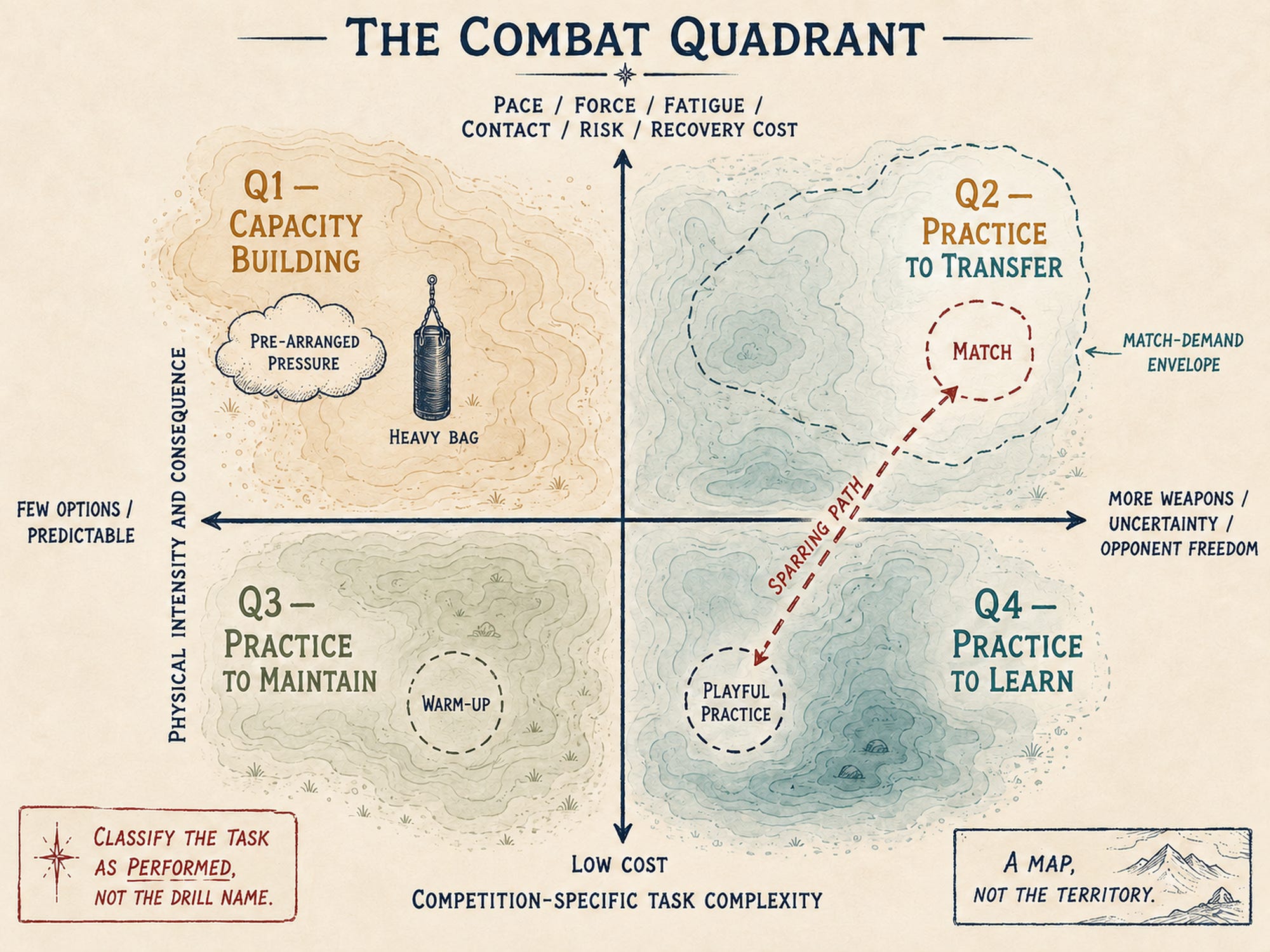
The axes are deliberately simplified. They are separable for thinking, not independent in reality. Increasing opponent freedom may increase fatigue and threat. Increasing contact can alter what information the athlete attends to. A useful map compresses. A dangerous map forgets that it compressed.
Four regions, four dominant intentions
The two axes create four broad practice regions. They are dominant intentions, not exclusive effects. Learning can occur everywhere. Capacity may change during sparring. Confidence may improve during maintenance. A transfer test may reveal the next learning problem.
The useful question is not, “What could this drill possibly develop?” If we stare long enough, every task produces a Christmas tree of possible adaptations.
Ask instead:
What is the main job of this version today?
The quadrant names are practical shorthand for common dominant uses, not intentions mechanically generated by coordinates. A high-information, low-cost task may maintain an expert’s skill; a constrained task may teach a novice something about their own coordination. The map proposes a likely job. The coach still has to state the actual one.
Q1 — Capacity Building
Capacity Building occupies the upper-left: relatively constrained information with relatively high physical demand.
Here we simplify the problem so the fighter can produce, repeat, tolerate, or organise substantial work. The target may be output, mechanics under load, force transmission, tissue tolerance, robustness, repeatability, or work capacity. Heavy-bag work is a useful extreme point. Pre-arranged pressure and predictable partner or pad exchanges occupy a wider region.
This gives Substance a legitimate home. Capacity work builds potential; it does not prove that the potential will be organised against an adaptive opponent (Jovanović 2026e). That is not a criticism. A screwdriver is not a bad hammer. It has another job.
The question is: Which resource are we loading, and where will we later check whether it becomes available in representative action?
Q2 — Practice to Transfer
Practice to Transfer occupies the upper-right: high competition-specific complexity combined with meaningful physical or consequential pressure.
This is where we ask what survives. Can the fighter still perceive, decide, coordinate, and act when pace, fatigue, threat, opposition, and consequence converge?
The match sits inside a wider match-demand envelope. A match is not one stable dose, nor is it maximal on every component. A practice task may exceed match pace, repetition, force, or option density on one selected dimension. That is component overload, not proof that the whole task has become “more specific than competition.”
Transfer practice is expensive. It can narrow exploration, reduce the number of quality attempts, create recovery cost, and punish unstable solutions. That does not make it bad. It makes it scarce.
The question is: What must be present for this to count as a meaningful transfer test, and what is the minimum justified cost of obtaining that information?
Q3 — Practice to Maintain
Practice to Maintain occupies the lower-left: familiar, predictable work with relatively low physical and consequential cost.
Its job is to rehearse, refresh, stabilise, prepare, or restore confidence. Warm-up is an extreme point, but it is not the whole quadrant. Familiar chain drills, controlled technical work, low-cost shadowboxing, and simple partner exchanges may live here.
Maintenance is not failed learning. Not every session needs novelty, destabilisation, and a nervous system press conference. Sometimes a solution must remain available. Sometimes the fighter needs successful repetitions without an additional recovery bill. Sometimes this practice prepares the athlete for what follows.
The question is: What should remain available, and how can we preserve it without paying an unnecessary price?
Q4 — Practice to Learn
Practice to Learn occupies the lower-right: high competition-specific complexity with bounded physical and consequential cost.
The fighter still reads, chooses, times, adapts, and solves. We reduce the price of being wrong so that errors remain usable rather than merely painful.
Lower consequence can create more attempts, wider exploration, more interpretable errors, and less defensive protection of status. Playful practice is one valuable region here. Play is not the absence of structure or intent; it is a motivational frame that can permit invention without turning every attempt into selection.
But learning practice is not transfer practice. Behaviour can change when force, fatigue, threat, scoring, and stakes rise. That is precisely why the two regions remain distinct.
The question is: Have we reduced the cost without removing the information that makes this the same problem?
The map has four layers, not only two axes
The Combat Quadrant becomes clearer when we separate four questions, shown in Figure 2.
First, the two axes locate the nominal task: what the coach designed, independent of who performs it.
Second, representativeness asks about task–target fit. Does the task preserve the information–action–consequence relations that matter for the target performance problem?
Third, functional difficulty asks about task–athlete fit. How challenging is this task for this fighter, with this partner, in this state, today?
Fourth, practice intention asks why the coach is using it: learn, transfer, maintain, or build capacity?
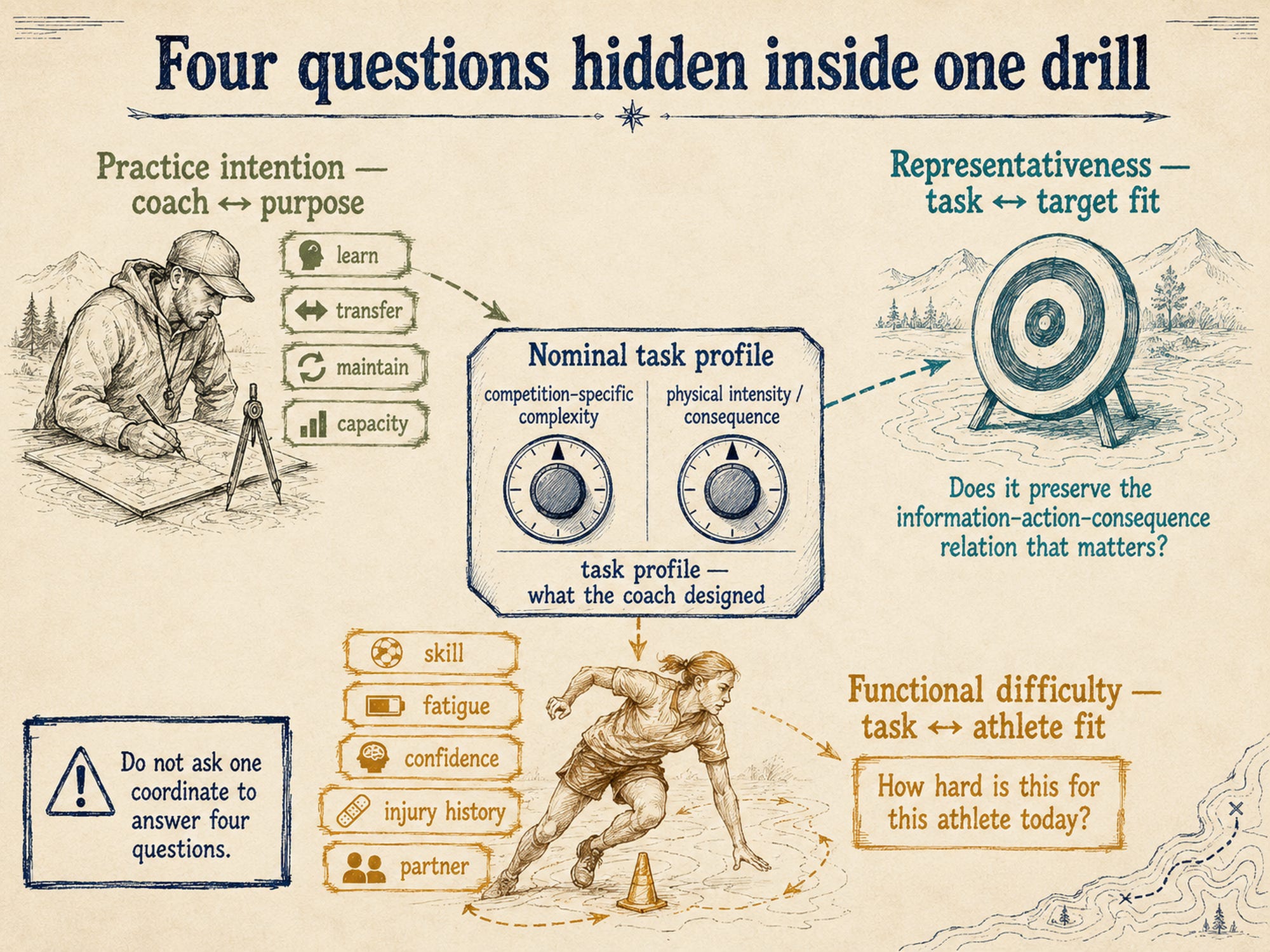
This separation prevents several category errors. A task can be highly complex but poorly representative because the options are irrelevant to the competition problem. A task can be representative of a narrow problem without being complicated. A task can be nominally modest and functionally punishing for a novice. A task can be highly specific yet deliberately easy because the goal is maintenance.
Similar to Challenge Point, but not the same model
The closest theoretical relative is the original Challenge Point Framework (Guadagnoli and Lee 2004) and the Extended Challenge-Based Framework developed for sports coaching (Hodges and Lohse 2022).
The original framework distinguishes nominal task difficulty from functional task difficulty. The same nominal task can provide a very different challenge to a novice and an expert. Learning is expected to benefit from usable information—not from difficulty for its own sake—and too little or too much functional difficulty can reduce learning potential. The nominal–functional distinction has also been examined experimentally in transfer tasks (Sanli and Lee 2015). Even so, the framework should not be treated as a machine that calculates one universal optimal difficulty.
Hodges and Lohse add motivation, competition specificity, and three non-exclusive practice priorities: practice to learn, practice to transfer, and practice to maintain. Their central two-dimensional figure places specificity to competition on the horizontal axis and functional task difficulty on the vertical axis. Figure 3 is a simplified redrawing of that relationship, not a reproduction of their published figure.
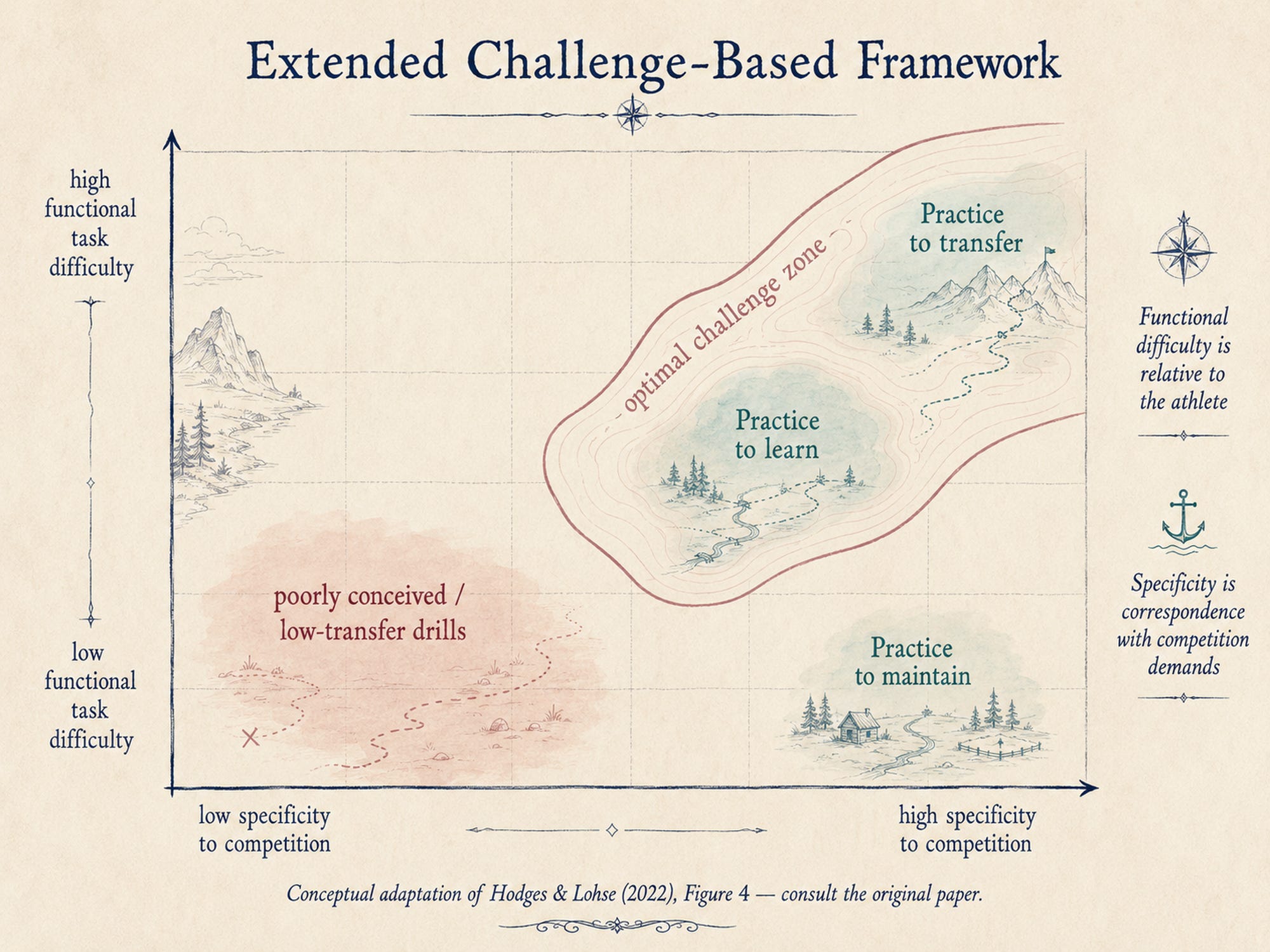
The family resemblance is obvious. Both models care about information, challenge, specificity, motivation, learning, transfer, and maintenance. Both reject the idea that one drill has one fixed difficulty.
The difference is the level of decomposition.
The Extended framework maps specificity against the athlete-relative difficulty of the task. The Combat Quadrant first decomposes the nominal practice environment into two directions from which challenge may emerge: informational complexity and physical intensity/consequence. Functional difficulty then becomes an athlete-specific overlay. The Combat Quadrant also adds Capacity Building because combat practice includes legitimate high-output, decision-light work that does not need to pretend it is skill-transfer practice.
In compact form:
where functional difficulty depends on competition-specific complexity , physical intensity/consequence , athlete capability , current state , partner behaviour , and context .
This is not an equation to calculate. It is a reminder not to confuse the task’s coordinates with the athlete’s experience.
Rotated axes? Useful analogy, not identity
In our group discussion, I compared the relationship to principal component analysis: perhaps the Extended model and the Combat Quadrant describe similar territory with axes rotated in another direction.
I still find that analogy useful, but only as a conceptual sketch. Nobody has collected a task-rating dataset and run PCA here. We do not know that the variables are statistically correlated, much less that the axes are orthogonal components.
The safer claim is that the constructs overlap and may covary.
Competition specificity can depend on opponent information, timing, options, speed, force, fatigue, contact, psychological pressure, and the target problem. Functional difficulty can rise because options overwhelm the athlete, because pace removes time, because fatigue changes action capability, or because being hit makes the error expensive. Neither construct is identical to either Combat Quadrant axis.
Figure 4 shows the relationship as a factor-loading sketch rather than an empirical result.
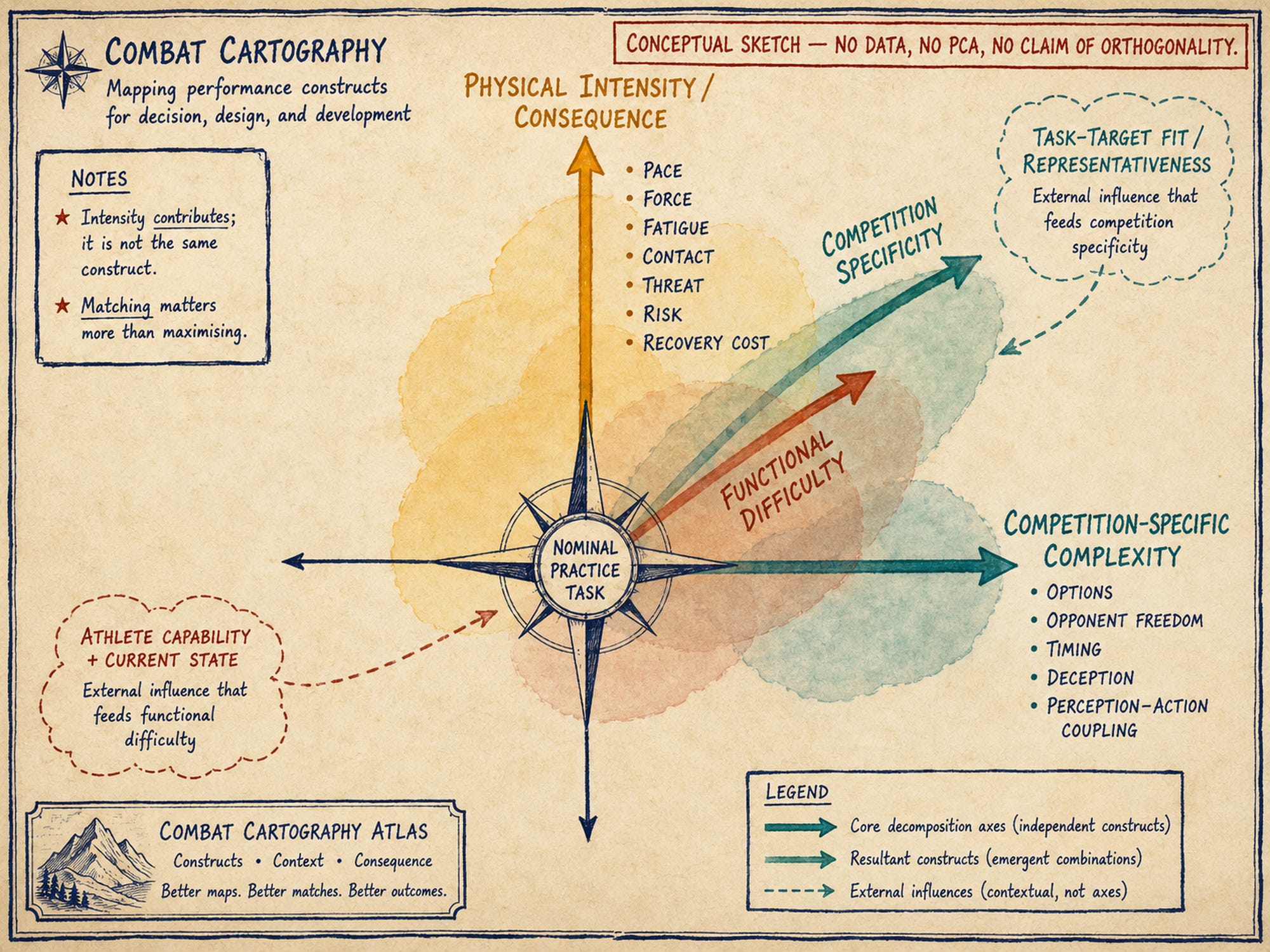
This is why intensity belongs inside the story of functional difficulty without becoming its synonym. Being hit can make a task functionally harder. It can also make a stupid task more costly without making it more informative.
Representativeness is an overlay, not a compulsory Z-axis
Representative Learning Design asks whether practice samples relevant informational variables and preserves the perception–action relations required by the performance environment (Pinder et al. 2011). That identifies a real limitation in any two-axis model: a task can be complicated and brutal while preserving the wrong relationship.
This point is especially important in combat sports. Ecological-dynamics accounts of MMA emphasise live opponent information and the athlete’s continuing coupling of perception, decision, and action (Yearby et al. 2024; Myszka, Yearby, and Davids 2023). Yet this should not become another tribal slogan in which opposed practice is good and unopposed practice is bad. Unopposed tasks can have a bounded role when the coach is honest about the problem, the information removed, and the intended job (Parry et al. 2025).
Yet I would not add representativeness as a third spatial axis to the working map. A 3D model may improve descriptive precision while becoming harder to use on the mat. More importantly, representativeness is a relationship between the task and the target problem, not simply another quantity sitting inside the drill.
I therefore treat it as an overlay, contour, or entry threshold.
For Practice to Learn and Practice to Transfer, the task should be representative enough for the selected problem. That does not mean reproducing the whole match. A narrow wall-wrestling task can be highly representative of one problem while excluding most of MMA. A choreographed chain may contain many movements and high fatigue while preserving almost no opponent-coupled information.
For Capacity Building and some Maintenance work, falling below that representativeness threshold can be completely legitimate. Heavy bags, fixed chains, and shadowboxing do not need to lie about their job to earn a place in training.
Drills have paths, not addresses
The map becomes useful when we follow how a task moves.
A chain drill at low cost usually supports maintenance. Increase pace, force, density, or fatigue while keeping the sequence known, and it moves upward toward capacity. Add genuine branches and opponent-generated cues, and it moves right toward learning. Add adaptive continuation, scoring, and representative consequence, and it can move toward transfer—although at that point it is no longer a purely pre-arranged chain.
Shadowboxing can serve as warm-up, familiar rehearsal, rhythm work, or capacity development. Strong movement constraints may help a fighter explore self-coordination. But shadowboxing lacks an opponent supplying live information and adapting in return. I would not place pure shadowboxing deep inside opponent-coupled learning or transfer. It may help the athlete learn something; it does not independently demonstrate that the athlete can solve a fighting problem.
Pad work may occupy several regions. The holder can deliver choreography, meaningful cues, or a confusing hybrid in which the fighter guesses the coach’s private script. Ask whether the fighter is reading, remembering, producing, or solving.
Sparring is not one address either. Playful sparring, constrained learning sparring, technical sparring, hard performance rehearsal, selection rounds, and competition form a broad landscape. The noun tells us almost nothing about the actual information and cost.
Figure 5 shows several legitimate paths. Progress is not always up and to the right.
Moving down may restore confidence or exploration. Moving left may isolate a bottleneck. Returning to maintenance may stabilise a fragile solution. Capacity work may be correct when the solution exists but disappears under physical demand.
The athlete does not unlock Match Mode after collecting enough drill points.
Three problems, several legitimate practices
One recurring problem can generate several useful tasks. The quadrant changes because the job and constraints change—not because the coach has betrayed a methodology.
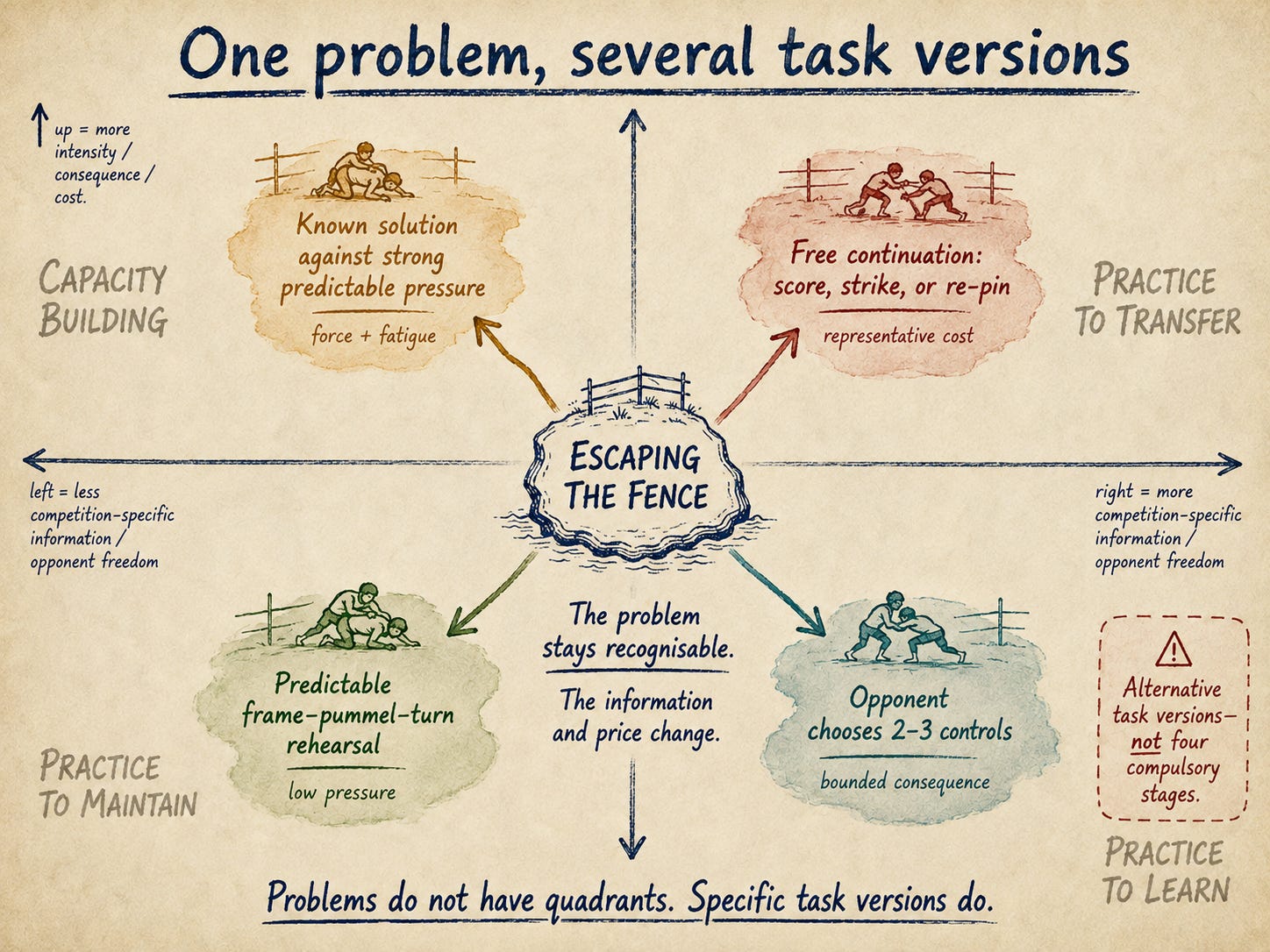
Problem 1 — Escaping the fence
Suppose a fighter repeatedly accepts a square stance, loses inside position, and remains trapped on the fence.
A low-cost sequence of framing, pummelling, turning, and resetting can support maintenance once the solution is already available. Keep the partner’s response predictable, raise the pressure, work density, and duration, and the task moves upward toward capacity: can the fighter keep posture and produce the escape against a stable but demanding load?
For learning, let the pinning partner choose between two or three representative controls while contact consequence remains bounded. The escaping fighter must read the pressure and discover when to frame, turn, change level, or reverse direction. For transfer, restore continuation, scoring, fatigue, strikes where appropriate, and the possibility of being re-pinned. Now we ask what survives.
The problem remained recognisable. The information and price changed.
Problem 2 — Entering behind the jab without living in the pocket
Shadowboxing the rhythm can prepare or maintain the movement. A fixed bag or pad sequence can build output and repeatability. Neither proves that the fighter can read distance or leave before the reply.
A lower-cost learning game can give the opponent two responses: retreat or counter after the jab. The attacker scores only by entering behind the jab and exiting at a useful angle. The defender’s genuine choice moves the task right; controlled contact keeps errors affordable. Later, broader weapons, continuation, fatigue, and meaningful scoring move the task toward transfer.
Problem 3 — Recovering from bottom position
A familiar frame–hip-escape–guard chain may maintain a solution. A partner providing predictable but substantial pressure can load the shapes, breathing, and repeated effort required to keep working: capacity. A constrained live task in which the top player may choose between passing and pinning, while the bottom player explores several escapes, belongs closer to learning. A hard positional round beginning from the compromised match position asks whether the solution transfers under representative cost.
These are not four compulsory stages. They are four possible jobs. The coach may move directly from a transfer failure to capacity, return from high consequence to learning, or use maintenance between expensive exposures. Problemming supplies the direction; the quadrant helps clarify the version.
Problemming comes before quadrant selection
There is an obvious danger here. Coaches can turn a problem-led map into another drill-storage cabinet.
“Heavy bag goes here. Playful sparring goes there. Good. Framework completed.”
No. The purpose is not to organise the exercise library more beautifully.
Start with the recurring performance problem. What repeatedly breaks, for whom, and under which conditions? What would meaningful improvement look like? Which information must remain for this still to be the same problem?
Then choose the dominant intention. Does the fighter need to learn, transfer, maintain, or build capacity?
Only then locate the nominal task. How much competition-specific information is present? What physical and consequential price is expected? Is the task representative enough for the target problem?
Now scale the functional difficulty. Who is the athlete today? Who is the partner? What is the motivational climate? Does the athlete experience this as play, learning, examination, or a threat to status?
Finally, regulate the dose and inspect what happened. Did the behaviour change? Did it survive when cost rose? What did the task cost? What should change next?
The full return path is shown in Figure 6. It is a loop because transfer and recovery do not close the case; they produce the next, better-framed problem.
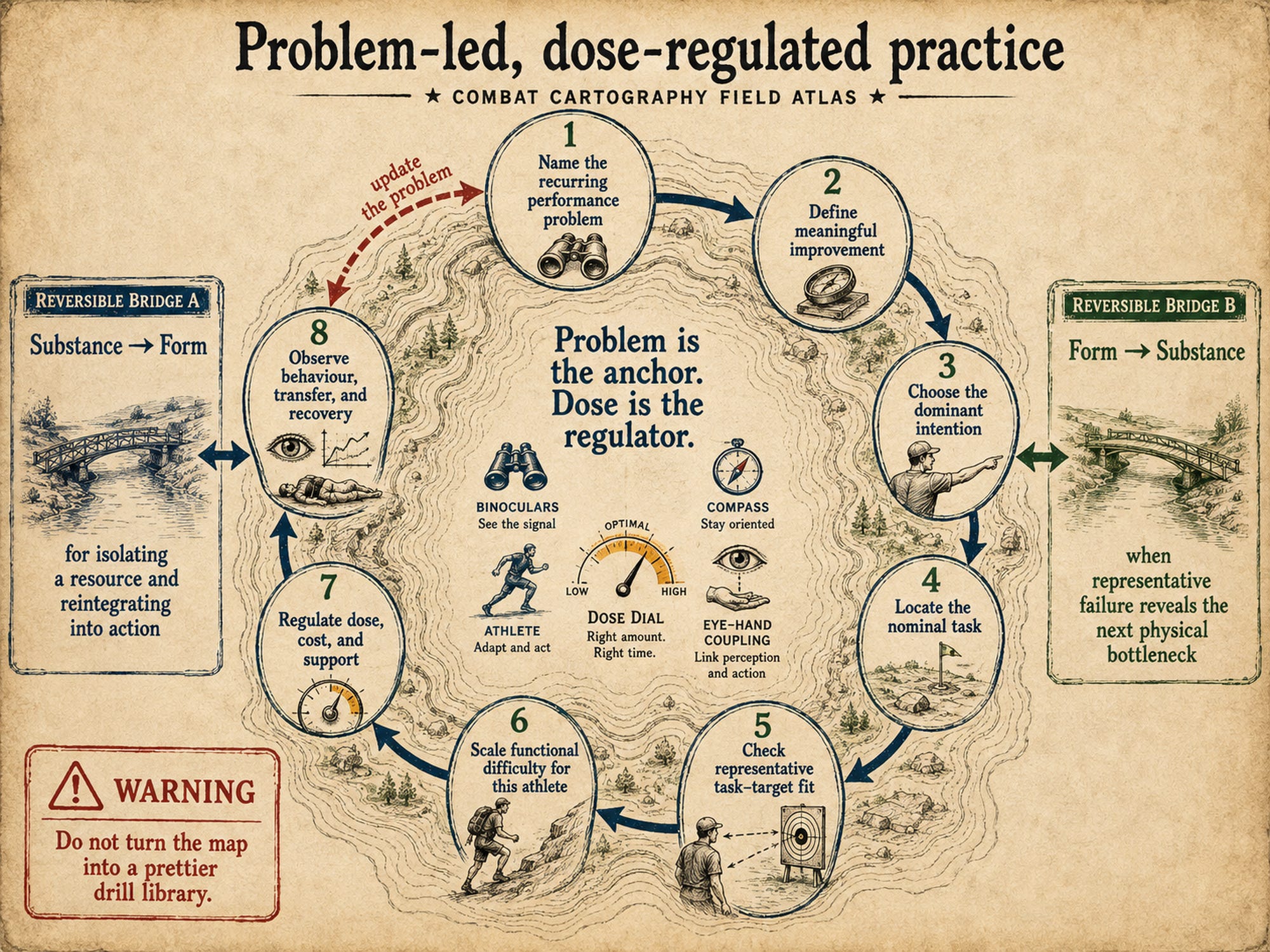
This connects directly with the distinction between the Dose Coach and the Problemming Coach (Jovanović 2026d). The Dose Coach protects us from vague practice theatre. The Problemming Coach protects us from sterile programming theatre. The useful synthesis is problem-led and dose-regulated.
It also connects with Substance~Form (Jovanović 2026e). Isolate to load. Reintegrate to express. If the fighter produces more output against a stable target, the capacity change may be real. Transfer remains a hypothesis until the fighter can organise it against representative information. Conversely, if an intelligent solution collapses whenever fatigue rises, the athlete may not need another explanation. They may need enough physical substance for the form to survive.
What the map deliberately hides
Every useful map compresses. The danger begins when we forget what disappeared.
The axes are bundles. Competition specificity and complexity can diverge. Effort, force, contact, risk, threat, and recovery cost can also diverge.
The borders are porous. Most practice lives in clouds, transitions, and mixed intentions—not clean boxes.
The athlete changes the task. Skill, fatigue, confidence, injury history, partner quality, and current state alter functional difficulty.
The motivational frame matters. A coach can call something playful while athletes experience hidden selection.
Representativeness is target-specific. A task can preserve one important relation without recreating the whole fight.
The model cannot calculate acceptable risk. Contact exposure and safety require qualified coaching, medical judgment, rules, athlete maturity, and local governance.
This is not a validated taxonomy. It is an evidence-informed coaching model open to inter-coach testing, criticism, and revision.
These are not reasons to discard it. A map does not fail because it leaves out the smell of the forest. It fails when the missing feature matters for the turn you are about to take.
What changes on Monday?
Take one practice task you already use. Do not invent a new drill yet.
Ask:
What recurring problem should the athlete solve?
What information must remain for this to be the same problem?
Where does this version sit on complexity and physical consequence?
Is it representative enough for the target problem—or is representativeness not its job?
What is the dominant intention: learn, transfer, maintain, or build capacity?
How functionally difficult is it for this athlete, with this partner, today?
What physical, psychological, recovery, and opportunity cost is justified?
What observation would make you keep, move, or abandon the task?
Then change one major dimension.
Preserve the information and reduce the cost. Preserve the cost and add a genuine decision. Simplify the information to load a physical resource. Return an isolated capacity to a representative problem. If useful, collect both Rating of Perceived Exertion and Rating of Perceived Challenge rather than forcing physical and technical-tactical difficulty into one number (Hendricks et al. 2019).
Do not call the new version better until you state its job.
A task is not improved because it became harder, more chaotic, more exhausting, or more realistic. It improves when its design serves the current problem at a justified cost.
That is the purpose of the Combat Quadrant.
Not to tell us where drills live.
To help us decide where practice should go next.
A working map, open to attack
The Combat Quadrant is similar to the Extended Challenge-Based Framework, but it is not the same model and certainly not a validated extension. It borrows compatible distinctions, decomposes the nominal practice task in another way, adds an explicit combat-sport cost dimension, and gives capacity work a place without asking it to cosplay as representative learning.
That makes it useful. It also makes it provisional.
I am interested in three questions:
Which task changes position most dramatically when its rules or intention change?
Which part of the intensity-and-consequence bundle needs to be separated?
Where does representativeness work better as an overlay, and where would it genuinely deserve its own axis?
Try the map on a real week. Classify the task as performed. Follow one task as it moves. Then tell me where the map stops helping.
That is where the next version begins.
For the wider argument, continue with my articles on Problemming, Substance~Form, combat-practice design, and what MMA cannot reliably deliver (Jovanović 2026f, 2026e, 2026c, 2026b).

If you enjoyed this post, join me inside Agile Periodization Skool. Members get access to PDFs, books and book drafts, tools, courses, live Q&As, Agile Coffee, and deeper conversations about training, physiology, planning, and coaching practice with coaches, practitioners, and athletes who take this work seriously.
Agile Periodization Skool: https://www.skool.com/agileperiodization
Agile Periodization Website: https://agileperiodization.online/
References
Guadagnoli, Mark A., and Timothy D. Lee. 2004. “Challenge Point: A Framework for Conceptualizing the Effects of Various Practice Conditions in Motor Learning.” Journal of Motor Behavior 36 (2): 212–24. https://doi.org/10.3200/JMBR.36.2.212-224.
Hendricks, Sharief, Kevin Till, Jon L. Oliver, Rich D. Johnston, Matthew J. Attwood, James Craig Brown, David Drake, Simon MacLeod, Stephen D. Mellalieu, and Ben Jones. 2019. “Rating of Perceived Challenge as a Measure of Internal Load for Technical Skill Performance.” British Journal of Sports Medicine 53 (10): 611–13. https://doi.org/10.1136/bjsports-2018-099871.
Hodges, Nicola J., and Keith R. Lohse. 2022. “An Extended Challenge-Based Framework for Practice Design in Sports Coaching.” Journal of Sports Sciences 40 (7): 754–68. https://doi.org/10.1080/02640414.2021.2015917.
Jovanović, Mladen. 2026a. “The Problemming Coach: Training as Problem-Setting.” Agile Periodization. March 19, 2026. https://agileperiodization.substack.com/p/the-problemming-coach-training-as.
———. 2026b. “Conditioning for MMA: What the Sport Cannot Reliably Deliver.” Agile Periodization. May 17, 2026. https://agileperiodization.substack.com/p/conditioning-for-mma-what-the-sport.
———. 2026c. “[Serbian] Veština, Haos i Agilna Praksa Borbe.” Agile Periodization. May 25, 2026. https://agileperiodization.substack.com/p/serbian-vestina-haos-i-agilna-praksa.
———. 2026d. “The Dose Coach Vs. The Problemming Coach.” Agile Periodization. May 30, 2026. https://agileperiodization.substack.com/p/the-dose-coach-vs-the-problemming.
———. 2026e. “Substance Form in the Gym: Specialists, Generalists, Bottlenecks, Barbell Strategy, and Why the Same Squat Is Not the Same Squat.” Agile Periodization. June 8, 2026. https://agileperiodization.substack.com/p/substance-form-in-the-gym.
———. 2026f. “The Ten Commandments of Problemming: A Short Manifesto for Problem-Led Planning and Prescription.” Agile Periodization. June 11, 2026. https://agileperiodization.substack.com/p/the-ten-commandments-of-problemming.
Myszka, Shawn, Tyler Yearby, and Keith Davids. 2023. “(Re)conceptualizing Movement Behavior in Sport as a Problem-Solving Activity.” Frontiers in Sports and Active Living 5: 1130131. https://doi.org/10.3389/fspor.2023.1130131.
Parry, Tom E., Shawn Myszka, Tyler Yearby, Mark O’Sullivan, and Fabian Otte. 2025. “The Value of Opposed and Unopposed Practice: An Ecological Dynamics Rationale for Skill Development.” Quest 77 (1): 80–100. https://doi.org/10.1080/00336297.2024.2420759.
Pinder, Ross A., Keith Davids, Ian Renshaw, and Duarte Araújo. 2011. “Representative Learning Design and Functionality of Research and Practice in Sport.” Journal of Sport and Exercise Psychology 33 (1): 146–55. https://doi.org/10.1123/jsep.33.1.146.
Sanli, Elizabeth A., and Timothy D. Lee. 2015. “Nominal and Functional Task Difficulty in Skill Acquisition: Effects on Performance in Two Tests of Transfer.” Human Movement Science 41: 218–29. https://doi.org/10.1016/j.humov.2015.03.006.
Yearby, Tyler, Shawn Myszka, Andy Grahn, Scott Sievewright, Adam Singer, and Keith Davids. 2024. “Applying an Ecological Dynamics Framework to Mixed Martial Arts Training.” Sports Coaching Review. https://doi.org/10.1080/21640629.2024.2325822.