

Training Effects: The Dose Is Not the Effect

We love the simple model because it feels clean:
Dose → Response
You apply training stress, the athlete adapts, performance improves, and everyone goes home smarter, stronger, and slightly more attractive. Unfortunately, this is where the model starts lying to us. Not because dose-response thinking is useless, but because we often treat it as a straight line. Training is not a straight line. Training is a circular mess with feedback loops, mediators, delays, nonlinearities, weird side effects, and humans who sleep poorly, cut weight, get stressed, feel pain, fight their egos, and occasionally decide to spar as if their family honor depends on it.
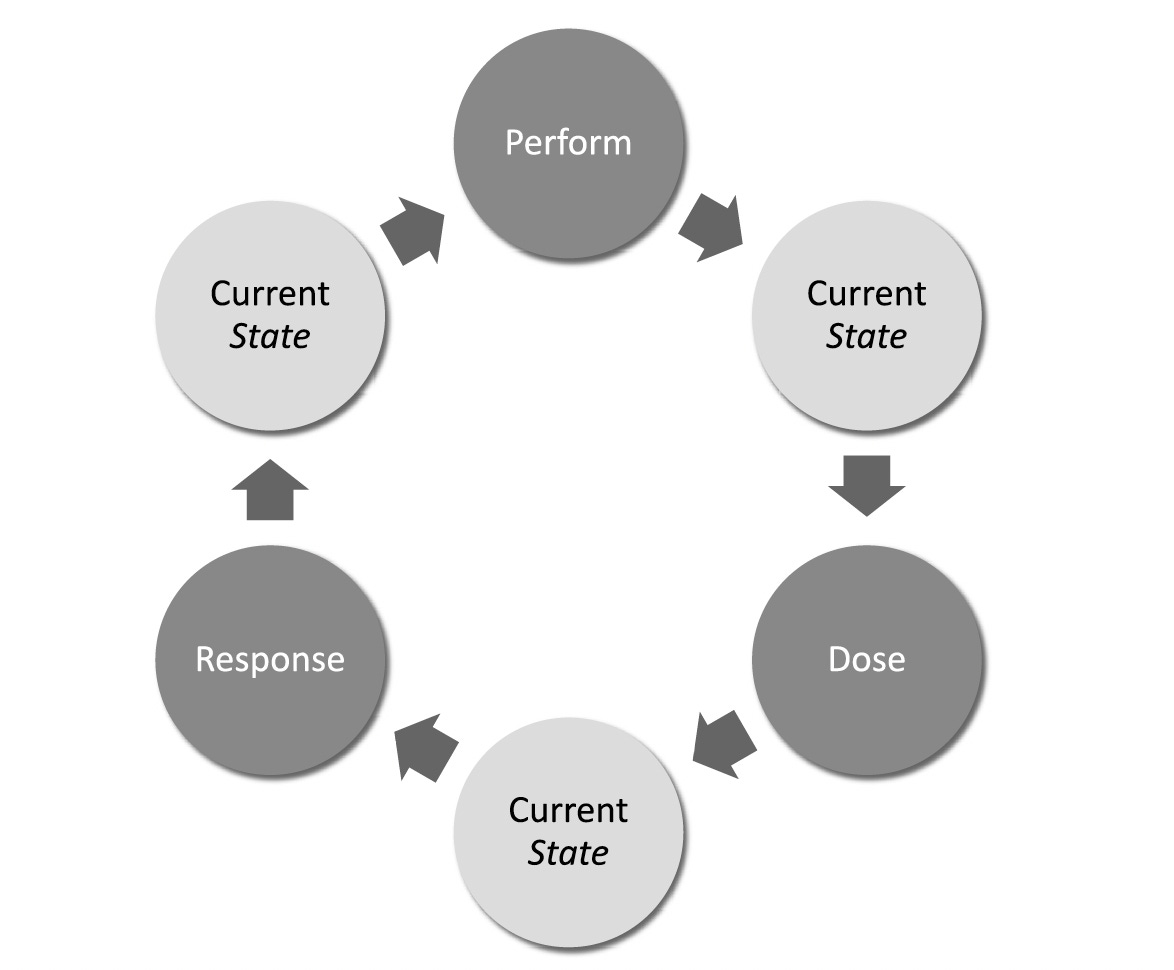
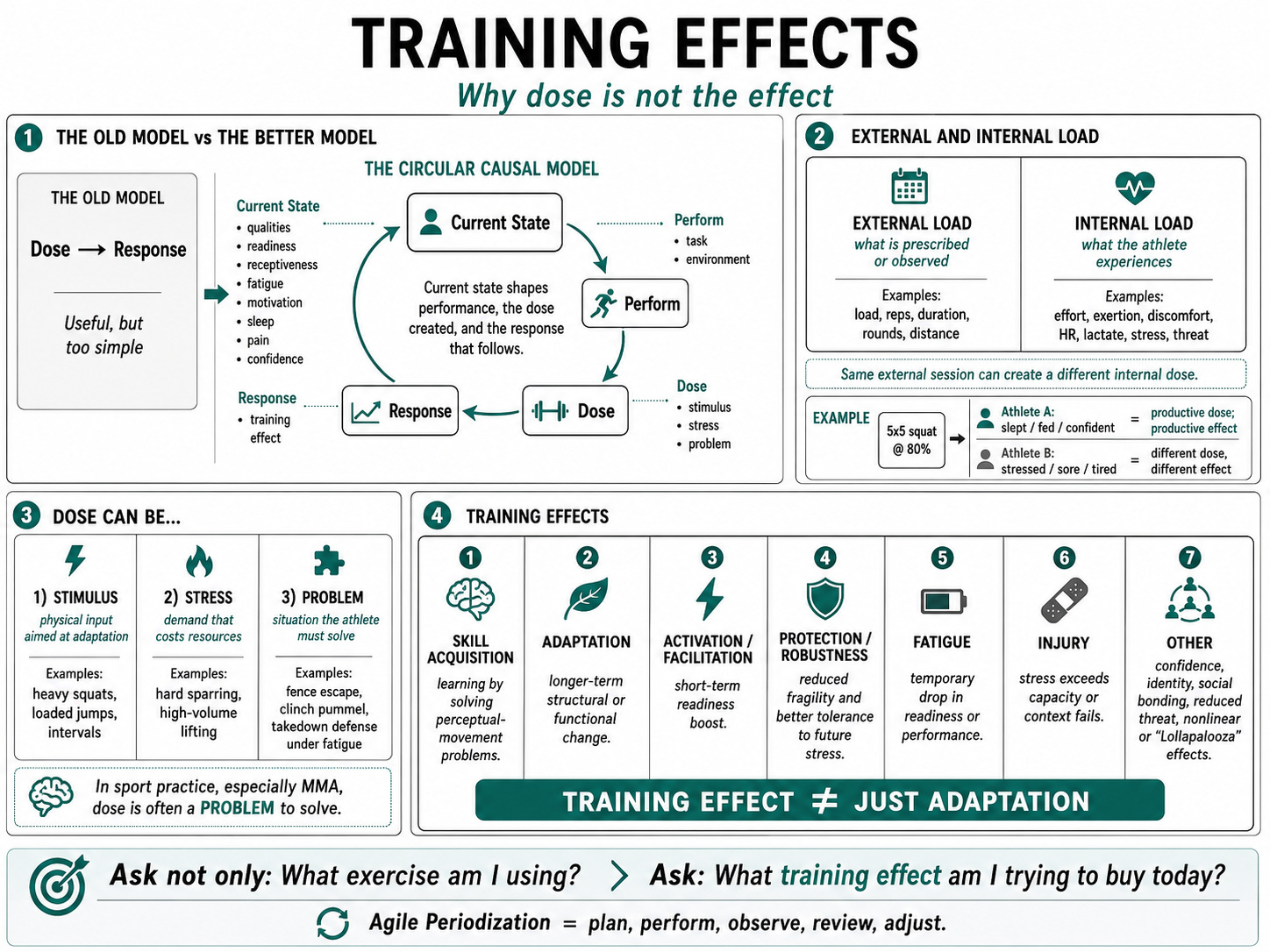
This is where the Circular Causal Model from the Strength Training Manual becomes useful. The athlete does not receive a dose passively, like a pill. To create a dose, the athlete first needs to perform inside a task and environment. That performance is filtered through the athlete’s current state. Then the performance creates a dose, which can be understood as a stimulus, stress, or problem. That dose creates a response, or what I will call a training effect. But the response is also filtered through the current state. Then the response changes the next current state, which changes the next performance, which changes the next dose, and the loop starts again. In the Strength Training Manual, this sits inside the broader discussion of training dose, dose-response, the 3F model, the circular model, and the current state.
Current state → Perform → Dose → Response → Current state
That is the whole point. The same session is never truly the same session. The prescription can repeat, but the organism does not.

Dose-response models are useful, but they are not coaching gods
Before we throw the dose-response baby out with the bathwater, let me be clear: dose-response modeling is useful. The classic Banister impulse-response model gave us a way to think about performance as the result of positive and negative responses to training. One component can be interpreted as fitness, the other as fatigue. They have different gains and decay rates. This is elegant, useful, and wrong enough to be helpful. The original systems-model work by Banister, Calvert, Savage, and Bach related training input to performance output, and it has influenced much of the later performance-modeling literature.
Clarke and Skiba later provided a very useful educational paper on mathematical modeling of athletic training and performance. I also used their cycling data in the {dorem} R-language package (short of DOse REsponse Model) example, where BikeScore is treated as dose and 5-minute power as the response. The goal of {dorem} is not to replace coaching judgment with mathematical astrology, but to provide easy-to-use dose-response models used in sport science, including the Banister model.

Stephen Hemmingway’s PhD thesis also fits here. From the accessible repository information, the thesis focuses on the utility of mathematical fitness-fatigue models for assisting with physical training planning in sport, including synthetic data, lower-bound operational conditions, model estimation, and software resources for future research. The thesis summary frames the main promise clearly: predicting future performance of individual athletes accurately enough to assist planning of training programs and tapering periods. It also makes the important point that model development is iterative and that the ideal model is unlikely to appear on the first attempt. Good. That means we can stop pretending models arrive from Mount Olympus fully formed.
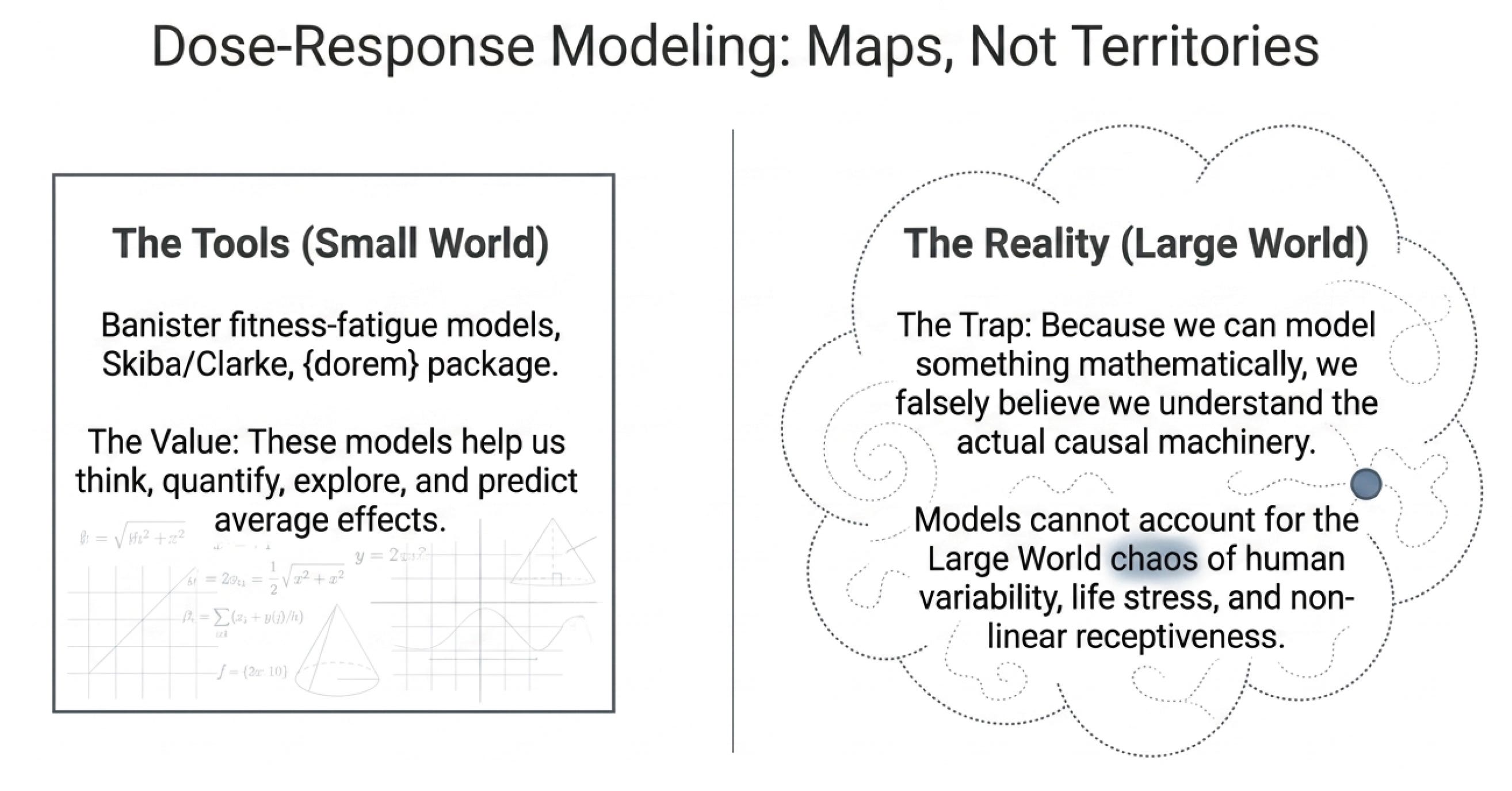
But here is the trap: because we can model something, we start believing we understand the causal machinery. A model can predict something without explaining why it happened. It can be useful without being true in the mechanistic sense. This is the same distinction I keep hammering: Small World models are useful, but they are not the Large World.
External load, internal load, and the dose that actually enters the athlete
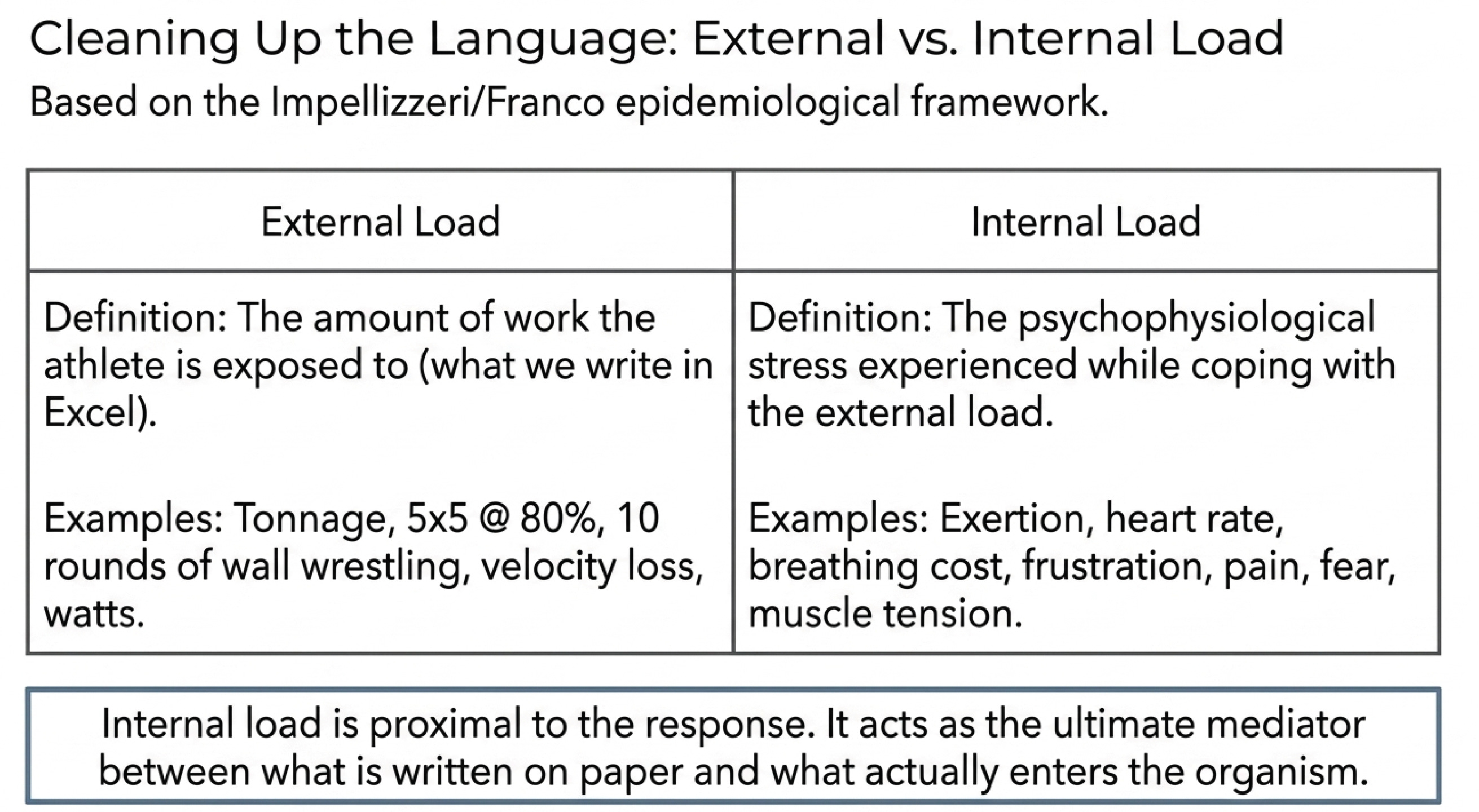
Franco Impellizzeri and colleagues’ article, Understanding Training Load as Exposure and Dose, is very useful because it forces us to clean up the language. They align training load with concepts from epidemiology and pharmacology, where exposure can be separated into external and internal dose. In their framework, training load is a multidimensional construct with two causally related subdimensions: external training load and internal training load. External load is the amount of training the athlete is exposed to, while internal load is the psycho-physiological stress experienced while coping with that external load. They also emphasize that internal load is more proximal to the response, acting as a mediator between external load and the outcome.
This fits perfectly with the circular model.
External load is what we write down: 5x5 at 80%, 6 x 3 minutes on the bag, 10 rounds of wall wrestling, 4 x 4 minutes on the Airdyne, or 30 minutes of positional sparring. Internal load is what the athlete actually experiences: effort, exertion, discomfort, breathing cost, threat, frustration, confidence, pain, fatigue, fear, motivation, and all the other things that do not fit nicely into Excel unless you force them there with bad dropdown menus.
The Strength Training Manual used a similar overview, splitting dose into external/internal and objective/subjective components. External-objective could be tonnage, number of lifts, force, velocity, power, or impulse. Internal-objective could be heart rate, lactate, EMG, or other physiological markers. External-subjective is the coach watching and judging what is happening. Internal-subjective is the athlete reporting effort, exertion, fatigue, discomfort, pleasure, displeasure, and related experiences.
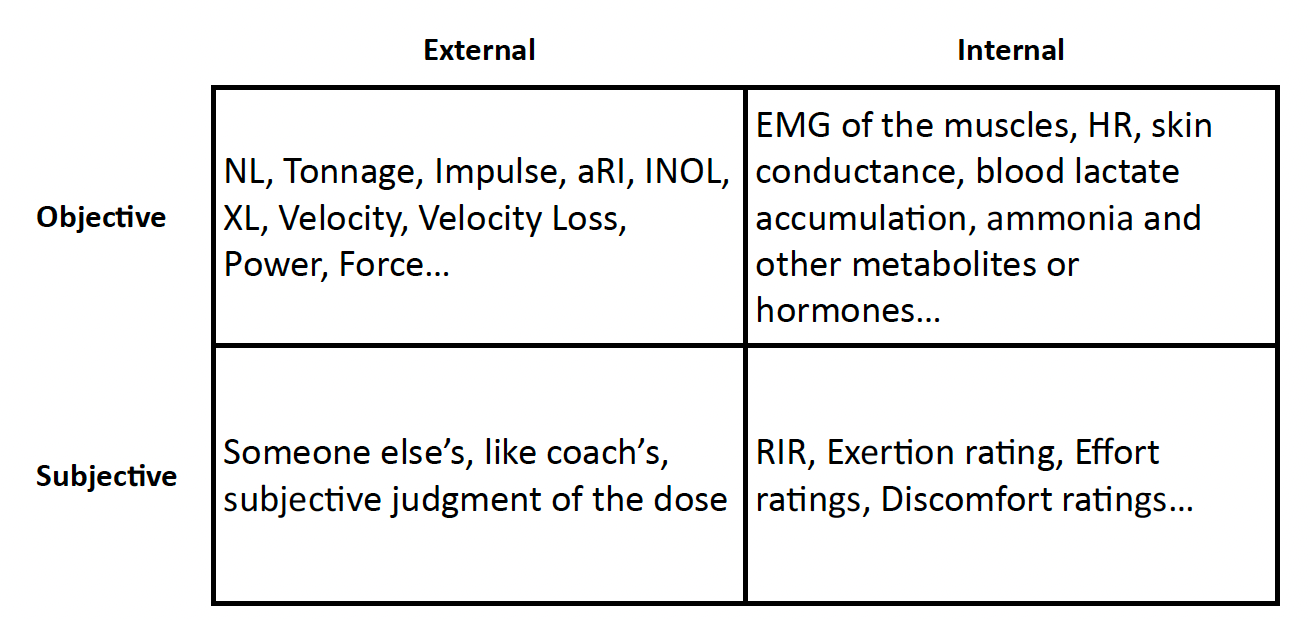
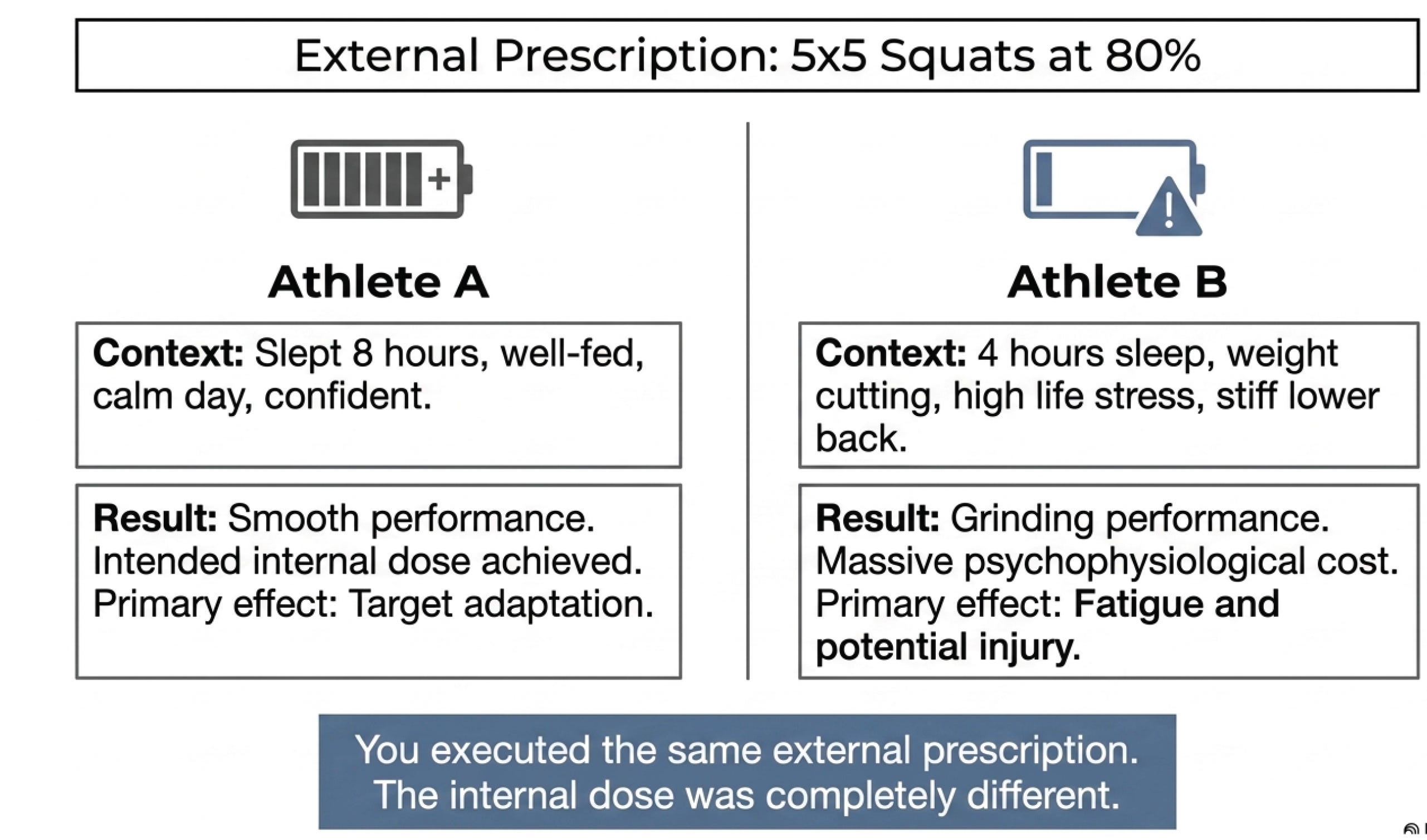
This is why “we did the same session” is often a fantasy. You did the same external prescription. The internal dose might have been completely different.
One athlete performs 5x5 squats after great sleep, good food, and a calm day. Another performs the same 5x5 after four hours of sleep, weight cutting, stress, and a back that feels like Windows 95 booting up. Same external load. Different current state. Different internal load. Different training effect.
Dose as stimulus, stress, or problem
In strength training, we usually think about dose as load, volume, intensity, density, velocity loss, RIR, RPE, number of lifts, tonnage, and so forth. Useful. But in sport practice, particularly in MMA and team sports, dose is often not just a stimulus. It is also a problem.
This connects to the “probleming” article and the broader Agile Periodization logic. We are not only dosing tissues. We are setting up situations that athletes must solve. Currently, we can frame the dose as a stimulus, stress, or a problem. The athlete performs under a current state, and this creates a dose. From a skill perspective, that dose is often a problem that forces perception, decision-making, coordination, pacing, and emotional regulation.
A wall-wrestling drill is not just local muscular endurance. It is a problem of head position, pummeling, breathing, posture, leverage, balance, grip, and not panicking when a sweaty refrigerator is trying to turn your ribs into origami. A constrained boxing round where the opponent is only allowed to double-jab and enter is not “just conditioning.” It is a problem that teaches distance, anticipation, defensive responsibility, and when not to be a hero.
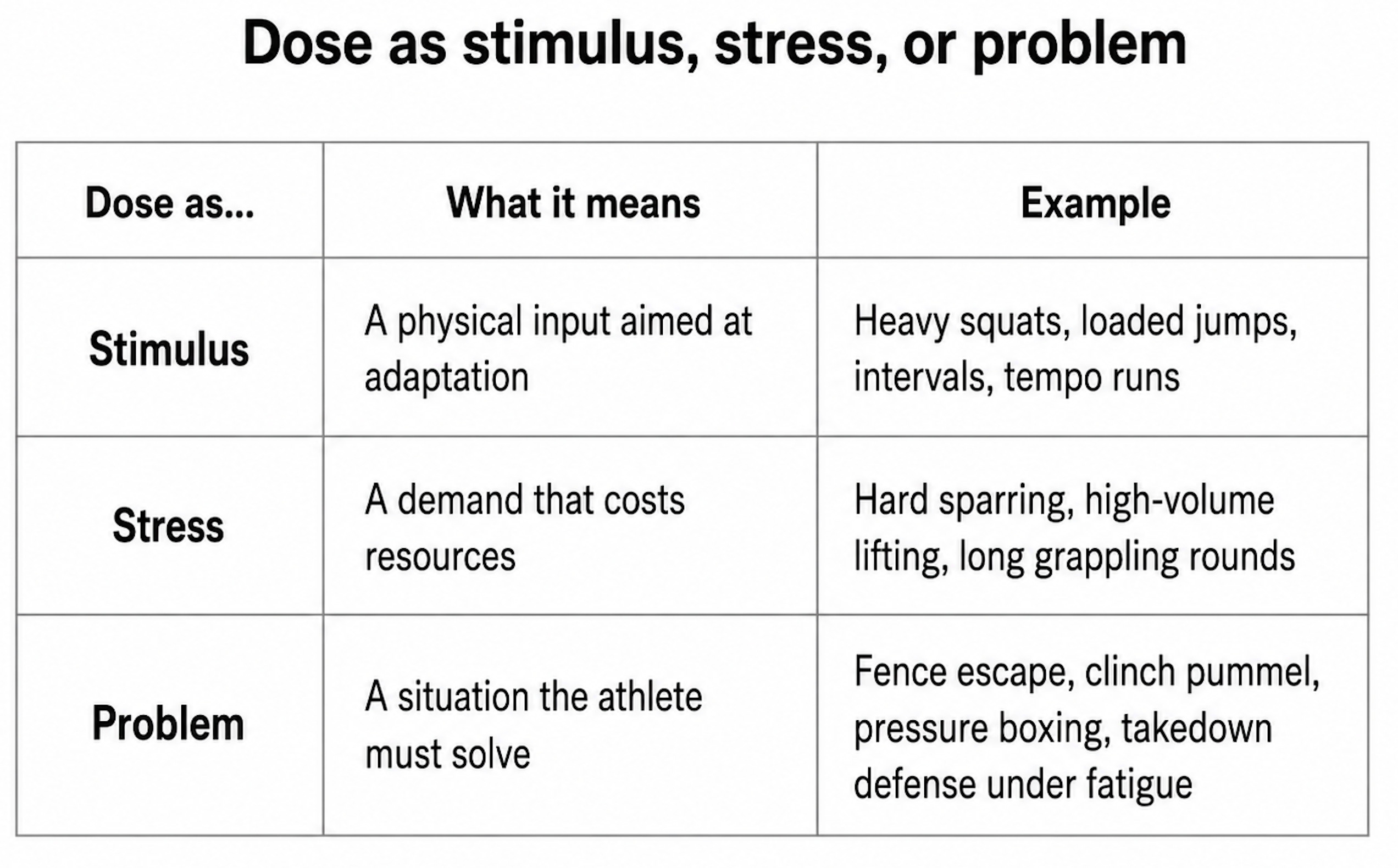
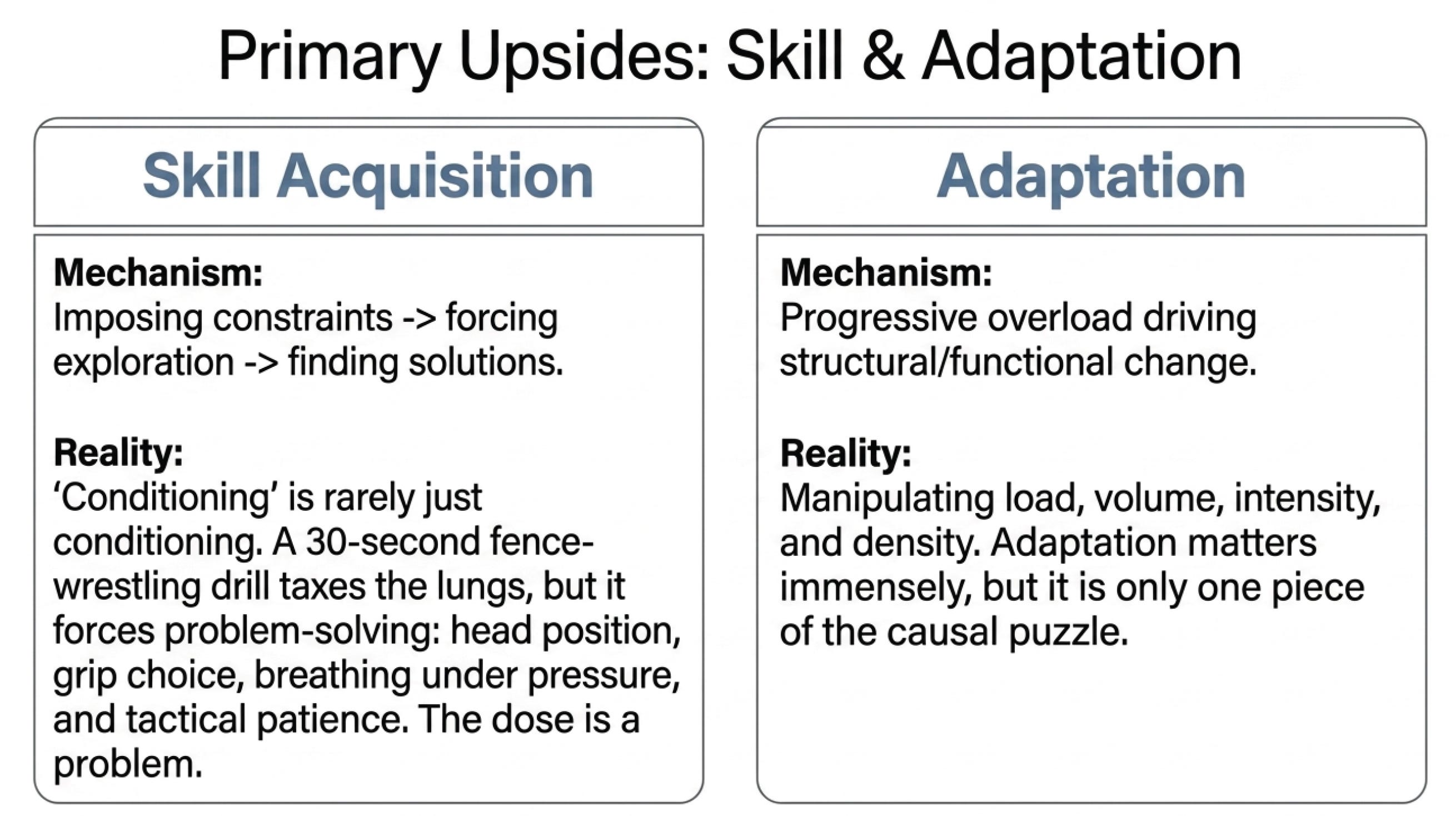
This matters because different doses bias different effects. If the main effect we want is adaptation, we can manipulate load, volume, intensity, density, and progression. If the main effect we want is skill acquisition, we need to manipulate information, constraints, representative design, opponent behavior, task difficulty, and consequences.
Response equals training effect
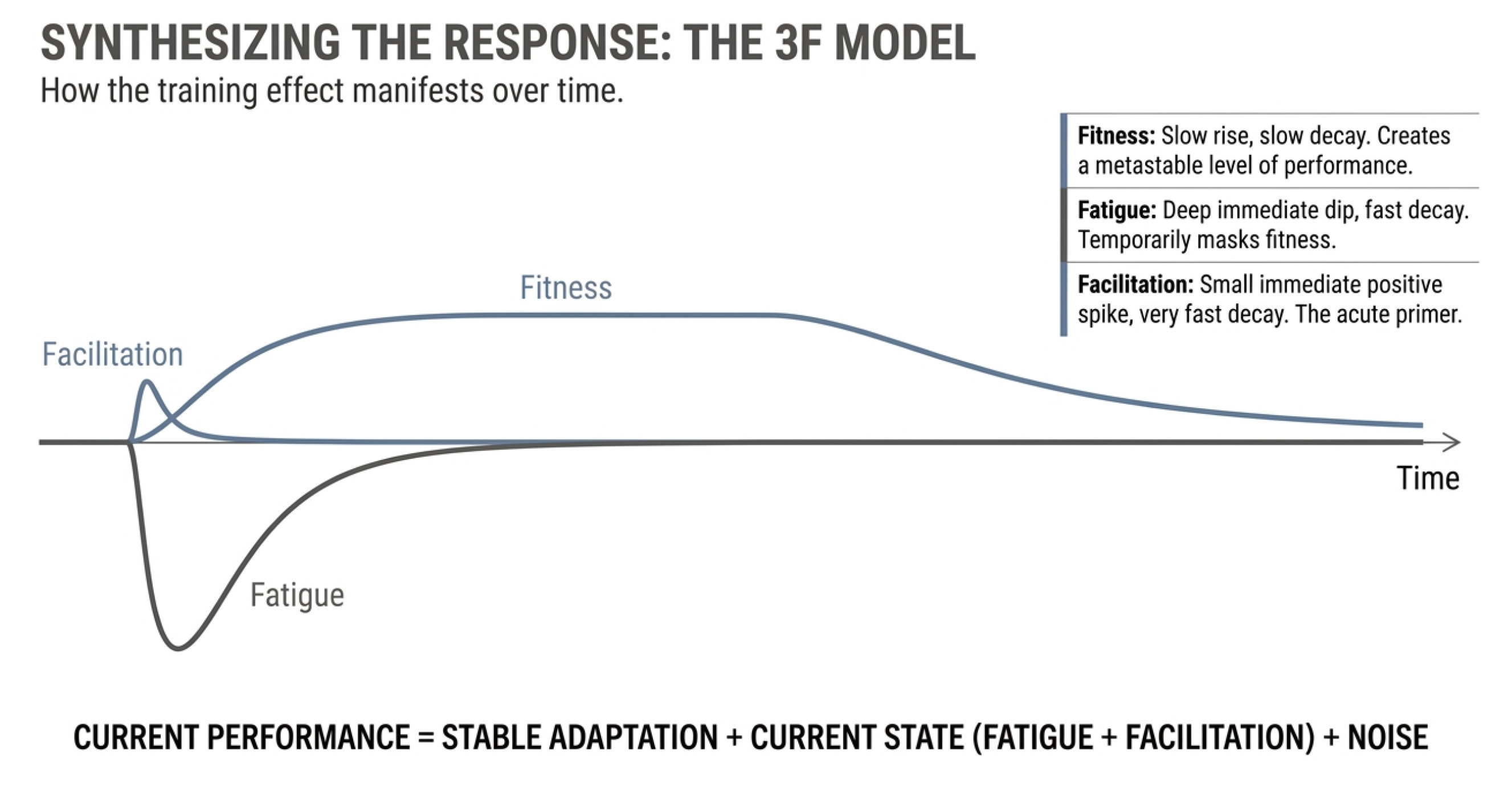
The next mistake is reducing response to adaptation. Adaptation is important, but it is not the only effect. A session can create skill acquisition, adaptation, activation, protection, fatigue, injury, and a bunch of weird other effects. The Strength Training Manual already separates dose-response thinking, upside and downside responses, the 3F model of fitness, fatigue and facilitation, and current state as a mediator of the whole process. Here, I will expand the the responses.
Here is the working classification:
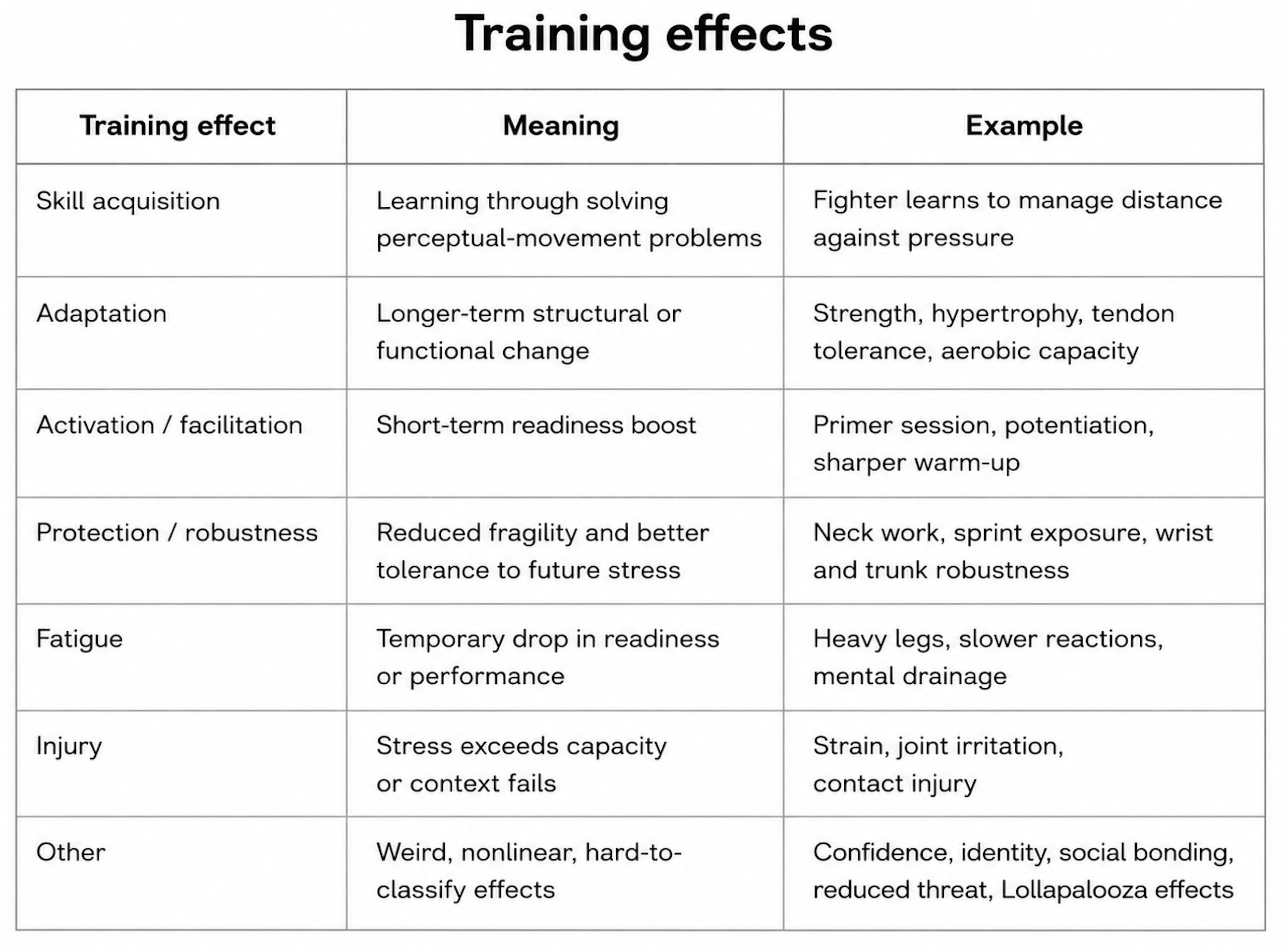
A session can create several of these at once. This is why “Did it work?” is usually a lazy question. Worked for what?
Five rounds of sparring might create skill acquisition for one athlete, confidence for another, fatigue for the third, and injury for the fourth. Same session name. Different current state. Different dose. Different response. Congratulations, we discovered coaching.
Skill acquisition: when dose is a problem
For MMA, skill acquisition is often the big rock. Conditioning matters. Strength matters. Repeatability matters. But the best way to get better at MMA is still to do MMA. This is not a motivational quote. This is the starting problem.
But “do MMA” is not precise enough. If the effect we want is skill acquisition, we need to design better problems. This is where the previous articles on probleming, domains, archetypes, and Agile Periodization fit together. The task must invite the behavior we want, constrain the athlete enough to make the problem visible, but not so much that it becomes artificial nonsense.
For example, instead of doing generic “conditioning,” we set up a fence problem: start in over-under against the cage, one athlete tries to turn off and exit, the other tries to keep pressure and re-pummel. Thirty seconds on, rotate. Now we are conditioning, yes, but we are also teaching breathing under pressure, posture, head position, grip choice, tactical patience, and how not to spend five matches trying to win one exchange.
That is skill acquisition as a training effect. The dose is not just work. The dose is a problem.
Adaptation: still important, but not the whole movie
Adaptation is the classic effect. Squats can build strength. Jumps can improve power expression. Intervals can improve aerobic capacity or repeatability. Neck work can build neck strength. Grip work can improve local capacity. None of this is controversial.
The issue starts when every session is judged only by whether it creates a direct measurable adaptation. That is too narrow. Sometimes the purpose of a session is to maintain. Sometimes it is to prime. Sometimes it is to protect. Sometimes it is to create information. Sometimes the best thing a session can do is avoid ruining tomorrow.
This is where archetypes and domains help. A powerlifter archetype, a fighter archetype, a bodybuilder archetype, an endurance-longevity archetype, and a general health archetype can all use squats, but they are not buying the same effect. Same exercise, different domain, different intention, different dose, different response. If we do not state the intended effect, we end up arguing like idiots about whether an exercise is “functional.” Functional for what, mate?
Activation and facilitation: not everything is building
Some sessions are not there to build. They are there to switch the athlete on.
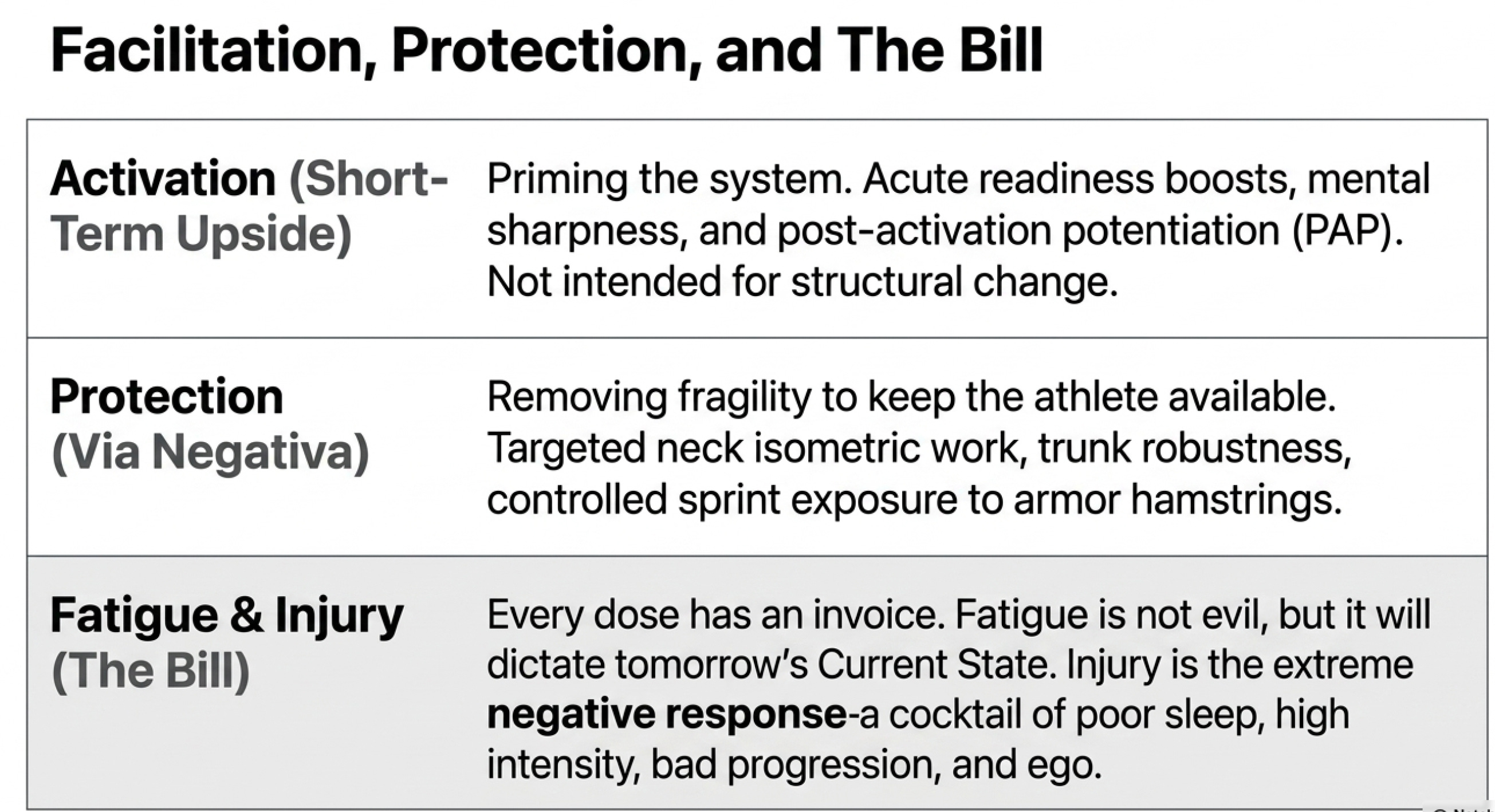
A primer before a fight. A short technical flow session the day before hard sparring. A few heavy singles before jumps. A warm-up that makes the athlete feel snappy and confident. This is activation or facilitation.
Do not confuse facilitation with adaptation. If the athlete jumps better after a potentiation protocol, he did not grow new legs in four minutes. He is expressing better in that moment. Useful, but different. If the goal is facilitation, the dose should create readiness, not a crime scene. A good primer makes the athlete feel like a weapon, not like he needs a nap, a massage, and a religious conversion.
Protection and robustness: the via negativa effect
Protection is one of the most underrated training effects. Some training does not directly improve performance. It protects the athlete from downside and keeps him available for better practice.
Neck work might not win the fight, but it can help the athlete tolerate clinch work, posting, wrestling, and general MMA chaos. Sprint exposure might not make a footballer faster, but it can reduce the shock of high-speed running when the game demands it. Trunk and rib robustness might not show up in a clean performance test, but it might allow the fighter to survive more body locks without feeling like he got hugged by a tractor.
This is via negativa: remove fragility, reduce downside, keep the athlete available. In the MMA conditioning transcript, I made the point that physical preparation often improves the quality and quantity of sport practice indirectly. Squats might not directly improve your takedown, but if they help you tolerate more high-quality MMA practice, recover better, and train more consistently, they matter.
Fatigue and injury: the bill always comes
Every dose has a bill. Sometimes the bill is worth paying. Sometimes it is stupid and we call it toughness because we need a story.
Fatigue is not evil. It can be part of the intended effect. But fatigue also changes the next current state. If Monday sparring buries the athlete, Tuesday lifting is no longer Tuesday lifting. It is Tuesday lifting with Monday’s invoice attached.
Injury is the extreme negative effect. Sometimes it is bad luck. Often it is a cocktail: poor sleep, poor readiness, too much intensity, wrong partner, bad progression, weight cut, ego, and the coach saying “one more round” because apparently the gods require a sacrifice. The circular model forces us to ask not only what the session did today, but what it did to the next opportunity to train.
Other: the weird bucket
Every useful model needs an Other category. If you do not have it, you start forcing reality into categories where it does not belong. That is how models become religions.
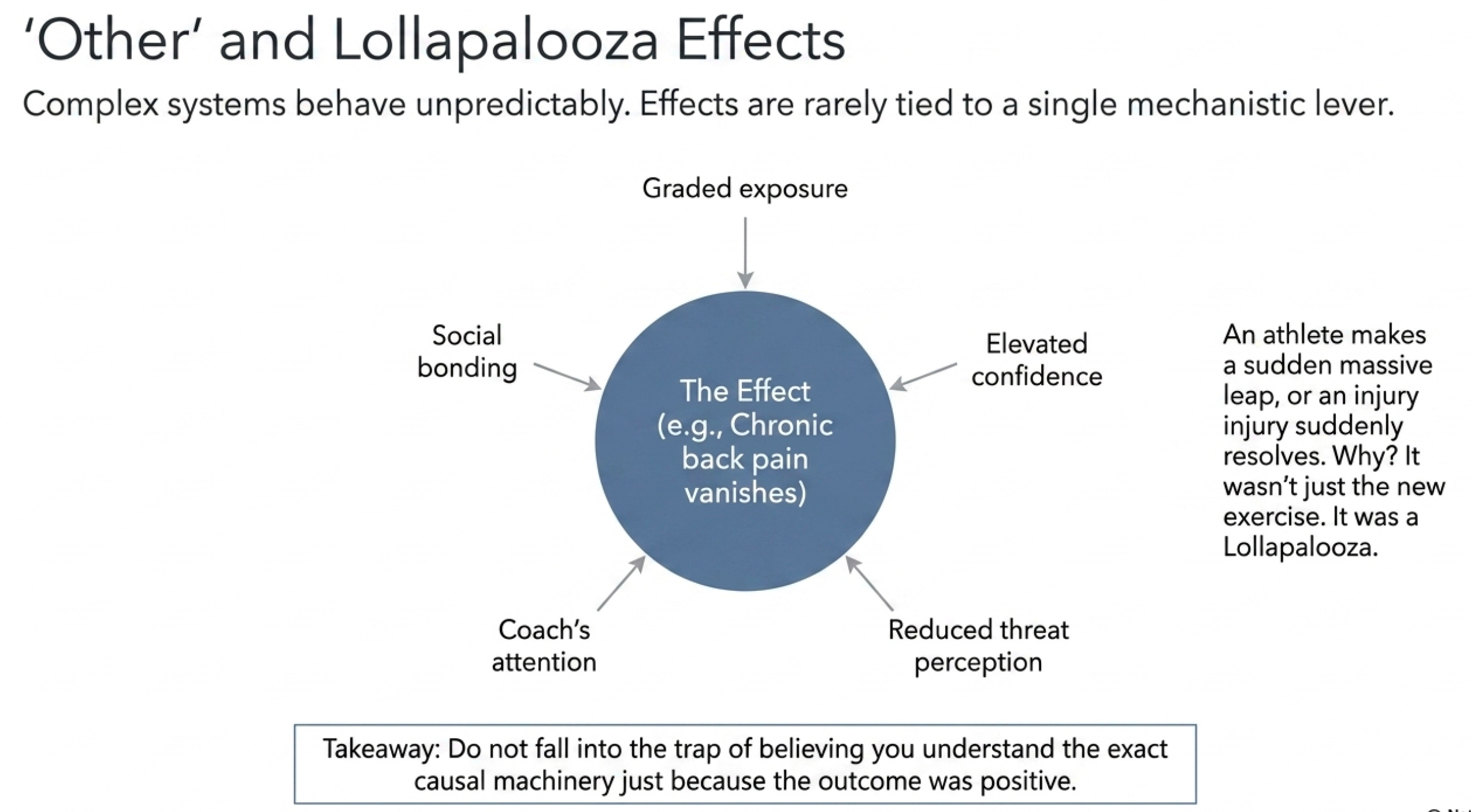
The Other bucket includes confidence, identity, social bonding, emotional regulation, frustration tolerance, placebo, nocebo, reduced threat, and the wonderful stupidity of humans. This is where Charlie Munger’s Lollapalooza effect fits nicely. Sometimes an outcome is not caused by one mechanism. It is caused by many small forces pushing in the same direction.
Someone’s low back pain improves after a few weeks of simple hinge work. Was it strength? Maybe. Motor control? Maybe. Graded exposure? Probably. Confidence? Likely. Better warm-up, better sleep, coach attention, reduced fear, and the athlete realizing he is not made of wet cardboard? Also yes.
That is not one mechanism. That is a cocktail.
The danger is turning this into guru nonsense. “This drill resets the nervous system and unlocks the fascia.” Mate, please. Something interesting happened. Good. Can we repeat it? For whom? Under what conditions? At what cost?
Practical takeaway
Before a session, ask:
What training effect am I trying to buy today?
Not what exercise. Not what method. Not what looks clever on Instagram. What effect?
Am I trying to create skill acquisition, adaptation, activation, protection, fatigue tolerance, confidence, or information? What is the external dose? What internal dose is this athlete likely to experience today? Is the athlete ready and receptive enough to get the intended effect? What will this response do to the next current state?
This is where Franco’s external-internal load framework, general dose-response modeling, Banister-type models, {dorem}, Hemmingway’s work on mathematical fitness-fatigue models, and the circular model can live together without fighting in the parking lot. Dose-response models help us think, quantify, explore, and sometimes predict. External and internal load remind us that the dose on paper is not the dose in the organism. The circular model reminds us that the response feeds back into the next current state. Agile Periodization ties this together as an iterative process: plan, perform, observe, review, adjust.
Training is not:
Dose → Response
Training is:
Current state → Perform → Dose → Training effect → Current state
The model helps us see. The athlete gets the final vote.
References
Banister, E. W., Calvert, T. W., Savage, M. V., & Bach, T. M. (1975). A systems model of training for athletic performance. Australian Journal of Sports Medicine, 7, 57–61.
Calvert, T. W., Banister, E. W., Savage, M. V., & Bach, T. M. (1976). A systems model of the effects of training on physical performance. IEEE Transactions on Systems, Man, and Cybernetics, 6(2), 94–102.
Clarke, D. C., & Skiba, P. F. (2013). Rationale and resources for teaching the mathematical modeling of athletic training and performance. Advances in Physiology Education, 37(2), 134–152.
Impellizzeri, F. M., Shrier, I., McLaren, S. J., Coutts, A. J., McCall, A., Slattery, K., Jeffries, A. C., & Kalkhoven, J. T. (2023). Understanding Training Load as Exposure and Dose. Sports Medicine, 53, 1667–1679.
Jovanović, M. (2020). Strength Training Manual: The Agile Periodization Approach, Volume One & Two: Theory. Sections on training dose, external/internal dose, 3F model, circular model, and current state.
Jovanović, M. {dorem} package documentation. Dose Response Modeling. The package provides dose-response models used in sport science and includes examples using Clarke and Skiba’s cycling dataset and the Banister model.
Stephens Hemingway, B. H. (2021). The utility of mathematical fitness-fatigue models for assisting with the planning of physical training for sport: from in silico experiments employing synthetic data, lower-bound operational conditions and model estimation, to the development of software resources for future research. Robert Gordon University PhD thesis.

If you enjoyed this post, join me inside Agile Periodization Skool. Members get access to PDFs, books and book drafts, tools, courses, live Q&As, Agile Coffee, and deeper conversations about training, physiology, planning, and coaching practice with coaches, practitioners, and athletes who take this work seriously.
Agile Periodization Skool: https://www.skool.com/agileperiodization
Agile Periodization Website: https://agileperiodization.online/